
 80813-00200



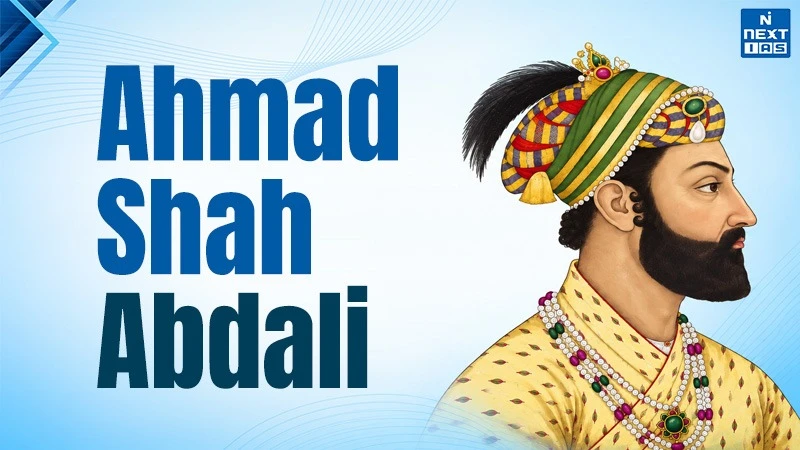
Ahmad Shah Durrani or Ahmad Shah Abdali is the founder of the Durrani Empire in Afghanistan. He was an important military leader in Asia in the 18th century. Ahmad Durrani created his empire in 1747 following the death of Nader Shah of Persia and named Kandahar as his capital.
Abdali raided India several times to attack the weakened Mughals to take control over the regions of Punjab and northern India. Abdali's most notable military success is his victory against Marathas in the 3rd Battle of Panipat on 14 January 1761, near modern-day Panipat in Haryana. This battle became an important event in the history of India and marked the halt of Maratha expansion in northern India.
About Ahmed Shah Abdali
- Ahmad Shah Abdali (1722–1772) founded the Afghan Durrani Empire and his coming into power significantly impacted northern India during the mid-18th century.
- He belonged to the Sadozai Pashtun tribe, and rose through the ranks of Nader Shah's Persian army. After the death of Nader Shah, a tribal council near Kandahar in 1747 declared him "King of the Afghans."
- He took the royal title Shah Durr-i-Durran ("pearl of pearls") and established Kandahar as his capital.
- He then united the Afghan tribes into a new Durrani polity stretching from the Oxus (Amu Darya) to the Arabian Sea.
- In forming the state he adopted much of the Persian-Mughal model as he headed all the civil and military departments and ruled with the advice of a council of tribal chiefs.
- In Afghan memory he is revered as Ahmad Shah Baba ("Father Ahmad") – indeed, he is widely regarded as the founder of modern Afghanistan.
- He was attracted to the fertility of the land and other natural treasures and wealth of India and wanted to spread the boundaries of his empire in India. He tried for it several times till his death, but his dream was not fulfilled.
Early Life of Ahmed Shah Abdali
- Abdali was born in Multan (the then Mughal Empire, now in Pakistan) in 1722 spent his youth in Herat and Multan, as his father was the Persian governor of Herat, later fled to Multan.
- After Nadir Shah of Persia conquered Kandahar in 1738, the young Abdali joined Nadir's army.
- He quickly made a name for himself and became a cavalry commander under Nadir, who reportedly held him in high regard.
- After Nadir's assassination in 1747, Ahmad returned to Kandahar and convened a tribal council, where he was elected ruler.
- He immediately took the title Durr-i-Durran ("pearl of pearls"), changing his tribal name from Abdali to Durrani.
- In 1747 he struck coins in his name at Kandahar and declared himself Shah, effectively founding the Durrani Empire.
- Within months he had seized Kabul and the surrounding region. His Afghan state extended "from the Amu Darya to the Indian Ocean and from Khorasan into Kashmir, the Punjab, and Sindh"
- In administering this empire, Ahmad Shah ruled from Kandahar (and later Kabul) and named Afghan chiefs as his councillors.
Durrani Empire
- The Durrani Kingdom, also known as the Sadozai Kingdom and the Afghan Empire, was a Central Asian empire formed by Ahmad Shah Abdali.
- The empire reigned over modern-day Afghanistan and Pakistan, as well as areas of northeastern and southeastern Iran, eastern Turkmenistan, and northern India at its peak.
- The Durrani Empire was the strongest Muslim empire of the second part of the eighteenth century, second only to the Ottoman Empire.
- Ahmad Shah Abdali unified the many Pashtun tribes and established the Durrani Empire with his Baloch allies, which comprised modern-day Afghanistan and Pakistan, as well as sections of northeastern Iran, eastern Turkmenistan, and northwestern India, including the Kashmir area, at its zenith.
Indian Invasion
Following Nadir Shah's demise, and establishing his rule in Afghanistan, Ahmad Shah turned eastward into the declining Mughal territories of Punjab and northern India. Between 1747 and 1769 he led a series of invasions into the subcontinent.
- The First invasion of Ahmad Shah Abdali took place in 1747–48, following the death of Nadir Shah. Moving into Punjab, the Afghan army was defeated by Mughal forces (notably at Manupur) and Abdali was forced to retreat.
- He again led the second invasion in early 1749 with a reinforced army, defeated the Mughal governor Munim-ud-Daulah (who led Punjab) and secured tribute. In frustration over unpaid dues, Ahmad Shah invaded again in 1752 and effectively caved in to his demands by ceding Punjab and Sindh.
- The most famous raid took place when Abdali crossed the Sutlej and marched to Delhi in 1756–57. He entered the Mughal capital unopposed and plundered it.
- He devastated Mathura and Vrindavan (Hindu holy cities) as well as Agra, looting treasures and temples. He installed Alamgir II as a pliant emperor, left with vast booty, having shown that the Mughal heartland was at his mercy.
- After Delhi, the situation quickly reversed. In March 1758 the Marathas under Raghunath Rao drove Abdali's allies (Najib-ud-Daula) out of Delhi and ejected the Afghans from Lahore.
- In late 1759 Abdali returned with intent to curb the Marathas. By late 1760 he had massed forces around Delhi and Punjab, allying with Shuja-ud-Daula of Awadh and Najib-ud-Daula. On January 14, 1761, the two armies clashed at Panipat.
- Abdali made further incursions into the Punjab to suppress rising Sikh power and other revolts. His final invasion was in 1767; by then the political situation in India had shifted, and Abdali returned home to find his own empire in turmoil. He died in October 1772 in Afghanistan and was buried at Kandahar.
The Third Battle of Panipat
- The Third Battle of Panipat was the climax of Abdali's Indian campaigns and one of the largest 18th-century battles in the world, marking a major turning point in Indian history.
- Ahmad Shah's army, supported by Rohilla and Awadhi auxiliaries, faced the Maratha confederacy led by Sadashivrao Bhau (Peshwa's cousin) on January 14, 1761.
- After fierce fighting over three days, the Afghans decisively routed the Marathas.
- The battle involved over 125,000 men, with long skirmishes in which both armies suffered losses.
- The magnitude of both sides' casualties is estimated to be between 60,000– 70,000 dead in battle, with the number of injured and captives taken varying greatly. As per some chronicles around 40,000 Maratha prisoners were massacred the day after the battle.
- This victory temporarily shattered the Maratha military power in the north, and Abdali regained control of the Delhi region. However, he did not attempt to advance further into the Deccan. Within a few weeks, he returned to Afghanistan, leaving behind only a nominal Afghan influence.
Impact of the Third Battle of Panipat
- Mughal Empire: Abdali raid further shattered the already crumbling Mughal administration.
- Maratha Confederacy: The Third Battle of Panipat was a severe setback for the Marathas. In the short run, the Maratha presence in north India collapsed. However, they gradually recovered.
- Sikhs and Punjab: Despite repeated campaigns, he failed to crush Sikh resistance. By the late 1760s, Afghan control over Punjab had largely collapsed, and Sikh misls established dominance over the region.
- British East India Company: While Abdali never aimed to overthrow British power, his campaigns indirectly created space for their expansion.
Frequently Asked Questions (FAQs)
Who was Ahmad Shah Abdali?
Ahmad Shah Abdali, also called Ahmad Shah Durrani, was an Afghan military commander who founded the Durrani Empire in 1747 and had a considerable influence on Indian history during the 18th century.
In what year was the Durrani Empire created by Ahmad Shah Abdali?
The Durrani Empire was created by Ahmad Shah Abdali in 1747 after the murder of Persian ruler Nader Shah. He is well-known as the founder of modern Afghanistan.
How many times did Ahmad Shah Abdali attack India?
Ahmad Shah Abdali attacked India multiple times throughout his lifetime, specifically eight invasions from 1748 to 1767, invading the territories of the Mughals and controlling northern India.
What was the Third Battle of Panipat?
The Third Battle of Panipat took place on January 14, 1761 between the coalition forces of Ahmad Shah Abdali and the Marathas. Abdali's victory marked the decline of Marathas in northern India.
When did Ahmad Shah Abdali die?
Ahmad Shah Abdali died in 1772. He left behind the Durrani Empire, which emerged as a major political force in Afghanistan and the surrounding areas.
