
 80813-00200
Home / Nandini K.R. CSE 2016
Nandini K.R., AIR-01, UPSC CSE 2016
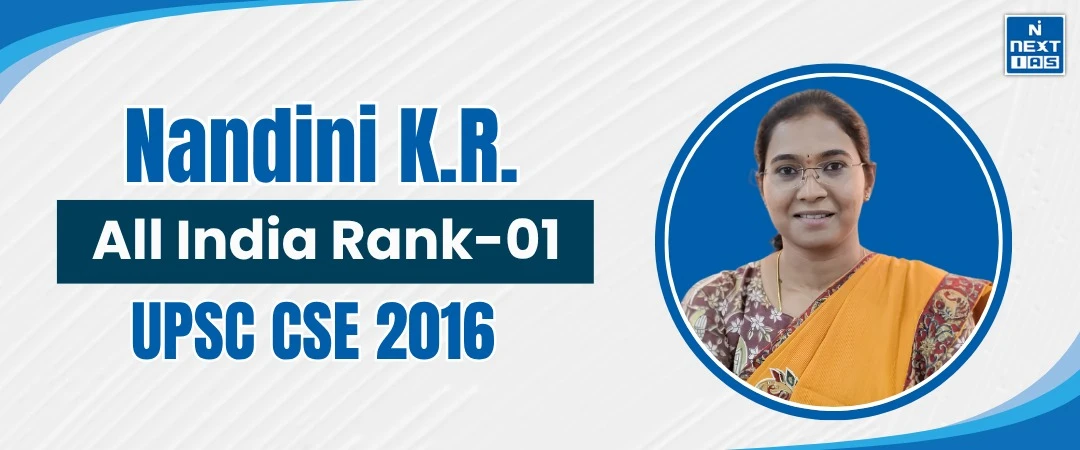
- Nandini K.R., from Kembodi village (Kolar, Karnataka), topped UPSC CSE 2016 in her 4th attempt, scoring 1120/2025 with Kannada Literature optional.
- B.Tech Civil Engineering gold medalist (MS Ramaiah Institute), ex-IRS (AIR 849, 2014), she battled dengue during prep.
- Daughter of school teacher KV Ramesh, her self-study, NCERT mastery, and answer-writing focus inspire millions.
- She is an IAS officer in Karnataka cadre.
Personal, Educational & Family Details of Nandini K.R.
Personal Information
| Parameter | Details |
|---|---|
| Full Name | Nandini K.R. |
| Rank & Year | AIR 1, UPSC CSE 2016 (4th attempt) |
| Date of Birth | September 15, 1990 |
| Age (2025) | 35 years |
| Hometown | Kembodi village, Kolar district, Karnataka |
| Education | B.Tech Civil Engineering, MS Ramaiah Institute of Technology, Bengaluru (Gold Medalist) |
| School | Thimmaiah Vidyalaya / St. Joseph Convent, Kolar |
| Optional Subject | Kannada Literature |
| Total Marks | 1120/2025 (Mains: 927, Interview: 193) |
| Previous Achievement | AIR 849 CSE 2014 (IRS Customs & Excise) |
| Family | Father: KV Ramesh (Govt School Teacher), Mother: KV Vimala (Homemaker) |
| Cadre | IAS Karnataka Cadre (2017 batch) |
Educational Background
- Nandini completed her schooling largely in Kannada-medium institutions in Karnataka, proving that English-medium education is not a prerequisite for success in UPSC.
- She later pursued a B.E. in Civil Engineering from M. S. Ramaiah Institute of Technology, Bengaluru, where she excelled academically and graduated as a gold medalist.
- Her engineering background and interest in infrastructure and public works later helped during her brief stint as an Assistant Engineer in the Karnataka Public Works Department (PWD).
- For UPSC, she chose Kannada Literature as her optional subject, combining her comfort in the language with a strong command over the syllabus.
| Level | Institution | Course / Degree | Year | Key Achievements |
|---|---|---|---|---|
| Schooling | Thimmaiah Vidyalaya, Kolar | Class 10 (Kannada medium) | Early 2000s | Strong academic foundation |
| Pre-University | Alva’s College, Dakshina Kannada | PUC (Pre-University) | 2010 | Excellent performance |
| Undergraduate | MS Ramaiah Institute of Technology, Bengaluru | B.E. Civil Engineering | 2014 | Gold medalist |
| Professional | Karnataka Public Works Department | Assistant Engineer | 2014–2016 | Gained practical experience before UPSC |
| UPSC Preparation | Self-study with Kannada Literature optional | Civil Services Examination | 2013–2016 | AIR 1 (1120/2025 total), 4th attempt success |
Family Background
- Nandini comes from a modest yet academically oriented family from Kembodi village.
- Her father, K. V. Ramesh, is a government school teacher, and her mother, K. V. Vimala, is a homemaker, both of whom emphasized education and values from an early age.
- The supportive environment at home, along with encouragement to pursue her ambition despite multiple attempts, played a crucial role in her eventual success.
- Nandini has often highlighted her parents’ role in building her confidence and resilience, especially after earlier setbacks in the exam.
| Aspect | Details |
|---|---|
| Birthplace | Kembodi village, Kolar district, Karnataka |
| Father | K. V. Ramesh, assistant schoolmaster / government school teacher |
| Mother | K. V. Vimala, former teacher turned homemaker |
| Siblings | Brother pursuing post-graduation at Indian Agriculture Research Institute, New Delhi |
Marks Obtained by Nandini K.R. in CSE 2016
- In UPSC CSE 2016, Nandini scored a total of 1,120 marks out of 2,025, which translates to about 55.3 percent.
- She secured 927 marks in the written Mains examination and 193 marks in the Personality Test (Interview).
- This score placed her ahead of the second ranker, Anmol Sher Singh Bedi, who got 1,105 marks, and the third ranker, Gopalakrishna Ronanki, who scored 1,101 marks.
- Her moderate percentage once again underlines the fact that UPSC is more about relative performance, conceptual clarity, and balanced scoring across papers than chasing extremely high percentages.
| S.No. | Stage / Paper | Marks Obtained | Maximum Marks |
|---|---|---|---|
| 1 | Essay | 142 | 250 |
| 2 | GS Paper 1 | 131 | 250 |
| 3 | GS Paper 2 | 103 | 250 |
| 4 | GS Paper 3 | 116 | 250 |
| 5 | GS Paper 4 | 104 | 250 |
| 6 | GS Total | 454 | 1,000 |
| 7 | Optional Kannada Literature Paper 1 | 164 | 250 |
| 8 | Optional Kannada Literature Paper 2 | 167 | 250 |
| 9 | Optional Total | 331 | 500 |
| 10 | Mains Total | 927 | 1750 |
| 11 | Interview Marks | 193 | 275 |
| 12 | Grand Total | 1,120 | 2,025 |
AIR 1, UPSC 2016 Topper – Preparation Strategy
- An integrated Prelims-cum-Mains strategy was implemented, where Nandini's preparation method inculcated lessons from her earlier attempts and work experience as an IRS officer: the need for consistency and time management.
- She planned her daily timetable in such a way that it coincided with the test series schedule and kept on writing answers.
- A disciplined routine was a key feature of her approach: maintaining eight hours of sleep, an hour of sports, and short breaks between the study slots to avoid burnout.
- She focused more on ‘studying with purpose’ rather than reading many sources, preferring to revise limited, high-quality material multiple times.
Prelims Strategy
- For Prelims, Nandini relied extensively on a structured test series and an integrated timetable that covered both static and current affairs topics.
- She used the schedule of the test series to plan her daily targets, ensuring that every test forced her to revise and complete specific portions of the syllabus on time.
- She emphasized repeated revision of NCERTs and standard books, and carefully analyzed her test performance to identify weak areas.
- According to her, the habit of writing regular tests improved not only her factual recall but also her speed and decision-making in the exam hall, minimizing negative marking.
Mains Strategy
- For Mains, Nandini focused on both quality and speed of answer writing, as she felt earlier attempts suffered due to slow writing.
- She earlier practiced writing 10 questions in one hour, gradually improving to comfortably completing 20 questions in the three-hour exam without sacrificing content quality.
- She completed most of the static syllabus before Prelims, so the post-Prelims phase was devoted mainly to current issues and refining answer structure.
- Her strategy included correlating topics across subjects,for example, using her knowledge of medieval history, culture, and Kannada literature together to enrich answers, thus demonstrating depth and inter-linkages in her responses.
- She also stressed the use of diagrams, flowcharts, and examples from newspapers to substantiate every statement.
Interview Strategy
- In preparation for the Personality Test, Nandini concentrated on self-awareness, clarity about her work in IRS and PWD, and a deep understanding of her Detailed Application Form (DAF).
- She attended mock interviews to refine her communication skills, body language, and ability to handle opinion-based or situational questions calmly.
- Her interview performance reflected humility, honesty about her previous attempts, and a strong commitment to serving in the IAS, all of which impressed the board and contributed to her 193 marks.
- She recommends that aspirants should treat the interview as a conversation rather than an interrogation and focus on presenting a balanced, well‑reasoned viewpoint on public issues.
Conclusion
- Nandini K. R.’s journey from a Kannada-medium student in rural Karnataka to AIR 1 in UPSC CSE 2016 illustrates how perseverance, strategic planning, and the right guidance can overcome initial disadvantages. Her story shows that repeated attempts are not failures but stepping stones, provided each attempt is used to refine strategy and work on weaknesses.
- For aspirants, her example reinforces three core lessons: build a realistic timetable, integrate Prelims-Mains preparation with intensive test practice, and maintain mental resilience through a strong sense of purpose.
FAQs
In which attempt did Nandini K. R. secure AIR 1 in UPSC?
She secured All India Rank 1 in UPSC CSE 2016 in her fourth attempt, after earlier clearing the exam and joining the IRS.
What was Nandini K. R.’s educational background?
She completed a B.E. in Civil Engineering from M. S. Ramaiah Institute of Technology, Bengaluru, and was a gold medalist in her course.
How many marks did Nandini K. R. score in UPSC CSE 2016?
She obtained 927 marks in the written Mains and 193 in the interview, giving a total of 1,120 out of 2,025 marks (about 55.3%).
What was her optional subject in UPSC?
Nandini chose Kannada Literature as her optional subject, leveraging her comfort with the language and strong literary background.
