
 80813-00200

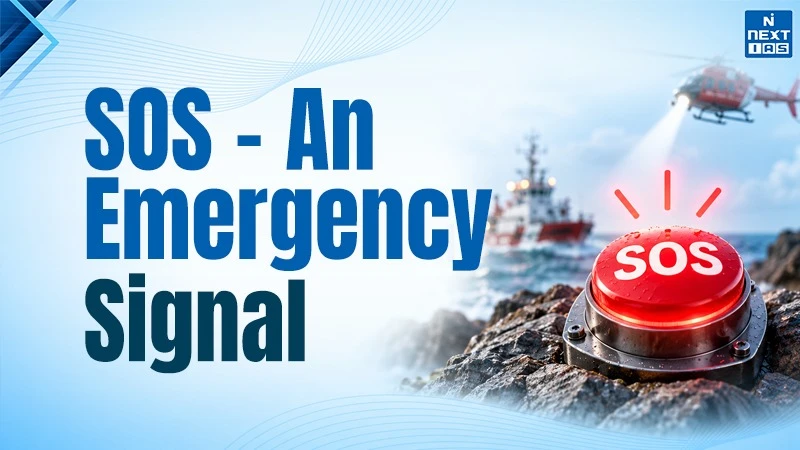
There is no official full form of SOS. However, the term is often used as 'Save Our Ships' or 'Save Our Souls'. SOS is an emergency signal or term used for various emergency applications such as fire, police, and Hospital or medical help. Historically, SOS was used as a morse code pattern for simple emergency situations. Germany introduced the SOS in 1905 and it was adopted in the Berlin conference globally in 1906. The famous incident of a titanic ship transmitted the SOS distress signal when it was met with an accidental crash with a large iceberg in 1912. In modern times, the maritime authorities replaced SOS with the satellite and digital emergency system.
SOS Full Form in Medical
In medical terms, SOS means 'if necessary'. It comes from the latin phrase 'si opus sit' which means 'when required'. It is advised to the patients to take their medicines only at the time of urgency and avoid using it regularly. For example, if the doctor has asked to consume SOS medicine for pain-relief then it has to be consumed when high pain is experienced.
SOS medicines are commonly prescribed for symptoms such as pain, fever, allergy or breathing problems. However, the patient should follow the prescribed medicine dose, minimum interval and maximum daily limit. It doesn't mean that the medicine can be taken repeatedly without any restriction. The medical prescription must clearly mention the number of doses and time of intake. Self-medication can be risky, particularly with antibiotics, steroids and powerful painkillers.
SOS in Mobile
In mobile phones, SOS is an emergency feature or network status message. When a phone displays SOS, it usually means that the phone is not connected to the regular mobile network. The message which appears on screen is due to weak network coverage, inactive SIM card, issue of an e-SIM, airplane mode, account related limitations or network setting error.
Various smartphones provide an emergency SOS feature which readily connects to the emergency services and informs the prior selected emergency contacts in mobile phones. Depending on the region or devices, it has different activation methods. One needs to check the network settings, restart the mobile phone, insert the SIM again, refresh the airplane mode off-on, and contact the service provider in case the issue is not resolved. At the time of an actual emergency situation, you may use the emergency call or text feature in the mobile phone.
History of SOS as an emergency
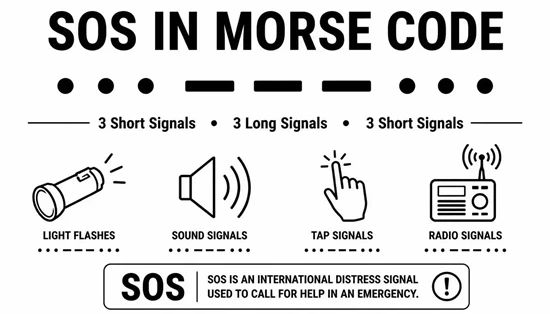
SOS was used in ship vessels travelling in the ocean to send a distress signal through morse-code. It includes 3 short, 3 long and 3 short signals (. . . - - - . . .) in repetition. It was easier to recognise the pattern due to its simplicity. These signals do not officially mean 'Save Our Ship' or 'Save Our Souls'. In 1905, Germany included such types of signals in their radio transmission for any emergency situations.
The International Radiotelegraph Convention in 1906 adopted the SOS as the international maritime distress signal with effect on 1st July 1908. SOS was transmitted by wireless telegraphy, flashing lights, sound or tapping. It became famous when it proved to be a life savior in major maritime disaster events such as the Titanic disaster in 1912. With the technological advancements, a voice radio was required where a person can speak and ask for help at the time of urgency. Thus, 'Mayday' was adopted later as the standard voice expression which was the same as SOS.
Later Developments in Emergency Signals
| S.No. | Development | Description |
|---|---|---|
| 1 | Mayday voice code |
|
| 2 | World War II code |
|
| 3 | Audio tone signals |
|
| 4 | Automatic alarms |
|
| 5 | Modern emergency systems |
|
FAQs about SOS
What is the full form of SOS?
There is no official full form of SOS. It is the morse-code distress signal which means an emergency request for help.
What is SOS?
SOS is the global emergency signal for urgent or life-threatening situations. The signal is transmitted in the form of 3 dots, 3 dashes and 3 dots in morse-code.
What is SOS in medical prescription?
In medical prescription, an SOS indicates that the medicine must only be consumed when required or 'if necessary'.
