
 80813-00200



Maha Kumbh is one of the largest religious congregations in the world, which requires exceptional planning, coordination, and public administration skills. The Maha Kumbh to be held in Prayagraj in 2025 exhibited the potential role that temporary infrastructure could play in serving millions of visitors through integrated administration. Sector-wise planning, a comprehensive sanitation system, provision of drinking water sources, healthcare centres, traffic control, surveillance, and use of technology have been implemented.
Use of artificial intelligence, CCTV cameras, drones, geographic information system (GIS) mapping, and multilingual communication system were vital for crowd control and disaster management. Coordination between district administration, police department, healthcare, sanitation, transportation departments, and volunteers played a vital role in the whole process.
Origin of Kumbh Mela
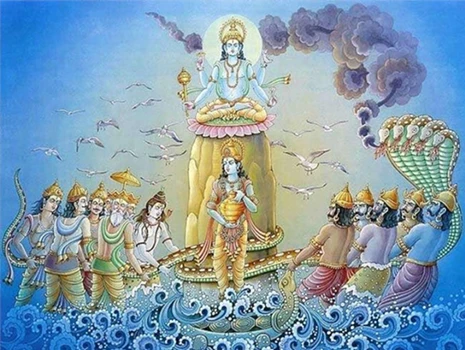
- Kumbh Mela, a prominent Hindu pilgrimage that occurs once in 12 years, has its roots in the story of Samudra Manthan (churning of the cosmic ocean).
- During this process, the ocean was churned by the gods and the demons for amrit (nectar of immortality), and, at the end, Lord Dhanvantri appeared with a pitcher of nectar.
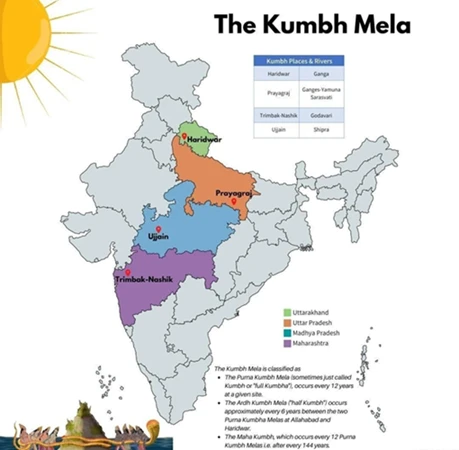
- To keep it away from the demons, Indra's son Jayant ran away, dropping some at four different places—Prayagraj, Haridwar, Nashik, and Ujjain—which consequently turned out to be holy ones.
- Along with these places, Kumbh Mela is celebrated according to the stellar alignments of the Sun, Moon, and Jupiter. People believe that the holy rivers' baths will make them saviors, and Prayagraj's Kumbh is the biggest and holiest among them all.
Various Types of Kumbh Maha Mela
| Type of Kumbh Mela | Description | Frequency & Location |
|---|---|---|
| Maha Kumbh Mela | The rarest and most sacred Kumbh Mela; celebrated once after 12 Purna (Complete) Kumbh Melas. | Held every 144 years only at Prayagraj. |
| Purna (Complete) Kumbh Mela | The main Kumbh Mela celebrated at four river sites. | Held every 12 years at Prayagraj, Haridwar, Nashik, and Ujjain (rotationally). |
| Ardh (Half) Kumbh Mela | A “half” Kumbh Mela celebrated midway between two Purna Melas. | Held every 6 years at Haridwar and Prayagraj. |
| Kumbh Mela | Regular Kumbh Mela organised with massive participation and spiritual fervour. | Held at the four main pilgrimage sites by the respective state governments. |
| Magh (Mini) Kumbh Mela | Also known as Mini Kumbh, marked by holy baths and rituals in the month of Magh. | Held annually at Prayagraj; timing based on positions of the Sun, Moon, and Jupiter. |
Kumbha Mela 2025 & Shahi Snan
- The 2025 Maha Kumbh Mela took place in Prayagraj at the Triveni Sangam between January 13 and February 26.
- The Shahi Snan, which were the royal holy baths of the akharas, were the major highlights of the event on the important dates: January 14 (Makar Sankranti, first), January 29 (Mauni Amavasya, second), and February 3 (Basant Panchami, third).
- Spiritual purification during bathing drew over 400 million pilgrims to this rare 144-year spectacle, as millions took the opportunity.
What is the Debate over History of Kumbh Mela?
- The Kumbh Mela history is presented differently by various people; hence, it becomes a matter of discussion. The Skanda Purana is often quoted as the source of the festival's origin, but the currently available versions of the Purana do not really mention the festival or amrita being poured out at the four sites.
- According to some scholars like Girija Shankar Shastri of BHU, no scripture has given a clear description of the Kumbh Mela.
- There are discussions regarding the claims about the Rig Veda mentioning the festival through Gita Press's Maha Kumbh Parva.
- Adi Shankaracharya is believed to have set up the festivals for ascetic gatherings in the 8th century.
- Kama Maclean proposes the Prayag Magh Mela was disguised after the year of the revolt as a British non-interference strategy, while Prof. DP Dubey recounts the initial Haridwar fair tracing back to river worship and pilgrim networks, as per Mughal and akhada accounts.
Brief Timeline of Maha Kumbh Mela
| Year | Event Details |
|---|---|
| 8th Century CE | Adi Shankaracharya is credited with promoting gatherings of ascetics and establishing akharas. |
| 644 CE | Earliest account by Xuanzang of a bathing ritual at Prayag, possibly precursor. |
| 1695–1759 CE | Mughal texts reference Haridwar Kumbh as "Kumbh Mela". |
| 1870 | First British-supervised Kumbh at Prayag post-1857 Revolt. |
| 1954 | Post-Independence Maha Kumbh with five pontoon bridges. |
| 1977 | 144-year cycle completion; 1 crore pilgrims, 14 bridges amid Emergency. |
| 2001 | Millennium Maha Kumbh with live telecasts, satellite imaging, enhanced security. |
| 2013 | Ardh Kumbh peak: 3 crore on Mauni Amavasya across 22 ghats [conversation_history]. |
| 2025 | The latest Maha Kumbh (Jan 13–Feb 26) drew over 400 million. |
Importance
- Kumbh Mela is very important in Pauranic and the Vedic times. Rig Veda (10.89.7) exalts the sangam baths as a means to remove all impurities and give new life to the soul; the other two Vedas, Atharva and Yajur, are also heard praying for it.
- In astrological terms, it marks the 12 divine days (one god-year equals one human year) of the Samudra Manthan when the amrit drops sanctified places.
- It is a great social event that over a million people come together without any invitation for participation in yajnas, donations to the poor/saints, Vedic chants, and so on, thereby promoting welfare, noble thoughts, and global peace.
Economic Significance
- The 2025 Maha Kumbh Mela was a huge economic event with expected revenue of up to ₹2 lakh crore from 40 crore visitors, according to UP CM Yogi Adityanath—outshining 2019 Ardh Kumbh's ₹1.2 lakh crore.
- The turnover comprised ₹25,000 crore from traders (puja items, dairy, flowers), and ₹6,000 crore in the hospitality sector.
- It was able to create over 600,000 jobs in the various sectors hospitality (250,000), airlines (150,000), tourism, and informal.
- The infrastructure was 2,500 hectares large with 4,000 tents, 250 km of roads, 22 bridges, and 11 hospitals which helped temporary livelihoods and global tourism to the destination.
Various Technological Innovations at the Maha Kumbh 2025
For the first time, Maha Kumbh 2025 integrated cutting-edge tech for seamless organization. AI chatbots provided real-time ritual info and schedules. Over 2,500 AI cameras monitored crowds (3 AM–7 PM) at ghats with 95% accuracy, tested in Magh Mela. Underwater drones enhanced Shahi Snan security. The official app offered maps and updates. [conversation_history]
New District
| Aspect | Details |
|---|---|
| Name | Maha Kumbh Mela District (76th of UP) |
| Declaration | December 2, 2024; temporary till March 31, 2025 |
| Coverage | 66 villages from Sadar, Soraon, Phulpur, Karchana tehsils + parade area |
| Purpose | Dedicated admin for logistics, law enforcement, facilities, and coordination [conversation_history] |
Six Coloured E-Passes
| Color | Category |
|---|---|
| White | High Court, VIPs, foreign ambassadors, NRIs, govt reps |
| Saffron | Akharas and institutions |
| Yellow | Agencies, vendors, food courts, milk booths |
| Red | Emergency and essential services |
| Sky Blue | Media |
| Blue | Police force [conversation_history] |
Why Western Universities are Studying Mahakumbh?
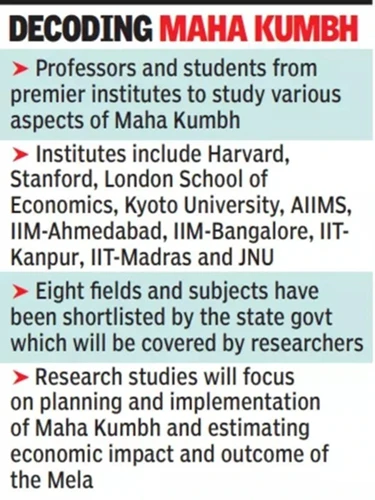
- The Maha Kumbh Mela 2025 at Prayagraj attracted 400 million visitors—far more than the city’s 5.5 million inhabitants and exceeding 250 million in 2019.
- More than a dozen eminent universities such as Harvard, Stanford, LSE, Kyoto, along with AIIMS, IIMs, IITs, and JNU were on-site for the purpose of studying crowd management, economic impact, and socio-cultural aspects, among others.
- This temporary city made up of tents and pontoons demonstrates perfect logistics even with the absence of major incidents.
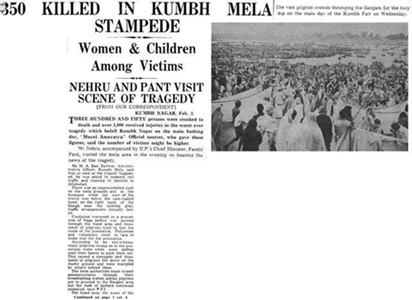
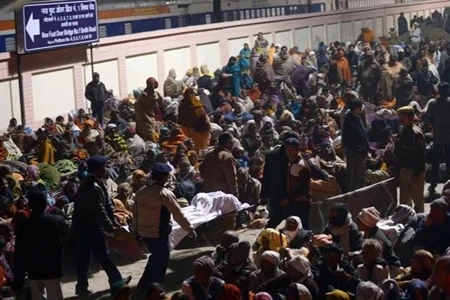
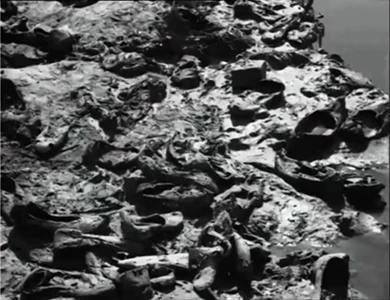
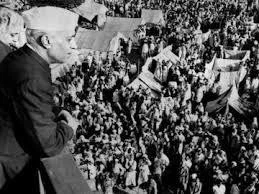
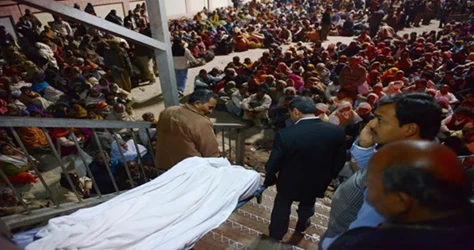
Mention about the tragedies that happened at Kumbh?
| Year | Tragedy |
|---|---|
| 1954 |
|
| 2013 |
|
Security Challenges
- Maha Kumbh 2025 had to confront huge security challenges because of the high number of 400 million pilgrims and the associated risks of stampedes, drowning, terrorism, and cyber security failure.
- Among the major difficulties were the coordination of more than 50,000 personnel positioned at the three different modes of transport land, water, and air; the measures taken against the illegal flying of drones and underwater threats; and the surveillance through the 2,751 AI cameras in spite of the past incidents like stampedes.
- The situation at the ghats was made even more complex by the huge number of people, vehicle regulations, and cyber scam that were directed against the devotees, but this was dealt with by the seven-tier security system, the cyber police, and the use of advanced technology.
Maha Kumbha and Global Appeal
- The worldwide attraction of the Maha Kumbh Mela brings together worshippers from more than one hundred nations, comprising the USA, the UK, Australia as well as Southeast Asia, combining spiritual quest with a great cultural feast.
- Scholars from Harvard, Stanford, and LSE examine the handling of the crowds and the temporary city that arises.
- Besides being regarded by UNESCO as an Intangible Cultural Heritage, it gathers 400 million people in 2025 for Shahi Snan, thereby creating peace and attracting visitors due to its vastness and calmness.
Gainings & Achievements From Mahakumbha 2025
- The 2025 Maha Kumbh Mela in Prayagraj set new records and gained worldwide recognition for its impeccable management by allowing more than 400 million pilgrims with no major incidents.
- Some of the main advantages were economic growth of ₹2 lakh crore coming from tourism, hospitality, and vendors, plus over 600,000 jobs created.
- Safety was guaranteed through high-end tech such as AI cameras, underwater drones, and e-passes.
- The new Maha Kumbh District made the administration easier. Scholars from Harvard, Stanford, and IITs studied the aspects of crowd dynamics, sanitation, and culture.
- UNESCO heritage status was a factor that made the event a focal point for spiritual unity, which was reflected in the record Shahi Snans that took place.
Relevance of the Topic for UPSC CSE
For Prelims: Godavari River, Shipra River, Sangam, Ardh-Kumbh, Vijayanagar empires, Delhi Sultanate, and Mughals, UNESCO, Intangible cultural heritage
For Mains: Significance of Kumbh, Historical Evolution.
FAQs about Kumbh Mela
How is the Place of Kumbha Mela decided ?
Kumbh Mela is celebrated at four alternating (Prayagraj, Haridwar, Nashik, Ujjain) sacred places in India, according to Hindu mythology where amrit drops fell during the Lauding of the Milky Ocean (Samudra Manthan).
Astrologic Criteria
Birth of gods and demons (Sun, Moon, and Jupiter) specific planetary alignments determine Kumbh Mela site each time:
Prayagraj: Jupiter in Taurus, Sun in Capricorn.
Haridwar: Jupiter in Aquarius, Sun in Aries.
Nashik: Both Sun and Jupiter in Leo.
Ujjain: Jupiter in Leo, Sun in Aries.
This alignment repeats every twelve years, hence the cycle of hosting is secured.
How did the Britishers look at the Kumbh Mela?
- British colonial perception of Kumbh Mela was a mixture of mistrust, control, and through that a source of revenue. The image of soldier monks was one that the British had in mind and they reacted to it by taxing which drove the number of visitors down to half and reorganizing the 'akharas' after the clashes that were held in 1796.
- The site at Prayagraj became a military camp after the 1857 rebellion when the government suppressed the Prayagwals; there were bans during World War II in 1942 due to fear of WWII. Later on, the British controlled the process from 1870, giving rise to the infrastructure that they later checked for riots.
Why is Maha Kumbh 2025 an Historic event?
The Maha Kumbh of 2025 was a historical event that took place in a rare astronomical phenomenon of Jupiter-Sun-Moon alignment, which was not seen for the last 14 centuries. It was attended by more than 660 million people, thus breaking the record of the largest human gathering. The involvement of PM Modi, AI-powered organization, and a zero major incident policy for the whole event contributed to its international recognition and legacy.
When and why was Kumbh included as an Intangible Cultural Heritage site?
- Kumbh Mela was added to the UNESCO's Representative List of Intangible Cultural Heritage of Humanity in 2017 during the 12th session in Jeju, South Korea.
- UNESCO admitted that it is the largest peaceful gathering in the world, which includes combined religions rituals, holy baths for sin-cleansing, and togetherness of the different pilgrim communities.
