
 80813-00200


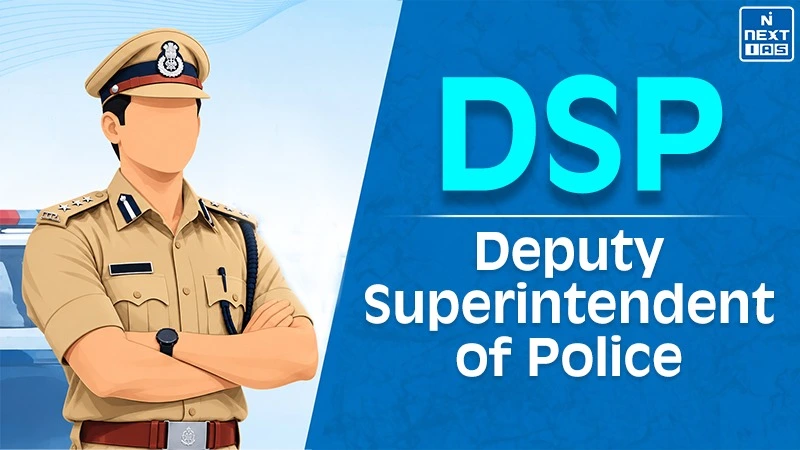
The full form of DSP is Deputy Superintendent of Police. DSP is a gazetted entry level rank in state police services. In commissionerate systems such as Delhi and Mumbai, a DSP rank officer is designated as Assistant Commissioner of Police or ACP. A DSP wears 3 silver stars or pips on shoulder lapels without an emblem or colored ribbon stripes. The high performances by DSPs help them to get an opportunity to have an induction into the prestigious Indian Police Service (IPS) after serving their specified tenure.
Qualification to Become a DSP
- Educational Criteria: The candidates must have attained a graduation degree in any discipline from a recognized university.
- Age Limit: The age usually ranges between 21 and 30 to 38 years. It depends on specific regulations of the State Public Services Commission (SPSC) and category relaxations.
- Physical Standard: The candidates must satisfy the minimum physical criteria such as height of 165 cms for males and 155 cms for females.
Exam Stages
- Stage 1 (Preliminary Exam): It comprises objective type questions with multiple choice of options. It includes the General Studies (Paper- I) and CSAT (Paper-II) which is designed to test the basic awareness, reasoning, and also the knowledge related to the particular state. The marks of stage 1 are not counted for the final merit.
- Stage 2 (Mains Exam): It consists of descriptive or written papers that cover the general studies, essay writing , state specific subjects, and compulsory language papers. In few states such as Punjab and Haryana, the physical test is usually conducted after qualifying the mains stage and before the Interview stage.
- Stage 3 (Interview): The Personality Test or Interview is conducted by a board of the specific state service commission such as UPPSC, RPSC, MPPSC and others. The board members assess the leadership qualities, integrity, communication, presence of mind, and administrative suitability of the candidate.
Training for Deputy Superintendent of Police
- Induction in Police Academy: The newly recruited candidates undergo foundation training at the state police academy such as Uttar Pradesh Police Academy, and Rajasthan Police Academy for about 1 to 1.5 years.
- Physical Training: The training covers Indian penal laws, forensic science, investigation of cyber crimes, drill, weapon handling, unarmed combat, and physical fitness.
- Field work Experience: The candidates are attached to different police stations, district headquarters, specialized branches, and courts for experiencing the real world before their final posting.
DSP Salary Rankwise
| S.No. | Rank (State Police) | Pay Level (7th CPC) | Approx. Gross Salary (Rs/month) |
|---|---|---|---|
| 1 | Deputy Superintendent of Police (DSP) or ASP | Level 10 | 90,000 to 1,10,000 |
| 2 | Superintendent of Police (SP) | Level 11 or 12 | 1,20,000 to 1,60,000 |
| 3 | Deputy Inspector General (DIG) | Level 13 or 13A | 2,00,000+ |
| 4 | Inspector General (IG) | Level 14 | 2,50,000+ |
| 5 | ADG or DGP (Director General of Police) | Level 15 to 17 | 3,00,000+ (top scale) |
Promotion Chart with Years of Experience
| S.No. | Rank | Service Experience |
|---|---|---|
| 1 | DSP or ASP |
|
| 2 | SP (Senior Scale) |
|
| 3 | DIG |
|
| 4 | IG |
|
| 5 | ADG / DGP |
|
DySP Roles and Responsibilities
- Sub-divisional Law and Order: They serve as the officer in charge of a sub-division. They look after many police stations to maintain public order and prevent crime.
- Investigation: DSP rank officer supervises the criminal cases, follows compliances, and conducts inquiries against subordinate officers, if required.
- VIP Security: DSP rank officers deploy police personnels during public events, political rallies, elections, riots, and VIP or VVIP travel from within their jurisdiction.
- Administrative Leadership: DSP rank officers maintain staff discipline, resource allocation, and conduct inspections at police stations.
FAQs about Deputy SP
What is the full form of DSP?
The full form of DSP is Deputy superintendent of Police.
How to become a DSP?
The candidates need to qualify the State PSC exam and undergo police training to become a DSP.
How many DSP are there in one district?
Generally, there are 3 to 8 DSPs in one district depending on the size and subdivisions of the district.
