
 80813-00200



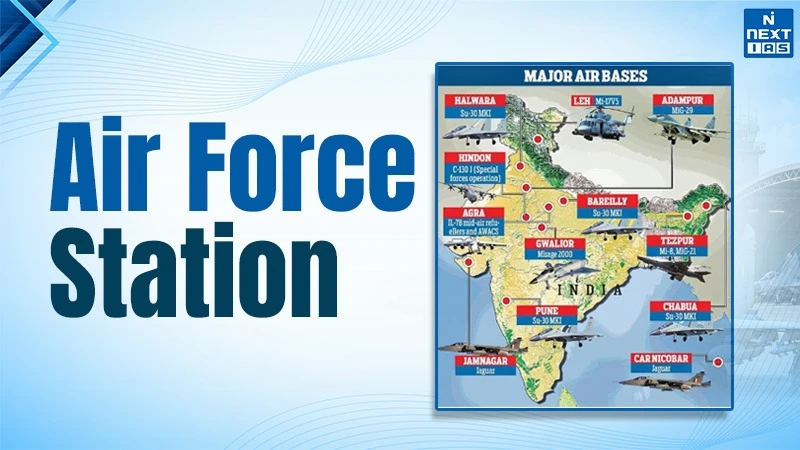
Air Force Stations are very important military and civil establishments. They are 0ver 60 in numbers in India and managed by the Indian Air Force (IAF). The Air Force Stations act as bases for the planes, the skilled personnel, the maintenance, communication and logistics. The Indian Air Force was founded on 8 October 1932. The motto of IAF, Nabhaḥ Sparsham Deeptam, means "Touch the Sky with Glory."
The Air Force Stations are instrumental in securing India's skies, combat-readiness, and the support of Army and Navy forces. Furthermore, they help in providing assistance in disasters such as floods, earthquakes, etc. The air bases of India are organized in seven Air Commands. The functions of the Air Force Stations include operational, training, and maintenance of the Indian Air Force. Apart from the defence of the nation, the stations reflect the significance of technology and teamwork in protecting the sovereignty of the country.
Historical Background
- The Indian Air force was officially established on 8 October, 1932 as an auxiliary arm of the Royal Air Force during British Rule.
- Initially, it had operated from small airfields in Karachi and Punjab with a small number of personnel and had only a few aircrafts.
- After India got independence in 1947, it built a wide network of Air Force Stations to ensure self-reliance in air defence.
- Over the period of time, several forward and technical bases were established across India's borders, with modern aircraft induction and increasing regional security concerns.
- At present, the IAF operates over 60 major Air Force stations, making it one of the most extensive air defence infrastructure system in Asia.
List of Air Force Stations
| S. No. | Air Force Station | State/Union Territory |
|---|---|---|
| 1 | Adampur Air Force Station | Punjab |
| 2 | Ambala Air Force Station | Haryana |
| 3 | Amritsar Air Force Station | Punjab |
| 4 | Awantipur Air Force Station | Jammu and Kashmir |
| 5 | Bagdogra Air Force Station | West Bengal |
| 6 | Bakshi Ka Talab Air Force Station | Uttar Pradesh |
| 7 | Bamrauli Air Force Station | Uttar Pradesh |
| 8 | Barrackpore Air Force Station | West Bengal |
| 9 | Bathinda Air Force Station | Punjab |
| 10 | Begumpet Air Force Station | Telangana |
| 11 | Bhuj Air Force Station | Gujarat |
| 12 | Bidar Air Force Station | Karnataka |
| 13 | Chandigarh Air Force Station | Chandigarh |
| 14 | Chabua Air Force Station | Assam |
| 15 | Car Nicobar Air Force Station | Andaman and Nicobar Islands |
| 16 | Darbhanga Air Force Station | Bihar |
| 17 | Deesa Air Force Station | Gujarat |
| 18 | Dundigal Air Force Academy | Telangana |
| 19 | Gwalior Air Force Station | Madhya Pradesh |
| 20 | Halwara Air Force Station | Punjab |
| 21 | Hasimara Air Force Station | West Bengal |
| 22 | Hindon Air Force Station | Uttar Pradesh |
| 23 | Jaisalmer Air Force Station | Rajasthan |
| 24 | Jamnagar Air Force Station | Gujarat |
| 25 | Jammu Air Force Station | Jammu and Kashmir |
| 26 | Jodhpur Air Force Station | Rajasthan |
| 27 | Kalaikunda Air Force Station | West Bengal |
| 28 | Kanpur Air Force Station | Uttar Pradesh |
| 29 | Leh Air Force Station | Ladakh |
| 30 | Lohegaon Air Force Station | Maharashtra |
| 31 | Maharajpur Air Force Station | Madhya Pradesh |
| 32 | Nal Air Force Station | Rajasthan |
| 33 | Ojhar Air Force Station | Maharashtra |
| 34 | Palam Air Force Station | Delhi |
| 35 | Pathankot Air Force Station | Punjab |
| 36 | Phalodi Air Force Station | Rajasthan |
| 37 | Pune Air Force Station | Maharashtra |
| 38 | Purnea Air Force Station | Bihar |
| 39 | Sarsawa Air Force Station | Uttar Pradesh |
| 40 | Shillong/Barapani Air Force Station | Meghalaya |
| 41 | Sirsa Air Force Station | Haryana |
| 42 | Srinagar Air Force Station | Jammu and Kashmir |
| 43 | Sulur Air Force Station | Tamil Nadu |
| 44 | Tambaram Air Force Station | Tamil Nadu |
| 45 | Tezpur Air Force Station | Assam |
| 46 | Thanjavur Air Force Station | Tamil Nadu |
| 47 | Thiruvananthapuram Air Force Station | Kerala |
| 48 | Tinsukia Air Force Station | Assam |
| 49 | Udhampur Air Force Station | Jammu and Kashmir |
| 50 | Yelahanka Air Force Station | Karnataka |
Purpose and Functions
- Air Defence: They provide protection to Indian airspace from enemy aircraft and missiles etc.
- Operational Hub: they act as the launch and recovery point for fighter jets, transport aircraft and helicopters etc.
- Maintenance and Repair: handle the regular inspection, servicing, and upgradation of aircraft.
- Training and Simulation: they provide technical, flying and ground crew training.
- Logistics and Supply: the stations also help to manage aviation fuel, armament and spare parts.
- Disaster Relief: at the time of disaster situations, they help to conduct rescue and relief operations in the region during floods, earthquakes and other emergencies.
- Coordination with Other Forces: play a key role in supporting Army forces and Navy forces operations through joint planning and intelligence sharing.
Organisational Structure
- Each air force station is commanded by an Air Officer Commanding (AOC) or a Group Captain (GC) depending on its size.
- The command station is divided into several functional wings :
- Operational wings : it is responsible for flying missions, radar detection and constant surveillance.
- Technical wing : it looks after the aircraft servicing, repairing, maintaining and weapon systems.
- Administrative wing : it is responsible for managing personnel, security and welfare.
- Logistics Wing: it is responsible for ensuring uninterrupted supply of fuel, spares and ammunition etc.
- Hindon Air Force Station : It is the largest in Asia and 8th largest airbase in the world.
- Siachen Glacier Air Force Station : this station is situated at the highest altitude in the world at an elevation of 22,000 feet.
Classification of Air Force Stations
Flying Stations
- They are fully equipped with runways, hangars, air traffic and radar systems.
- They host operational squadrons of fighter, transport or helicopter units.
- For example : Ambala, (Rafale base), Jodhpur, Tezpur, Bareilly, Pune.
Technical or Maintenance Bases
- On these stations repair, overhaul and testing or aircraft and avionics systems work are carried out.
- For Examples: Sulur (Tamil Nadu), Kanpur (Uttar Pradesh).
Training Bases
- These bases carry out training of pilots, airmen and technical personnel.
- For example : Air Force Academy (Dundigal, Telangana), Yelahanka (Karnataka), Hakimpet (Telangana).
Logistics and Administrative Bases
- They handle transportations, records, communications and supply chain management.
- For Example: Tughlakabad (Delhi).
Forward Air Bases (FABs)
- FAB act as the tactical bases located near the border areas for quick deployment and operational readiness.
- For example: Leh (Ladakh), Pathankot (Punjab), Chabua (Assam).
Strategic Significance
- They facilitate rapid deployment or air assets during emergencies or war situations.
- Provide assistance in airlifting troops and material supplies to remote or conflict areas.
- Support joint operations with the army and navy.
- Provide surveillance and intelligence for border security and maritime awareness.
- Play a significant role to maintain constant monitoring of sensitive areas and borders.
- The air force stations also support the government's foreign and defence policies through peacekeeping missions and international cooperation etc.
Recent Developments
- The air force recently added Rafale jets, Tejas fighter jets, Apache attack helicopters and Chinook helicopters etc.
- Integrated Air Command or Control System for better coordination.
- Development of forward bases in the Ladakh and North-East sectors to counter the challenges of neighboring countries in the region like China and Pakistan.
- constant surveillance focusing on cyber defense systems, drones, UAV and space-based threats.
- Focus on indigenisation under Make in India and Atmanirbhar Bharat initiatives.
- Participation of the Indian Air Force in international exercises such as Garuda (France), Cope India (USA), and Pitch Black (Australia) etc.
Overseas Air Force Stations/Bases of India
- These overseas stations, bases and cooperative air facilities allow the Indian air force (IAF) to enhance its operational reach, while ensuring strategic presence and strengthening defense partnerships with friendly nations.
- Rather than traditional permanent bases, these sites serve as logistical, training or strategic cooperation airfields established through bilateral agreements with partner countries.
Types of Overseas Air Force Facilities
India's international presence is primarily established through three types of arrangements:
- Bilateral Access Facilities: under these facilities the established airfields or stations in friendly countries, have permission to the IAF for refueling, repair, or temporary stationing of aircraft.
- For Examples: Oman, Singapore, and France.
- Joint Defense Bases: These bases are shared with partner countries for joint exercises, training and operational coordination.
- For example: Mauritius and Seychelles.
- Logistics and Technical Support Points: These are airstrips or islands utilized for logistical supply, communication and disaster relief operations.
- For example: Madagascar and Reunion Island (France).
Key Overseas Air Force Stations and Facilities
- Oman – Duqm Airbase : a defense agreement signed in 2018 between India and Oman, allowing the Indian Navy and Air Force access to Duqm Port and Airbase.
- Tajikistan – Farkhor Airbase : it is India's first overseas airbase located near the Afghanistan border.
- This air base was established jointly by India and Tajikistan with the assistance of Russia.
- Mauritius – Agalega Island Airstrip : India is currently working on developing a new airstrip and communication facility on Agalega Island as part of a bilateral agreement with Mauritius.
- Seychelles – Assumption Island : India signed an agreement with Seychelles to jointly develop military infrastructure on Assumption Island.
- France – Reunion Island : this base was established between India and France to have close defense cooperation in the Indian Ocean Region (IOR).
- Singapore – Changi Air Base : Allowing IAF aircraft to use Changi Air Base for joint training and refueling.
- Madagascar – Coastal Surveillance Radar Station : India set up a coastal surveillance radar system in Madagascar to monitor maritime movement.
Contemporary Challenges
- Evolving Technology : Use of drones, precision-guided missiles and cyber attacks etc pose new forms of threats beyond traditional air assault.
- Infrastructure Upgrade: At the time of growing challenges of 21st century warfare India needs to update runways, shelters, hangars and Radar systems.
- Harsh Climatic conditions : Air force stations in high altitude and desert regions sometimes face operational difficulties due to low level of oxygen, freezing temperature and dust storms etc.
- Cyber attacks : increasing risk of hacking and data theft targeting command control and communication systems.
- Environmental Impact: Even noise pollution and ecological damage in or around populated areas can be equally worrisome.
- Budget Constraints: Balancing operational readiness with limited defense allocations is also very challenging for a developing country like India.
Way Forward
- Upgradation of airbases : India needs to prioritize renovation of old runways, hangars, and communication systems.
- For this purpose the ministry of defence launched the Modernisation of Airfield Infrastructure (MAFI) programme.
- Integration with DRDO and ISRO: This will not only enhance our communication and satellite-based surveillance capabilities but also research and development for future need.
- Strengthening Forward Presence: To counter regional balance particularly along with China and Pakistan borders, need to develop forward operating bases in areas like ladakh, arunachal pradesh and andaman & Nicobar for quick response capabilities.
- Encouraging Indigenous Manufacturing: promoting indigenisation through Atmanirbhar Bharat and make in india initiative for aircraft parts, drones and radar systems etc.
- Public–Private Partnership (PPP) : Engaging private companies for MRO facilities to reduce the reliance on imports.
- Green Practices Promotion: during the conversion from conventional fuel based energy to green energy such as solar, waste management, eco-friendly construction of station also should be promoted.
Conclusion
The air force stations of India are not just the foundation of the nation's aerial defence network but they are the symbols of national pride. Air force stations ensure operational readiness, technological advancement and national security at the time of both peace and conflict. From defending airspace by the enemies to saving lives in disaster time, air force stations play a multifaceted role in the nation's growth and security.
Frequently Asked Questions (FAQs)
What is an air force station?
Air Force station is a military base playing a critical role in national defence, aerial surveillance, and logistics transports etc.
Which Air Force Station of the world is situated at the highest elevation?
The Siachen Glacier Air Force Station is situated at the highest altitude in the world at an elevation of 22,000 feet.
