


Piprahwa Relics of the Buddha
Syllabus :GS1/History
In News
- Jewels from the sacred Piprahwa Buddha relics, recently auctioned at Sotheby’s Hong Kong, were repatriated to India, 127 years after being taken during colonial rule.
Piprahwa relics
- The Piprahwa relics were discovered in 1898 by British civil engineer William Claxton Peppé in Piprahwa, Uttar Pradesh.
- They include bone fragments, soapstone and crystal caskets, a sandstone coffer, and offerings such as gold ornaments and gemstones,
- They are believed to be associated with the mortal remains of Lord Buddha.
- An inscription in the Brahmi script on one of the caskets confirms these as relics of the Buddha deposited by the Sakya clan
- They are excavated from the Piprahwa Stupa—widely recognized as the ancient city of Kapilavastu, the birthplace of Lord Buddha.
Status
- Most of these relics were moved to the Indian Museum in Kolkata in 1899 and are legally protected as ‘AA’ antiquities, forbidding their sale or removal.
- While some bone relics were gifted to the King of Siam, a portion kept by Peppé’s descendants.
Source: PIB
Ratadiya Ri Dheri
Syllabus: GS1/Ancient Indian History
Context
- A Harappan site has surfaced at Ratadiya Ri Dheri in Jaisalmer district, marking the first known Indus Valley settlement in the region.
About
- It is located 17km northwest of Pakistan’s Sadewala where Harappan traces were earlier found.
- This finds bridges a vital archaeological gap between northern Rajasthan and Gujarat.
- Until now, Pilibanga in northern Rajasthan was the state’s most prominent Harappan site — discovered by Italian Indologist Luigi Pio Tessitori in the early 20th century and excavated in the 1960s.
Harappan Civilization
- The Harappan civilization is believed to be one of the oldest world civilizations together with Egypt and Mesopotamia.
- It was developed along the river Indus and for that reason it is also known as the Indus Valley Civilization.
- The Harappan civilization is identified as a Bronze-age civilization because many objects have been found that are made up of copper based alloys.
Major Harappan Sites
| Site | Present Day |
| Harappa | Punjab, Pakistan |
| Mohenjo-Daro | Sindh, Pakistan |
| Dholavira | Kutch district of Gujarat, |
| Kalibangan | Rajasthan |
| Lothal | Gujarat |
| Rakhigarhi | Haryana |
| Chanhudaro | Sindh, Pakistan |
| Ganweriwala | Punjab, Pakistan |
| Sutkagendor | Baluchistan Province, Pakistan |
| Alamgirpur | Uttar Pradesh |
Source: TOI
Chronic Traumatic Encephalopathy (CTE)
Syllabus :GS2/Health
In News
- The gunman who killed four people in New York was suffering from chronic traumatic encephalopathy (CTE).
Chronic traumatic encephalopathy (CTE)
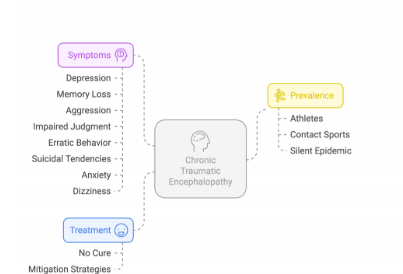
- It is a degenerative brain disease linked to repeated brain trauma.
- It was historically noted as “commotio cerebri” by Hippocrates and later described by Jacopo Berengario da Carpi as brain bruising.
- It is most commonly diagnosed among athletes, especially those in contact sports, and has been referred to in recent years as a “silent epidemic”
Source: IE
1267 Sanctions Committee of United Nations
Syllabus: GS2/IR
Context
- The recent inclusion of The Resistance Front (TRF) in the UN Security Council’s 1267 Sanctions Committee report represents a significant boost for India in its global campaign against cross-border terrorism.
About
- The Resistance Front (TRF) emerged in 2019 post the abrogation of Article 370 in Jammu and Kashmir.
- The report explicitly names the TRF as responsible for the Pahalgam terror attack that occurred in April 2025.
1267 Sanctions Committee
- It is also called the ISIS and Al-Qaeda Sanctions Committee, was established under a UNSC resolution in 1999, to focus on combating terrorism linked to ISIS, Al-Qaeda, and related groups.
- Member States may at any time submit to the Committee listing requests for inclusion of individuals, groups, undertakings and entities.
- The Committee comprises all 15 members of the Security Council and makes its decision by consensus.
- Sanctions Measures Include:
- Asset Freeze: All assets of designated individuals/entities are frozen.
- Travel Ban: Listed individuals are banned from entering or transiting through any member state.
- Arms Embargo: Prohibition on supplying arms or related material.
Source: TH
UN Women
Syllabus: GS2/ International Organisation
In News
- UN Women marks its 15th anniversary this year.
About UN Women
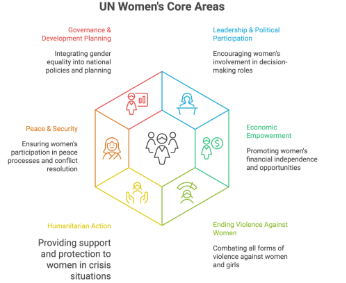
- UN Women is the United Nations entity dedicated to gender equality and the empowerment of women and girls globally.
- Established by the UN General Assembly in July 2010 and operational from January 2011.
- UN Women serves as the secretariat to the UN Commission on the Status of Women (CSW).
- UN Women Executive Board:
- Comprises representatives from 41 Member States.
- Members are elected by ECOSOC for three-year terms on a rotational basis, ensuring geographical balance and global representation.
Source: TH
IEPFA Launches “Saksham Niveshak”
Syllabus :GS2/Governance
In News
- The Investor Education and Protection Fund Authority (IEPFA) has launched a 100-day campaign titled “Saksham Niveshak”, running from 28th July to 6th November 2025.
“Saksham Niveshak”
- It is a national drive which is aimed at empowering shareholders by creating awareness about unclaimed dividends held by companies and guiding them through the process of updating their KYC and nomination details to reclaim their rightful dividend.
- It encourages companies to proactively reach out to their shareholders, helping them recover unclaimed dividends and resume the regular receipt of dividends by updating essential records.
- Timely action by shareholders will ensure that their dividends and underlying shares are not transferred to IEPFA.
| The Investor Education and Protection Fund Authority (IEPFA) – The Government of India established the Investor Education and Protection Fund Authority (IEPFA) in 2016 under section 125 of the Companies Act, 2013, to administer the Investor Education and Protection Fund. – It was established under the Ministry of Corporate Affairs. – It is committed to promoting financial literacy, safeguarding investor interests, and protecting unclaimed dividends and shares. 1. Through initiatives like Niveshak Didi, Niveshak Panchayat, and Niveshak Shivir, IEPFA strives to build a financially informed and empowered investor base across the country. |
Source :PIB
India’s Skill Impact Bond (SIB)
Syllabus: GS2/Economy
Context
- India’s Skill Impact Bond (SIB), launched in 2021, is the country’s first development impact bond focused on employment.
About
- Backed by the Ministry of Skill Development and Entrepreneurship through the National Skill Development Corporation, it brings together public and private players.
- Aim: To support 50,000 young people from vulnerable backgrounds with job-ready skills and employment.
- Eligibility: Each candidate must be between 18-40 years of age, unemployed or earning below Rs 15,000 a month (or from a household earning less than Rs 25,000), and have an education level of undergraduate or below.
- 62% of participants are targeted to be women, addressing long-standing gender gaps in employment.
- Outcome Based Financing: The SIB represents a major shift from input-based funding to outcome-based financing.
- Rather than measuring success by how many people enrol, it rewards outcomes like certification, placement in jobs, and retention for three months.
Source: IE
Digital Payments Index
Syllabus: GS3/Economy
Context
- The Reserve Bank of India (RBI) announced that its Digital Payments Index (RBI-DPI) surged to 493.22 in March 2025, up from 465.33 in September 2024.
- The latest increase is primarily driven by improvements in Payment Infrastructure – Supply-side factors – and Payment Performance.
About
- The RBI-DPI was introduced in 2021, the index is published semi-annually and is based on March 2018 as the base period (Index = 100).
- To track the extent of digitalisation in payments across the country.
- The consistent upward trend reflects India’s rapid adoption of digital payment systems, spanning both urban and rural areas.
Source: PIB
Supply and Use Tables (SUTs)
Syllabus: GS3/ Economy
In News
- The Ministry of Statistics and Programme Implementation (MoSPI) has released the ‘Supply and Use Tables of 2020-21 and 2021-22’.
About Supply and Use Tables (SUTs)
- Supply and Use Tables (SUT) are a foundational tool for national accounting, providing a comprehensive and detailed statistical framework that integrates the measurement of Gross Domestic Product (GDP) through its three main approaches—production, income, and expenditure.
- Supply and Use Tables (SUT) are presented as two interlinked matrices: the Supply Table and the Use Table, structured in a product-by-industry matrix.
- The Supply Table captures the total supply of goods and services, both from domestic production by industry and from imports.
- In contrast, the Use Table records the utilization of these products across various components—intermediate consumption by industries, final consumption, gross capital formation, and exports.
Source: PIB
Next article
Impact of Flash Floods in India
