


Syllabus: GS2/Governance
In News
- The Lok Sabha has given its approval to the statutory resolution regarding the extension of President’s rule in Manipur for a further period of six months with effect from 13th of August 2025.
Background
- Manipur was placed under President’s Rule in February 2025 after erstwhile Chief Minister N. Biren Singh stepped down, nearly two years after the ethnic conflict began in the State between the valley-based Meitei community and the hills-based Scheduled Tribe Kuki-Zo group of communities.
- The conflict originated from the Meitei demand for Scheduled Tribe (ST) status, which the Kukis opposed, fearing loss of job opportunities and other affirmative actions meant for STs.
| Do you know? – Emergency provisions in Part XVIII of the Indian Constitution, inspired by the German Constitution, allow the Central government to manage crises threatening India’s sovereignty, unity, or security. – There are three types of emergencies: national (Article 352), state (Article 356), and financial (Article 360). |
President’s Rule
- It is a state emergency which is commonly called President’s Rule. The term ‘President’s Rule’ is not mentioned in the Constitution.
- It has been declared under Article 356, fulfilling the Union’s duty under Article 355 to protect states from external aggression or internal disturbances to ensure that State governments operate as per the Constitution.
- Article 356(1) allows the President to declare President’s Rule if a State’s constitutional machinery fails due to non-performance or malperformance, based on the Governor’s report or otherwise.
- This shifts the State’s executive powers to the Centre and legislative powers to Parliament, while the High Court remains unaffected.
- Under Article 365, if a State disobeys Union directions, the President may also declare a Constitutional Emergency.
Conditions
- The proclamation must be approved by both Houses of Parliament within two months and can last six months per approval.
- It may be extended beyond a year only if a national emergency is in force and the Election Commission certifies election difficulties.
- However, President’s Rule cannot exceed three years in total and can be revoked anytime.
| How is a ‘constitutional emergency’ different from a ‘national emergency’? – A Constitutional emergency (Article 356) and a National emergency (Article 352) differ in purpose, scope, and procedure. – A national emergency is declared when India’s security is threatened by war, external aggression, or armed rebellion. 1. It affects the entire nation or part of it and requires a special majority in Parliament. 2. It has no time limit, and state governments continue to function. 3. The 44th Amendment (1978) introduced safeguards, including Cabinet approval, judicial review, and protection of fundamental rights under Articles 20 and 21. – A constitutional emergency, or President’s Rule, is imposed when a state’s government fails to function constitutionally. 1. It requires only a simple majority in Parliament, can last up to three years, and shifts executive powers to the Centre while suspending or dissolving the state legislature. |
Impacts
- Unlike a national emergency, President’s Rule does not suspend citizens’ fundamental rights.
- During a national emergency, Article 19 freedoms can be suspended under Article 358, and other rights (except Articles 20 and 21) may also be restricted.
- Under President’s Rule, the President assumes special powers, with the Governor administering the State on her behalf, aided by the Chief Secretary or appointed advisers.
- Article 357 allows Parliament to transfer legislative powers to the President or another authority and enables the President to approve spending from the State’s Consolidated Fund.
Instances of Use
- Despite Dr. B.R. Ambedkar’s hope that it would remain a “dead letter,” President’s Rule has been imposed nearly 134 times across 29 States and UTs since 1950.
- First applied in Punjab in 1951, it has served as both a crisis-management tool and a politically sensitive measure.
- Manipur and Uttar Pradesh share the highest number of impositions at 10 each, with Manipur’s latest making it 11 times.
- Jammu & Kashmir holds the record for the longest cumulative period under President’s Rule (over 12 years), followed by Punjab (over 10 years) and Puducherry (over 7 years).
Judicial Interpretation
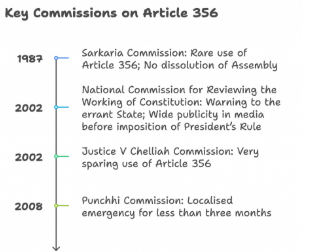
- The Supreme Court’s landmark judgment in S.R. Bommai v. Union of India (1994) redefined the use of President’s Rule under Article 356, emphasizing it should be a last resort option.
- The Court stated that while India’s federal system favors the Centre, States are not mere extensions of it.
- It should be used only in cases of constitutional breakdown.
- The SC ruled that the President’s power under Article 356 is conditional, not absolute, and subject to judicial review.
- Once imposed, the State government must step down, as two governments cannot coexist.
Source: TH
Previous article
News In Short 30-07-2025
Next article
Single-window System for Appointing State DGPs
