


Syllabus: GS3/ Science and Technology
Context
- China’s suspension of rare earth magnet exports to India since April 2025 has disrupted key sectors like EVs, electronics, and drones, highlighting India’s heavy reliance on Chinese supplies.
What are Rare Earth Magnets?
- Rare earth magnets are powerful permanent magnets made using rare earth elements, including 17 different elements from the periodic table.
- The two main types are Neodymium (Nd-Fe-B) and Samarium Cobalt (SmCo) magnets.
- Despite the name, rare earth elements are not geologically rare but are difficult to extract economically due to their dispersed occurrence and the environmental cost of mining.
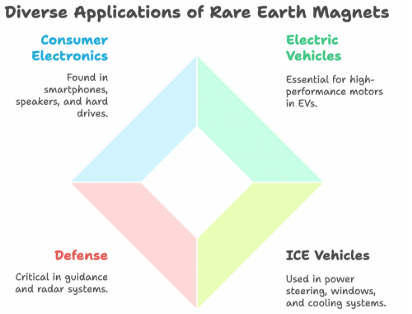
Availability of Rare Earth magnets
- China controls over 85% of global rare earth magnet production, and dominates the supply chain from mining to refining to magnet manufacturing.
- India, despite having rare earth reserves (especially in monazite sands in Kerala, Tamil Nadu, Odisha), lacks;
- Advanced refining capabilities
- Downstream magnet manufacturing industry
- R&D and private sector participation
Immediate Impact on India
- Electric Vehicles: Bajaj Auto halved electric scooter production in July 2025 and may close its EV plant if the crisis persists.
- Electronics: Apple was forced to shut down its AirPods assembly line in Telangana for two weeks due to magnet shortages.
- Automobile Industry: The Society of Indian Automobile Manufacturers (SIAM) has petitioned the government to cut import duty on electric motors to mitigate rising costs.
- Cost Pressure: With no magnets, companies are forced to import fully assembled electric motors from China, increasing production costs significantly.
India’s Response
- The Indian government has earmarked ₹18,000 crore under the National Critical Mineral Mission (NCMM) for a seven-year period (2024-25 to 2030-31) to enhance domestic production of strategic minerals.
- The Geological Survey of India (GSI) is exploring over 100 rare earth projects, although commercial mining may begin only after three years.
Way Ahead
- Short-Term Measures: To mitigate the current crisis, the government should reduce customs duties on fully assembled electric motors to control rising production costs in the EV sector.
- India must secure alternative supplies from countries like Japan, Uzbekistan, and Australia through trade negotiations.
- Medium to Long-Term Measures: India should develop a strategic reserve of critical rare earth elements to safeguard against future supply disruptions.
- India must pursue technology collaborations and joint ventures with countries rich in rare earths and those advanced in processing technologies, such as Japan, the US, and Australia.
Source: BS
Previous article
India Launches NISAR Earth Observation Satellite
Next article
News In Short 31-07-2025
