


Syllabus: GS3/Science and Technology
Context
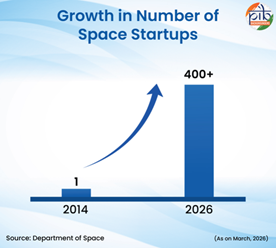
- According to the Tracxn Space Tech in India Report, India’s space-tech startups raised a record $200 million in 2025, with Bengaluru accounting for 57% of the sector’s total funding, reaffirming its position as India’s leading space innovation hub.
Private Sector Powering India’s Space Transformation
- India’s space economy is currently valued at $8 billion with a share of 2–3% in the global space economy.
- Companies such as Pixxel, Dhruva Space, Skyroot Aerospace, Agnikul Cosmos, and Bellatrix Aerospace have emerged as pioneers of a new space era.
- Skyroot Aerospace became India’s first space-tech unicorn. Its Vikram-1 became the first privately developed Indian orbital-class rocket to successfully place a payload into Low Earth Orbit (LEO).
Significance of Privatization of Space Sector
- Private companies operate with a profit motive, which drives them to reduced costs in space missions and satellite launches.
- Privatisation introduces competition into the space industry, which can drive efficiency and innovation.
- Private players facilitate the commercialisation of space applications and services in agriculture, disaster management, urban planning, navigation, and communication, as well as in other sectors.
- Private companies have a greater degree of autonomy in making decisions, which enables them to take up new projects.
- It helps to generate employment, enable modern technology absorption and make the sector self-reliant.
Major Reforms In Space Sector of India
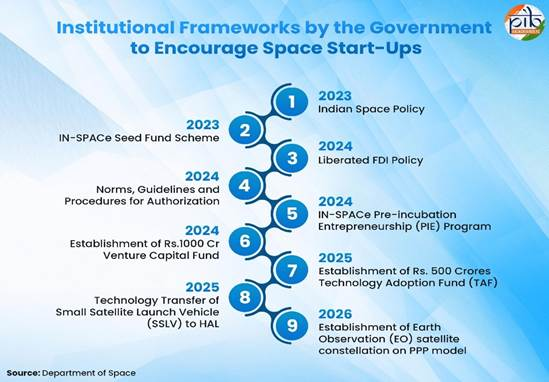
- Establishment of IN-SPACe (Indian National Space Promotion and Authorisation Centre, 2020): Acts as a single-window regulator and facilitator for private companies, authorising and promoting their participation in space activities.
- Corporatisation via NewSpace India Limited (2019): It was set up as ISRO’s commercial arm to transfer technology, manufacture satellites/launch vehicles through industry, and provide commercial satellite services.
- Schemes to encourage the private sector have been implemented by IN-SPACe: Seed Fund Scheme, Pricing Support Policy, Mentorship Support, Design Lab for NGEs, Skill Development in Space Sector, ISRO facility utilization support, Technology Transfer to Non-Governmental Entities (NGEs).
- Indian Space Policy 2023: It laid down roles and responsibilities of organisations such as ISRO, New Space India Limited (NSIL) and private sector entities.
- It aims to enhance the participation of research, academia, startups and industry.
- Liberalisation of FDI Norms (2024): The government eased foreign direct investment rules in the space sector to attract global capital and technology, especially in satellite manufacturing and launch services.
- SpaceTech Innovation Network (SpIN): SpIN is a one-of-its-kind public-private collaboration for start-ups and SMEs in the space industry.
Challenges
- Space technology is expensive and needs heavy investment. This kind of lucrative power is available only with selected rich corporates and thus can lead to monopolisation of the sector.
- Building and operating space technology and infrastructure requires specialised technical expertise and resources.
- Protecting intellectual property rights (IPR) is crucial for incentivising innovation and investment in the space sector.
- Indian private companies in the space sector have to face stiff competition from the established players such as SpaceX, Blue Origin, etc. in the international market.
Way Ahead
- India’s space sector stands at the threshold of a new era, driven by Government-led reforms and a vibrant private ecosystem.
- The Indian Space Policy 2023, liberalised FDI norms, and dedicated funding initiatives have opened the entire space value chain to any potential players.
- These reforms have fostered a dynamic ecosystem marked by growing startups, indigenous innovation, and expanding commercial activities.
Source: TH
Previous article
The Next Frontier in India’s Innovation Strategy
