


Syllabus: GS3/ Science and Technology
Context
- India’s rise in the Global Innovation Index must now be matched by stronger home-grown R&D, business sophistication, and emphasis on domestic intellectual property ownership.
About
- Global Innovation Index (GII) is a metric of R&D output maintained by the World Intellectual Property Organization.
- India was ranked 81st globally in the GII 2015, and rose to 38th rank in 2025.
- India also holds the top position among lower-middle-income countries and within the Central and Southern Asian region.
- Since 2015, the Indian government’s sustained encouragement of the research and development (R&D) ecosystem, along with new science-backed policies.
- India’s Ambitions: The Indian government aims to ascend among the leading nations in the GII.
- Govt. is investing in venture stakes in strategic technology sectors such as semiconductors, artificial intelligence, and space.
- The approximately US$10 billion Anusandhan National Research Foundation Fund is expected to propel R&D financing across various academic and scientific disciplines.
Areas India Needs to Improve in
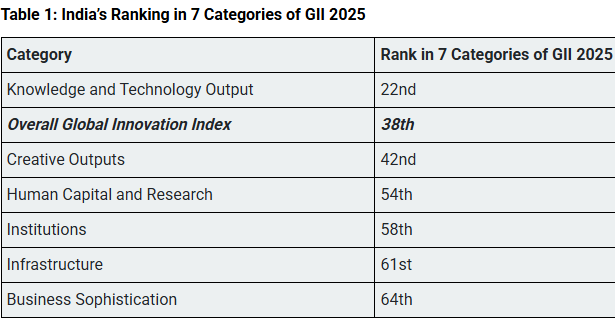
- The six other categories in the GII country rankings suggest considerable scope for improvement.
- These are: Knowledge and Technology, Creative Outputs, Human Capital and Research, Institutions, Infrastructure, and Business Sophistication.
- India ranks below its overall position of 38th in five of these six categories.
- The key to improving performance across these categories lies in strengthening the ‘Business Sophistication’ of the country’s R&D ecosystem.
- The metrics within the GII’s Business Sophistication category are subdivided into three distinct sub-categories:
- Knowledge Workers, which measures the share of employment engaged in knowledge-intensive activities;
- Innovation Linkages, which assesses collaboration between the public and private research sectors;
- and Knowledge Absorption, which includes indicators such as foreign direct investment (FDI) inflows, high-technology imports, information and communication technology (ICT) services imports, and payments for intellectual property, expressed as proportions of total trade.
Concerns Needs to be Addressed
- Patent Filing: The quantity of patents filed should not be regarded as the sole objective, despite its influence on India’s overall GII ranking.
- An increase in the number of patents granted in India, as well as in high-impact patents, should become the next shared objective.
- Technological Innovation: The technological interventions needed must emerge from India’s own R&D ecosystem, foreign innovation will not solve India’s challenges and security threats.
- Funding Constraints: Despite robust government support, private sector investment in R&D in India remains limited compared to global benchmarks, constraining large-scale innovation.
- Talent Retention Challenges: The brain drain persists, as skilled researchers are often drawn abroad by better infrastructure, funding, and career advancement opportunities.
- Limited University-Industry Collaboration: Weak links between academia and industry hinder commercialization of research.
- Skilled Workforce Deficit: Shortage of trained R&D professionals in deep-tech and interdisciplinary fields.
Major Initiatives taken by the Government
- Research, Development and Innovation (RDI) Scheme: Approved with a ₹1 lakh crore corpus, this scheme aims to energise private-sector R&D and deep-tech startups.
- It offers long-term, low- or zero-interest loans, equity investments, and funds a new Deep-Tech Fund of Funds via the Anusandhan National Research Foundation (ANRF).
- Anusandhan National Research Foundation (ANRF): The ANRF established in 2023, provides high-level strategic direction for research, innovation, and entrepreneurship in science and technology.
- The Foundation aims to mobilise funds amounting to ₹50,000 crore during 2023–28 through multiple streams, including the ANRF Fund, Innovation Fund, Science and Engineering Research Fund, and Special Purpose Funds.
- National Geospatial Policy, 2022: It seeks to position India as a global leader in the geospatial sector by 2035.
- The policy liberalises access to geospatial data, encouraging its use in governance, business, and research.
- Indian Space Policy, 2023: It builds on the space reforms introduced in 2020, which opened the domain to non-governmental entities for end-to-end participation.
- It aims to enhance space capabilities, promote a flourishing commercial space industry, and foster collaboration between public and private entities.
- National Quantum Mission: Allocated ₹6,003.65 crore for 2023–31, to advance quantum technologies through scientific and industrial R&D.
- BioE3 Policy, 2024: It encourages the creation of Biomanufacturing and Bio-AI hubs, along with a national Biofoundry network, to accelerate technology development and commercialisation.
- National Supercomputing Mission (NSM): Launched in 2015, the initiative empowers universities, research institutions, and government agencies with state-of-the-art supercomputing systems connected through the National Knowledge Network.
- India Semiconductor Mission (ISM): Established in 2021, the mission seeks to build a robust ecosystem for semiconductor and display manufacturing.
- India has already approved 10 semiconductor projects across six states, including the first commercial Silicon Carbide fabrication facility in Odisha.
- India AI Mission: The IndiaAI Mission embodies the vision of “Making AI in India and Making AI Work for India.”
- It is advancing rapidly, having already increased computing capacity from an initial target of 10,000 GPUs to 38,000 GPUs, ensuring accessible AI infrastructure for startups, researchers, and industries.
- Atal Innovation Mission (AIM): To foster innovation at the grassroots level by providing support to students, startups, and entrepreneurs.
- The National Mission on High-Yielding Seeds will focus on strengthening the research ecosystem and developing high-yielding, pest-resistant, and climate-resilient seeds, aligning with DBT’s efforts in agricultural biotechnology.
- The Seaweed Mission and Learn & Earn Program empower women entrepreneurs, supporting economic inclusion.
Way Ahead
- For India to enter the top 10 of the GII, its science and technology (S&T) policymakers must make fundamental changes to the country’s approach to innovation.
- India must improve its performance across the individual indicators underpinning the overall GII ranking.
- India should strengthen business sophistication within its innovation ecosystem.
- Ensure that domestic and indigenous intellectual property applicants fare better.
Source: ORF
Next article
Space Tech Funding in India
