


Syllabus: GS3/Science and Tech
In News
- Google DeepMind announced that its AI model C2S-Scale generated a new hypothesis about cancer cell behavior that was later confirmed in lab experiments.
C2S-Scale
- It is a family of large language models (LLMs) built upon Google’s Gemma-2 architecture.
- It is designed to interpret biological data by converting single-cell RNA sequencing into simplified “cell sentences”.
- It is trained on over 50 million cells and the 27-billion-parameter model learns gene expression patterns across tissues and diseases, enabling it to reason about cellular behavior in natural language.
Latest Developments
- C2S-Scale generated a novel hypothesis that the drug silmitasertib could make certain cancer cells more visible to the immune system when combined with low levels of interferon.
- Lab experiments confirmed this prediction in neuroendocrine cancer cells, showing a marked increase in antigen presentation under the specified conditions.
Role of AI and LLMs in Healthcare
- Transformative Technology: AI, especially Large Language Models (LLMs), is revolutionising healthcare by analysing vast biomedical and clinical datasets for faster diagnosis and innovation.
- Decoding Biology: Models like C2S-Scale interpret cellular and genetic signals, helping scientists understand disease mechanisms and cellular behaviour.
- Digital Scientific Partner: LLMs act as virtual collaborators, generating testable hypotheses, validating data, and accelerating biomedical research.
- Drug Discovery: They simulate drug–cell interactions, identify new therapeutic targets, and reduce the time and cost of R&D cycles.
- Precision Medicine: Enable personalised treatment based on individual genetic and molecular profiles, improving efficacy and reducing side effects.
- Patient Care & Engagement: AI-powered chatbots and virtual assistants offer 24×7 support, post-treatment guidance, and lifestyle counselling.
- Ethical Oversight: Ensuring data privacy, transparency, and accountability remains essential to integrate AI responsibly in healthcare.
| About Cancer – Overview: It refers to a group of diseases characterized by the rapid growth of abnormal cells that can invade nearby tissues and spread to other organs (metastasis), which is the leading cause of cancer-related deaths. – Causes: It develops through a multi-stage process influenced by genetic factors and external agents, including physical (e.g., radiation), chemical (e.g., tobacco, alcohol, asbestos), and biological carcinogens (e.g., viruses and bacteria). 1. Age increases cancer risk due to accumulated exposures and declining cellular repair mechanisms. – Prevention & Treatment: Early detection and proper treatment significantly improve outcomes. Prevention measures include avoiding tobacco and alcohol, maintaining a healthy diet and weight, regular exercise, vaccinations, sun protection, safe radiation use, and minimizing exposure to pollutants and carcinogens. Related Steps in India – The National Cancer Registry Programme (NCRP) under ICMR has been tracking cancer incidence, burden, and trends since 1982, playing a vital role in gathering and analyzing data, enabling evidence-based policy decisions. – Union Budget 2025-26: Prioritizing Cancer Care. 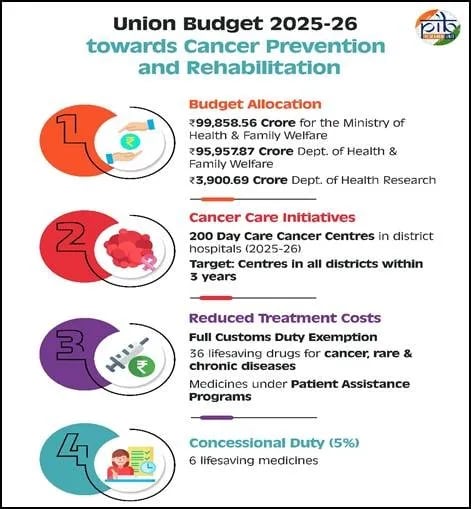 – National Programme for Prevention and Control of Cancer, Diabetes, Cardiovascular Diseases and Stroke (NPCDCS) – The NPCDCS is a flagship initiative under the National Health Mission (NHM) focused on controlling non-communicable diseases (NCDs), including cancer. – Launched in 2018, Ayushman Bharat provides universal health coverage for vulnerable populations, including cancer care. 1. It covers chemotherapy, radiotherapy, and surgical oncology, ensuring treatment within 30 days. – In April 2024, India achieved a historic milestone in cancer care with the launch of NexCAR19, the nation’s first indigenously developed CAR-T cell therapy, created through a groundbreaking collaboration between IIT Bombay, Tata Memorial Centre, and ImmunoACT. – In Sep 2024, India, in partnership with the US, Australia, and Japan, launched the Quad Cancer Moonshot to eliminate cervical cancer across the Indo-Pacific region. |
Source :IE
Previous article
Freedom of Religion and Right to Privacy Interlinked: Supreme Court
Next article
India-Japan Ties & QUAD
