


Syllabus: GS3/Science and Technology
Context
- The Blockchain India Challenge, launched by the Ministry of Electronics & Information Technology (MeitY) is a national initiative aimed at encouraging visionary Indian startups to pitch & pilot cutting-edge Blockchain-based digital governance solutions.
What is Blockchain?
- Blockchain is a distributed, transparent, secure, and immutable database that functions like a ledger of records or transactions, resistant to tampering and accessible across a network of computers.
- Understanding Types of Blockchain:
- Public Blockchain: In this network, all nodes can access records, verify transactions, perform proof-of-work, and add new blocks.
- Private Blockchain: It is a permissioned blockchain, restricted to selected participants within an organization.
- Consortium Blockchain: In this network, the blockchain is semi-decentralized, governed jointly by multiple organizations for shared data management and validation.
- Hybrid Blockchain: It is a blend of public and private blockchains allowing selective data access.
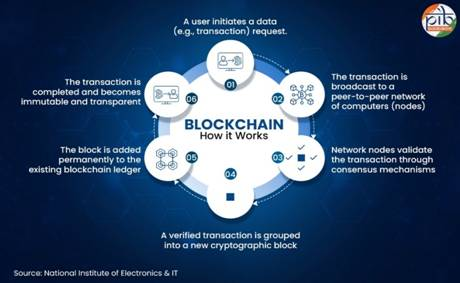
Role of Blockchain in Governance
- Certificates and Document Chain: The chain allows secure issuance, storage, and retrieval of documents such as academic certificates, caste, income, ration cards, driving licenses, and birth or death certificates.
- Logistics Chain: Provides a tamper-proof and transparent platform to track goods across multiple stakeholders.
- Example: Karnataka’s Aushada system tracks medicines from manufacturers to hospitals, verifying quality, expiry, and traceability, reducing the risk of spurious drugs.
- Land Records & Real Estate: Ensures transparency in land and property transactions, allowing verification of ownership and rights, minimizing disputes, and expediting resolution processes.
- Example: States like Telangana and Andhra Pradesh have piloted blockchain-based land registries where every transfer is recorded as a block, making illegal encroaching or title-tampering virtually impossible.
- Judiciary Chain: Blockchain facilitates electronic delivery of notices, summons, and bail orders, reducing delays and eliminating manual dependencies.
- The Inter-operable Criminal Justice System (ICJS) integrates the criminal justice ecosystem, ensuring a unified digital platform for case records, evidence, and judicial documents.
- Public Distribution System (PDS) & Supply Chain: The blockchain would eliminate the diversion of food grains and “leakages” in the subsidy chain.
- Example: By 2026, the World Bank’s FundsChain initiative has demonstrated success in tracking project funds globally. In India, blockchain can track a grain sack from a FCI godown to a ration shop.
- Healthcare Data Integrity: It will eliminate the problem of fragmented patient records and counterfeit medicines.
- Example: Under the Ayushman Bharat Digital Mission, blockchain can allow hospitals to share patient records securely while ensuring patients have absolute control over who views their data.
National Blockchain Framework (NBF)
- Developed by the Ministry of Electronics and Information Technology (MeitY), NBF was launched in 2024 with a budget outlay of ₹64.76 crore.
- NBF is designed to accelerate the development and deployment of permissioned blockchain-based applications, marking a strategic step towards building a secure, transparent, and scalable digital infrastructure for India.
Key Components of NBF
- Vishvasya Blockchain Stack: It is an indigenous and modular platform designed to provide the technical foundation for building and deploying blockchain-based applications for governance. The features of Vishvasya Blockchain Stack are:
- Distributed Infrastructure: The stack is deployed across NIC data centres located in Bhubaneswar, Pune, and Hyderabad, ensuring fault tolerance, scalability, and resilience for blockchain-based applications.
- Permissioned Blockchain Layer: The platform is built on a permissioned blockchain, ensuring that only verified and authorized participants can join or validate transactions.
- Open APIs and Integration Services: Vishvasya provides open APIs (Application Programming Interfaces) and integration modules for authentication and data exchange.
- NBFLite – Blockchain Sandbox for Startups and Academia: A sandbox environment for startups, academia, and research institutions to prototype blockchain applications in governance.
- Praamaanik: It is an innovative solution that leverages blockchain technology to verify the authenticity and source of mobile applications.
Initiatives for Blockchain Adoption in India
- The Centre of Excellence in Blockchain Technology (NIC) provides consultancy, training, and support for pilot projects, using platforms such as Hyperledger Fabric, Hyperledger Sawtooth, and Ethereum.
- RBI is leveraging blockchain for the Digital Rupee, enabling traceable, secure, and inclusive digital payments.
- Telecom Regulatory Authority of India (TRAI) has integrated blockchain-based Distributed Ledger Technology (DLT) to track SMS transmissions for regulatory compliance and consumer protection.
- The National Securities Depository Limited (NSDL) has introduced a Distributed Ledger Technology (DLT) based blockchain platform for Debenture Covenant Monitoring, marking a major step in modernizing India’s capital markets.
Source: TH
