


BRICS-MENA Envoys Express Concern Over War in West Asia
Syllabus: GS2/IR
Context
- Deputy Foreign Ministers and Special Envoys of the BRICS grouping and MENA (Middle East and North Africa) expressed “deep concern” about the U.S.-Israel war against Iran.
About BRICS
- BRICS is an acronym that refers to a group of five major emergingnational economies:Brazil, Russia, India, China, and South Africa.
- Egypt, Ethiopia, Iran, Indonesia, Saudi Arabia, and the United Arab Emirates have joined BRICS as new full members .
- BRICS represents around 41% of the global population, around 24% of the global GDP and around 16% of global trade.
- Origin: As a formal grouping, BRIC started after the meeting of the Leaders of Russia, India and China in St. Petersburg on the margins of the G8 Outreach Summit in 2006.
- The term was originally coined by economist Jim O’Neill in 2001.
- The grouping was formalized during the 1st meeting of BRIC Foreign Ministers on the margins of UNGA in New York in 2006.
- Initially, the grouping was termed BRIC as South Africa was inducted in 2010 and from there on it has been referred to as BRICS.
- BRICS countries have come together to deliberate on important issues under the three pillars of:
- political and security,
- economic and financial and
- cultural and people-to-people exchanges.
- Summits: The governments of the BRICS states have met annually at formal summits since 2009.
- Decision Making: All decisions are taken by BRICS member states in full consultation and consensus.
- New Development Bank: Formerly referred to as the BRICS Development Bank, is a multilateral development bank established by the BRICS states.
- The Bank shall support public or private projects through loans, guarantees, equity participation and other financial instruments.
MENA
- MENA stands for the Middle East and Northern Africa, referring to the countries between Iran in the East and Tunisia and Morocco in the West.
- It is pivotal due to its vast oil and natural gas reserves, holding more than half of the world’s oil reserves and two-fifths of its natural gas reserves.
- This makes MENA a crucial player in the energy markets and offers significant investment opportunities, particularly in the oil and natural gas sectors.
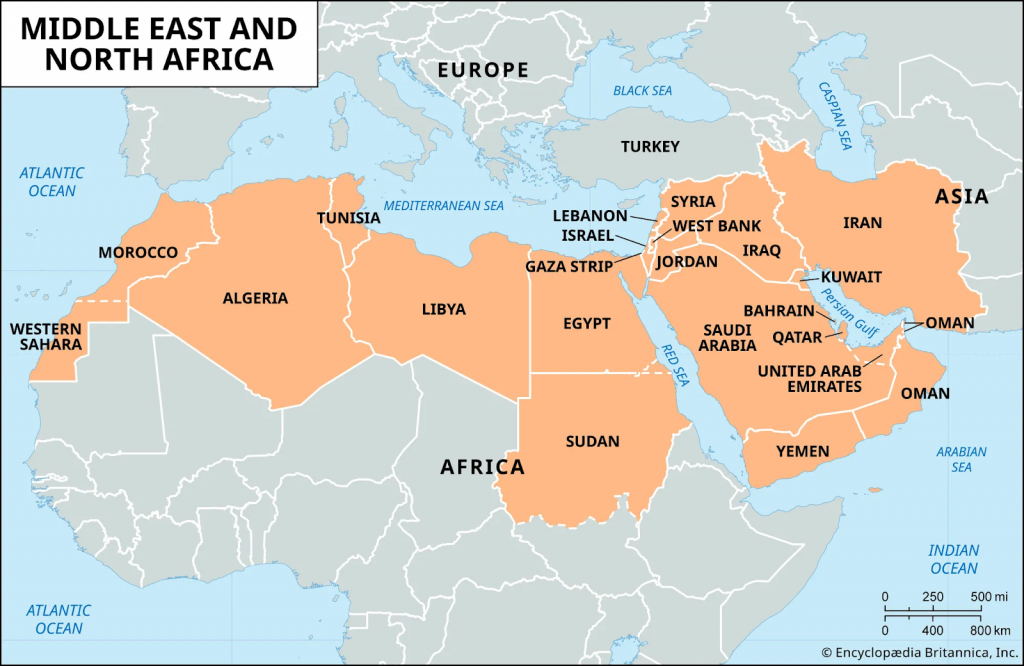
Source: TH
SAARC Currency Swap Framework
Syllabus: GS2/IR
Context
- India has approved the first withdrawal of 30 billion rupees for the Maldives under the SAARC Currency Swap Framework, reinforcing its ongoing financial support to the island nation.
SAARC Currency Swap Framework
- It is a recognised bilateral swap arrangement in the Global Financial Safety Net.
- It aims to further strengthen India’s ties with SAARC Countries and promote regional integration and inter-dependence.
- The Framework is in place since 2012 to provide SAARC countries a line of funding for short-term foreign exchange requirements.
SAARC
- The South Asian Association for Regional Cooperation (SAARC) was established with the signing of the SAARC Charter in Dhaka in 1985.
- SAARC comprises eight Member States: Afghanistan, Bangladesh, Bhutan, India, Maldives, Nepal, Pakistan and Sri Lanka.
- The objectives of the Association as outlined in the SAARC Charter are:
- to accelerate economic growth, social progress and cultural development in the region;
- to promote and strengthen collective self-reliance among the countries of South Asia;
- to promote active collaboration and mutual assistance in the economic, social, cultural, technical and scientific fields;
- to strengthen cooperation with other developing countries;
Source: AIR
RBI Cancelled Paytm Payments Bank’s Banking Licence
Syllabus:GS3/Economy
In News
- The Reserve Bank of India (RBI) has cancelled the banking licence of Paytm Payments Bank Limited, effectively barring it from carrying out any banking operations with immediate effect.
Payments Bank
- It is a specialized bank licensed by the RBI to offer basic banking services such as deposits, payments, and remittances, but without issuing credit cards or offering loans.
- Reserve Bank of India (RBI) issued guidelines for licensing of small finance banks and payments banks on November 27, 2014 .
- Key Features
- It Offers savings and current accounts and Facilitates bill payments and fund transfers
- It can accept deposits only up to Rs two lakh per customer and are not allowed to offer loans or credit cards.
- It Provides debit cards and mobile banking.
Source :Air
Project DANTAK
Syllabus:GS2/IR/GS3/Economy
In News
- Project DANTAK celebrated its Raising Day marking 65 years of its continuous service in Bhutan since 1961.
Project DANTAK
- Project DANTAK was established on 24 April 1961 through the vision of His Majesty the Third King of Bhutan and then Indian Prime Minister Jawaharlal Nehru to improve Bhutan’s connectivity and support its socio-economic development.
- It was assigned the task of building the country’s first motorable roads.
- By 1968, it had completed key routes, including the Samdrup Jongkhar–Trashigang road and the Phuentsholing–Thimphu highway.
- It is led by the Border Roads Organisation(BRO).
Progress
- Project DANTAK has been a key driver of Bhutan’s connectivity and socio-economic development, constructing over 1,500 km of roads, including the East–West Highway, and major infrastructure such as highways, airports, bridges, hospitals, schools, and communication networks.
- In recent years, it has focused on modernising infrastructure through road widening and upgrading major routes like Confluence–Haa and the Samdrup Jongkhar–Trashigang highway, improving safety and travel efficiency.
- It has also shown strong disaster response by quickly restoring connectivity after landslides and road damage.
Source :PIB
FTO Ranking
Syllabus:Miscellaneous
In News
- The Ministry of Civil Aviation (MoCA) has released the second phase ranking (April 2026) of the DGCA Approved Flying Training Organizations (FTOs).
FTO Ranking system
- It is compiled by The Directorate General of Civil Aviation (DGCA) under the Ministry of Civil Aviation (MoCA)
- It aims to improve transparency, enhance safety standards, and promote accountability across DGCA-approved flying training institutes.
- The first phase of the ranking framework was published in October 2025.
Objectives
- The ranking system aims to help aspiring pilots and their families make informed choices by increasing transparency in pilot training and making a flying career more attractive to youth.
Latest Ranking
- The latest rankings show overall progress, with Avyanna Aviation Pvt. Ltd. achieving the top Category ‘A’ for the first time, while more institutes have moved into Category ‘B’ and fewer remain in Category ‘C’, indicating improving standards.
Impacts of FTO ranking system
- India’s aviation training sector has improved significantly, with training flying hours increasing from 32% to 50%, expansion of aircraft fleets at flying training schools, and greater efficiency that has reduced the time needed for cadets to complete Commercial Pilot Licence requirements.
- The system has also helped aspiring pilots make informed choices using objective performance data and has strengthened pilot training infrastructure in line with India’s goal of becoming a global aviation hub.
Source :PIB
Previous article
Industry Body Flags Concern Over Proposed Pesticides Bill
Next article
Virli Khandar Excavation
