


Lokmanya Bal Gangadhar Tilak
Syllabus: GS1/Modern History
Context
- Prime Minister Narendra Modi paid tributes to Lokmanya Bal Gangadhar Tilak on his birth anniversary.
Early Life
- Born on 23 July 1856 in Ratnagiri, Maharashtra, Bal Gangadhar Tilak was a freedom fighter, social thinker, philosopher, teacher and one of the earliest and strongest advocates of Swaraj (self-rule).
- He organised two important public festivals, Ganeshotsav (1893) and Shiv Jayanti (1895), to promote national consciousness and political mobilisation.
Political career
- In 1890, Tilak joined the Indian National Congress.
- Tilak opposed the moderate views of Gopal Krishna Gokhale, and was supported by fellow Indian nationalists Bipin Chandra Pal in Bengal and Lala Lajpat Rai in Punjab. They were referred to as the “Lal-Bal-Pal”.
- The trio also mobilized Indians against the Bengal partition and proposed the Swadeshi movement and boycott of foreign goods.
- In 1908, Tilak was arrested on charges of sedition and sentenced to six years’ imprisonment in Mandalay (Burma).
- In 1916, he founded the Home Rule League at Belagavi to promote political awareness and mobilise support for self-rule. In the same year, he concluded the Lucknow Pact with Mohammed Ali Jinnah, which sought to promote Hindu-Muslim unity in the nationalist movement.
- He was conferred with the title of “Lokmanya”, which means “accepted by the people (as their leader)” and Mahatma Gandhi called him “The Maker of Modern India”.
Literary Work
- He launched two weeklies, Kesari (in Marathi) and Mahratta (in English), which criticized British policies of the time.
- His notable works include:
- The Orion or Researches into the Antiquity of the Vedas (1893)
- The Arctic Home in the Vedas (1903).
- In the Mandalay jail, he wrote the Srimad Bhagavadgita Rahasya (Secret of the Bhagavadgita), an original exposition of the most sacred book of the Hindus.
Source: PIB
Chandra Shekhar Azad
Syllabus: GS1/Modern History
Context
- Prime Minister Narendra Modi paid homage to Chandra Shekhar Azad on his birth anniversary.
Chandra Shekhar Azad
- Born on 23 July 1906 in present-day Madhya Pradesh, Chandra Shekhar Azad grew up in poverty and joined the freedom struggle as a teenager during the Non-Cooperation Movement.
- He was Arrested for protest activities, he famously declared his name as “Azad” and vowed never to be captured alive.
Role in Freedom struggle
- He joined the Hindustan Republican Army (HRA), later transforming it with Bhagat Singh into the more radical Hindustan Socialist Republican Association (HSRA).
- He was involved in the 1925 Kakori Train robbery, an attempt to blow up the India Viceroy’s train, and the shooting of British police officer JP Saunders in 1928 to avenge the killing of the great freedom fighter, Lala Lajpat Rai.
- After the Central Assembly bombing in 1929 and the subsequent British crackdown, Azad remained underground, trying to free Bhagat Singh.
Death and Legacy
- On February 27, 1931, surrounded by police in Allahabad’s Alfred Park, he helped a comrade escape, killed three policemen, and, with only one bullet left, shot himself to avoid capture.
- He died at just 24, staying true to his name and vow — Azad (free) until the end.
- His role in India’s quest for freedom is deeply valued and motivates our youth to stand up for what is just, with courage and conviction.
Source: AIR
U.S. Announces Civilian Nuclear Agreement with Saudi Arabia
Syllabus: GS2/IR
Context
- USA and Saudi Arabia had signed a peaceful nuclear cooperation agreement — commonly known as a 123 agreement.
About
- This agreement is named after Section 123 of the US Atomic Energy Act of 1954.
- It is a legally binding agreement that the USA requires before engaging in significant nuclear cooperation with another country.
- These agreements facilitate the transfer of nuclear materials, equipment and technology for peaceful purposes, while ensuring compliance with international nonproliferation standards.
- They also provide a framework for technical exchanges, scientific research, and safeguards discussions.
- India’s 123 Agreement with USA: It also known as the U.S.-India Civil Nuclear Agreement aims to facilitate civilian nuclear cooperation between the two countries.
- Key Features:
- Nuclear Trade: It allows the U.S. to supply India with nuclear fuel, technology, and reactors for civilian energy purposes.
- Non-Proliferation Commitment: India, in exchange, agrees to separate its civilian and military nuclear programs and place its civilian reactors under International Atomic Energy Agency (IAEA) safeguards.
- No Restrictions on Military Programs: Unlike the Nuclear Non-Proliferation Treaty (NPT), the agreement does not require India to forgo nuclear weapons development, as India is not a signatory to the NPT.
- Energy and Economic Cooperation: The agreement aims to enhance energy security, support India’s growing energy demands, and promote economic cooperation between the two nations.
Source: IE
Rome Declaration for an Unarmed and Disarming Peace
Syllabus: GS2/IR, GS3/ Internal Security
Context
- A group of Nobel laureates, AI scientists, religious leaders, and global experts signed the Rome Declaration for an Unarmed and Disarming Peace.
What is the Rome Declaration for an Unarmed and Disarming Peace?
- It is a global ethical declaration calling for human control over nuclear weapons in the age of Artificial Intelligence.
- It warns against delegating life-and-death decisions, especially nuclear launch decisions, to autonomous AI systems.
- The Declaration was inspired by Pope Leo XIV’s encyclical Magnifica Humanitas, which emphasizes protecting human dignity from technological overreach.
- Although non-binding, it seeks to build global consensus for an international treaty governing AI in military applications.
- Principles of the Declaration:
- Disarming the next arms race
- Responsible development
- Responsible use of AI
- Responsible governance
- Responsible leadership, and
- Nuclear disarmament.
Five Ethical and Operational Principles
- Mandatory meaningful human control: Absolutely prohibiting any automated, algorithmic or AI-driven system from making the final decision regarding the use or deployment of nuclear weapons.
- The digital commons model: Those who do not have access or control over technologies such as AI are likely to be affected more by its unintended consequences.
- Responsible development: A mandate for the developers of AI to publish the ethical frameworks guiding their models and explicitly forbidding the pursuit of fully autonomous and self-improving systems that cannot be monitored, audited or abruptly halted by human operators.
- Internal arsenal vulnerability audits: An urgent request to the world’s nuclear states to conduct rigorous internal reviews to protect existing atomic command-and-control systems from AI-driven cyber-tampering or unauthorised algorithmic interference.
- Time-bound, verifiable disarmament: A renewal of good-faith international negotiations in pursuit of completely, irreversibly, and verifiably eliminating nuclear weapons.
Source: TH
Mission Golden Spice
Syllabus: GS3/Economy
In News
- The Union Minister for the Development of the North Eastern Region launched the Lakadong Turmeric Mission Golden Spice.
Do you know?
- Lakadong turmeric is grown in Meghalaya’s West Jaintia hills.
- It is globally acclaimed for its exceptional quality, making it one of India’s most distinctive agricultural treasures.
- It contains 7–10 per cent curcumin, nearly four times the global average, making it one of the world’s finest turmeric varieties with significant nutraceutical and export potential.
Mission Golden Spice
- It is a project under the Ministry’s Unlock the Economic Potential of India’s Northeast (USP) initiative and is worth over 175 crore rupees.
- It is designed as a five-year roadmap to be implemented in two phases starting from 2025 till 2030.
- Phase One is Value Chain Strengthening, followed by Phase Two, which is Expansion and Scale-up, for promotion of Meghalaya’s Unique Selling Proposition (USP), the GI-tagged Lakadong Turmeric.
- It is built on years of institutional groundwork laid by the state government, officials and farmers.
Source: Air
Borophene-Based Green Lubricant
Syllabus: GS3/ Science and Technology
Context
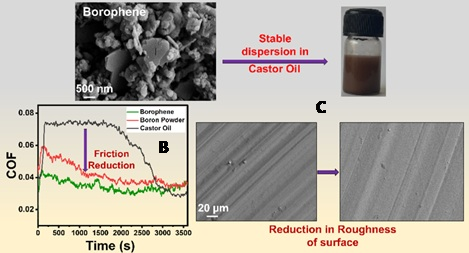
- Scientists have developed a borophene bio-lubricant that can reduce friction and wear in machines, a breakthrough that could lead to enhanced energy efficiency.
About
- Researchers used borophene as an additive in castor oil which is a biodegradable and renewable lubricant. Adding only 0.1% of borophene to castor oil reduced friction by about 42% compared to pure oil.
- In operation, borophene forms a tribofilm (a layer formed due to friction) on contact surfaces.
- This layer reduces shear stress, minimizes friction and wear, and protects machinery surfaces from damage.
What is Borophene?
- Borophene is a two-dimensional (2D) nanomaterial formed by a single layer of boron atoms.
- It is viewed as the boron counterpart of graphene, yet it exhibits different electrical and mechanical properties.
- It is lightweight, highly conductive, mechanically strong, and chemically active.
Source: PIB
Kutki
Syllabus: GS3/Environment
Context
- Himachal farmers have pioneered the sustainable cultivation of endangered Himalayan herb ‘Kutki’.
About
- Picrorhiza kurroa, locally known as Kutki is a herb used in medicinal formulations.
- It is the high-value medicinal herb native to the alpine and sub-alpine regions (2,700-4,500 metres) of the Himalayas.
- It is reported to be an ingredient in more than 2,000 herbal formulations.
- Conservation Status: Kutki is currently categorised as an Endangered species on the IUCN Red List.
- Recognising the threat posed by international trade, it was included in Appendix II of the Convention on International Trade in Endangered Species of Wild Fauna and Flora (CITES).
- This listing permits international trade only under regulated conditions and requires export permits.
- A sustainable cultivation model adopted by farmers in Himachal Pradesh’s Mandi district is showing promising signs of conserving the species while boosting the rural mountain economy.
Source: TH
