


Prepaid Payment Instruments (PPIs)
Syllabus: GS3/Economy
In News
- The RBI has released a draft framework to expand and restructure prepaid payment instruments (PPIs), while tightening rules around their use and issuance.
Prepaid payment instruments (PPIs)
- PPIs are digital wallets that allow users to load money in advance and use it to make payments.
- PPIs are currently divided into two categories:
- Full-KYC wallets, which require strict identity verification
- Small wallets, which have simpler onboarding rules.
Latest proposals
- RBI proposes introducing special-purpose prepaid wallets for specific needs such as public transport, gifting, and use by foreign nationals or NRIs in India.
- At the same time, it explicitly bans cross-border use of PPIs, keeping them limited to domestic transactions.
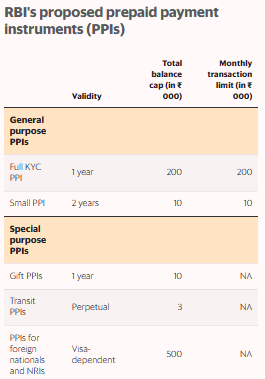
- It also introduces a broader classification: general-purpose PPIs and special-purpose PPIs (gift, transit, and foreign nationals/NRIs).
Key proposed limits and features include:
- Full-KYC PPIs: Valid for 1 year, with ₹2 lakh balance and monthly transaction limits; P2P transfers capped at ₹25,000/month; cash loading limited to ₹10,000.
- Small PPIs: Valid for 2 years, capped at ₹10,000 balance and monthly usage, restricted to goods and services only.
- Gift PPIs: Non-reloadable, max ₹10,000 value, 1-year validity, no cash purchase allowed.
- Transit PPIs: No KYC required, ₹3,000 limit, perpetual validity, but no withdrawal, refund, or transfer facility.
- Foreign national/NRIs PPIs: Up to ₹5 lakh limit, used via UPI One World for merchant payments in India, must be closed when visa expires.
- Regulation related : Only banks and RBI-approved non-banks can issue PPIs.
- Non-bank issuers must meet net worth requirements starting at ₹5 crore, rising to ₹15 crore within three years.
- PPIs cannot pay interest, and must follow strict KYC and operational rules.
- Consumer protection measures: It includes mandatory refunds for failed transactions, clear disclosures of terms and charges, grievance redressal systems, and automatic closure of inactive wallets after one year of inactivity (with prior user notification).
Source :LM
Evaporative Demand
Syllabus: GS3/Environment
In News
- A recent study reveals that roughly 30% of global land surface was under drought by end-2025, nearly triple the ~10% recorded in the 1990s, and signals a fundamental structural shift in how droughts form and intensify.
About
- The old drought pattern was driven primarily by precipitation deficit and emerging drought pattern driven by evaporative demand.
- Evaporative demand refers to the atmosphere’s ability to draw water from the Earth’s surface through evaporation and plant transpiration.
- It is influenced by factors like temperature, wind speed, humidity, and cloud cover, and when it is high, it can intensify drought conditions and increase wildfire risk.
Key Concepts
- Evapotranspiration (ET): The combined water loss from soil evaporation and plant transpiration. Potential evapotranspiration (PET) is the atmosphere’s theoretical demand for water under given temperature conditions — it rises sharply with warming.
- Snow Drought: A condition where reduced snowpack — rather than rainfall deficit — drives downstream water shortage. Particularly critical for glacially-fed river systems.
- Day Zero: The point at which a city’s municipal water supply system effectively fails — made globally prominent by Cape Town’s near-crisis in 2018.
- Compound Drought-Heat Events: Simultaneous or sequential occurrence of drought and extreme heat — mutually reinforcing, with heat amplifying evaporative demand and drought intensifying surface heating.
- La Niña: A periodic cooling of central and eastern Pacific Ocean surface temperatures — historically associated with increased rainfall in some drought-affected regions. Its failure to reverse drought trends in 2025 underscores the dominance of anthropogenic warming over natural variability.
Source: DTE
Govt pushes E100 fuel, flex-fuel vehicles
Syllabus: GS3/Environment
Context
- The government is considering E100 fuel blending and a transition to flex-fuel vehicles to reduce India’s dependence on imported crude.
About
- The steps come amid a growing energy crisis triggered by the war in West Asia, which has choked supplies of crude oil and gas.
- The government has allowed blends of sustainable aviation fuel (SAF), produced from used cooking oil or ethanol.
- The notification legally defines aviation turbine fuel (ATF) both as a complex mixture of hydrocarbons and as synthesised hydrocarbons blended with cooking oil or ethanol, creating a legal basis for SAF.
What is E100?
- E100 refers to fuel with 100% ethanol content or near-100%, since small quantities of water improve combustion.
- Flex-fuel vehicles are designed to run on any mixture of ethanol and petrol, from pure petrol to E100, with onboard sensors adjusting engine parameters accordingly.
- Brazil has operated the world’s most mature flex-fuel programme since 2003, where sugarcane-derived ethanol powers a large share of the vehicle fleet.
Source: HT
Pathogen Access and Benefit-Sharing (PABS) Annex.
Syllabus: GS2/Health
Context
- The historic WHO Pandemic Agreement (WPA), adopted in 2025, still lacks the much-needed Pathogen Access and Benefit-Sharing (PABS) Annex.
About
- PABS seeks to legally link sample-sharing to guaranteed benefits, making it mandatory for pharmaceutical manufacturers to provide 20% of real-time vaccines, therapeutics and diagnostics (VTD) production to the WHO during declared pandemics.
- PABS is backed by around 100 LMICs, including India, which represent nearly 80% of the world’s population, however, opposition comes from developed countries, which are home to some of the world’s largest pharmaceutical companies.
- Low- and middle-income countries (LMICs) in Africa, Southeast Asia and Latin America, where new pathogens often emerge, are expected to proactively share biological materials and genomic data through WHO.
- However, countries that develop life-critical VTDs using that material are under no obligation to reciprocate with fair and timely access to these clinical products.
- Without a binding legal framework to enforce fair sharing from samples to solutions, a coordinated global response to cross-border health crises will remain fraught with challenges.
The WHO Pandemic Agreement
- It was adopted by the World Health Assembly in 2025.
- The aim is to negotiate a WHO convention on pandemic prevention, preparedness and response, that would culminate in a legally binding international instrument.
- Following its adoption, the next crucial step is for an Intergovernmental Working Group (IGWG) on the Pandemic Agreement to negotiate the details of the Pathogen Access and Benefit-Sharing (PABS) system.
- The Agreement will officially enter into force 30 days after 60 countries have ratified it.
Source: TH
Previous article
India Welcomes Japan Easing Defence Export Curbs
Next article
Inner Party Democracy
