


Syllabus: GS2/ Governance
Context
- PM Modi emphasised practical skills over formal degrees and highlighted the role of Industrial Training Institutes (ITIs) in strengthening India’s skilled workforce.
Role of Skill Development
- Harnessing the Demographic Dividend: India has over 54% of its population below 25 years of age, and more than 62% belongs to the working-age group (15–59 years).
- Focused skilling is therefore essential to harness this opportunity and build a future-ready workforce.
- Meeting Global Talent Demand: India is expected to generate a surplus of 45 million skilled professionals by 2030, while global labour shortages are projected to reach 85 million at the same time.
- Hence, building a life-cycle approach to skill development is essential.
- Driving Economic Growth: Skills and knowledge remain fundamental drivers of economic growth and social development.
Industrial Training Institutes (ITIs)
- ITIs are vocational training institutions that impart technical and practical training to students in various engineering and non-engineering trades.
- Nodal Ministry: Ministry of Skill Development and Entrepreneurship (MSDE).
- Implementing agency: Directorate General of Training (DGT).
- Objective: To develop a skilled workforce for industries by providing trade-specific training and improving employability.
- Major training programmes:
- Craftsmen Training Scheme (CTS) provides long-term vocational training through ITIs in various trades.
- Craft Instructor Training Scheme (CITS) develops qualified instructors for vocational training institutions.
- Flexi-MoU Scheme enables industry-linked training through partnerships between industries and training institutions.
Initiatives to Strengthen Skill Development
- Skill India Mission, 2015, aims to provide skill, reskill and upskill training to young people through various programmes.
- Pradhan Mantri Kaushal Vikas Yojana (PMKVY) provides short-term skill training and upskilling/re-skilling through Recognition of Prior Learning (RPL) to youth nationwide, including rural areas.
- National Apprenticeship Promotion Scheme (NAPS) promotes apprenticeship training by providing financial support to establishments engaging apprentices.
- Jan Shikshan Sansthan (JSS) provides vocational training, particularly to non-literates, neo-literates and school dropouts, with a focus on disadvantaged groups.
- National Education Policy (NEP), 2020 emphasises vocational education, integration of skills into mainstream education and reducing the separation between academic and vocational streams.
- Pradhan Mantri Skilling and Employability Transformation through Upgraded ITIs (PM-SETU) aims to modernise ITIs through industry partnerships, improved infrastructure, updated curricula and industry-relevant training.
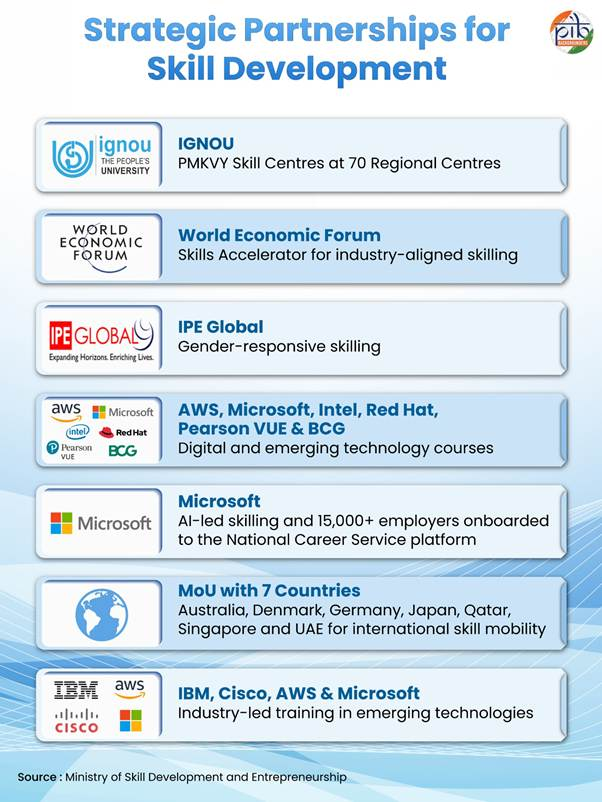
Challenges in India’s Skill Development Ecosystem
- Skill mismatch: Training programmes often do not adequately reflect the changing skill requirements of industries.
- Outdated infrastructure: Several ITIs continue to face shortages of modern machinery, laboratories and training facilities.
- Inadequate industry participation: Limited collaboration between training institutions and employers affects practical exposure and placement opportunities.
- Social stigma: Vocational education is often considered inferior to conventional university education, discouraging students from pursuing technical trades.
- Uneven access: Rural areas and economically weaker sections face barriers in accessing quality vocational training.
Way Ahead
- Periodically review ITI courses in conjunction with industries so that trainings are in line with developing technology and market needs.
- Strengthen women’s access to ITIs by providing safe infrastructure, flexible training arrangements and increasing their involvement in growing technical trades.
- Increase the mobility and recognition of vocational certifications via alignment with National Skills Qualifications Framework (NSQF).
Concluding remarks
- India’s demographic dividend can become a development advantage only when its young population is equipped with relevant skills and productive employment opportunities.
- Strengthening ITIs and recognising the dignity of vocational work are essential for building a skilled workforce, supporting industrial growth and achieving the vision of Viksit Bharat 2047.
National Skill Development Corporation (NSDC)
- NSDC was established in 2008, as a not-for-profit public limited company under section 25 of the Companies Act, 1956 (now section 8 of the Companies Act, 2013).
- It is a Public Private Partnership (PPP) enterprise working under the Ministry of Skill Development & Entrepreneurship (MSDE), Government of India.
- NSDC aims to promote skill development by catalyzing creation of large, quality and for-profit vocational institutions.
Source: TH
Previous article
News In Brief 21-11-2026
Next article
Inclusion Errors in the Public Distribution System
