


Syllabus: GS2/Education; GS3/Economy
Context
- India’s higher education enrolment grew from 3.42 crore (2014-15) to 4.46 crore (2022-23), yet nearly one in three graduates remains unemployed, raising a fundamental question about whether India is producing more graduates than its economy can productively absorb.
About
- Over the past decade, thousands of new colleges and universities have been established, producing millions of graduates every year.
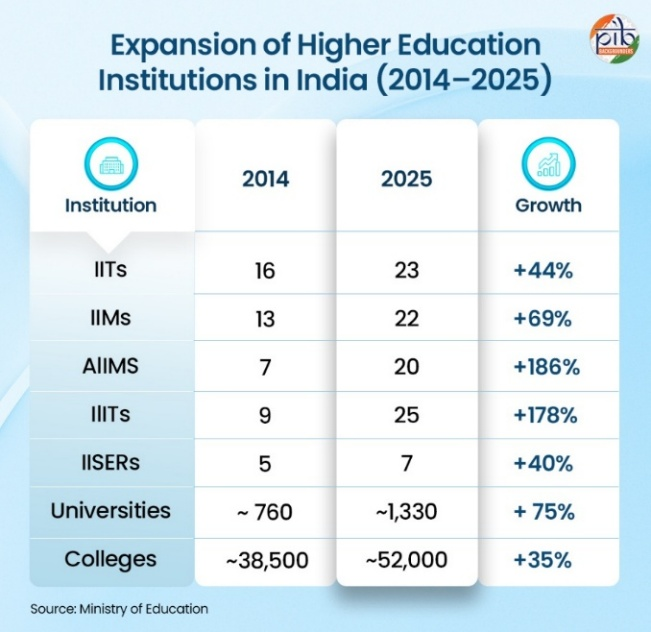
- Total enrolment in higher education has grown from 3.42 crore in 2014-15 to 4.46 crore in 2022-23.
Challenges Faced by Higher Education Graduates
- Gaps in Job Creation: In engineering alone, the number of graduates has risen sharply over the past few years while job creation has not kept pace.
- Slowed Hiring of IT Sector: Earlier, the IT services sector was the principal employer of engineering graduates.
- Today, hiring by IT services firms has slowed considerably and new opportunities have not grown fast enough to absorb the increasing number of graduates entering the labour market.
- Capital-Intensive Investment: Recent investments in semiconductors, advanced manufacturing, and technology are capital-intensive rather than labour-intensive; large investment announcements do not proportionately translate into graduate job creation (Economic Survey 2024-25).
- Introduction of AI: Companies require graduates who can work with AI systems, validate AI-generated outputs, and solve complex problems using technology.
- Universities cannot redesign programmes overnight, and students cannot acquire entirely new competencies instantly.
- Automation in Manufacturing: Manufacturing is also being transformed by automation, robotics, and Industry 4.0 systems.
- Historically, a large number of engineers were employed in supervisory and operational roles on factory floors, many of those functions are automated.
- As a result, the number of engineering jobs generated by manufacturing is not increasing at the pace expected.
Government Initiatives
- The National Youth Policy (NYP) 2014 defined youth as individuals aged 15–29 years and identified key areas such as education, employment, skill development, health, sports, social participation, and empowerment.
- The recently proposed National Youth Policy 2025 framework further underscores emerging priorities such as future-ready skills, entrepreneurship, leadership, civic engagement, digital participation, and sustainable development.
- The National Education Policy 2020 (NEP 2020) promotes experiential and multidisciplinary learning.
- The National Credit Framework (NCrF), adopted by 170 universities, allows students to accumulate credits across academic, skill-based, and experiential learning.
- The Automated Permanent Academic Account Registry (APAAR ID) accumulates academic and skill credits earned throughout a student’s learning journey.
- SWAYAM offers over 18,580 courses, recording more than 6.1 crore enrolments and 53.7 lakh certifications.
- SWAYAM PRABHA, PM e-VIDYA, and DIKSHA have further widened learning access through television, radio, digital content, and e-resources.
- The Atal Innovation Mission has established over 10,000 Atal Tinkering Labs, supporting the development of over 16 lakh projects in emerging technologies.
- National Apprenticeship Promotion Scheme (NAPS): Launched in 2016, the scheme is currently being implemented in its second phase, NAPS 2.0.
- The programme promotes apprenticeship training by providing partial stipend support to apprentices.
- Apprenticeship remains a key pillar for “earn while you learn” and industry-centric skill development.
- Industrial Training Institutes (ITIs): ITIs are the backbone of long-term vocational education in India and provide a steady flow of skilled personnel to the industry.
- Over the past 12 years, the Government ensured this network underwent a massive expansion and modernisation.
- SOAR (Skilling for AI Readiness): Launched in 2025, SOAR introduces Artificial Intelligence awareness and foundational AI skills to school students from Classes 6 to 12.
- It also equips educators to integrate AI concepts into learning. The programme offers three 15-hour modules for students.
- Prime Minister Internship Scheme (PMIS) 2024: It is a flagship transformative initiative to bridge the gap between academic learning and industry requirements.
- This initiative aims to provide structured, paid internship opportunities to youth across the country.
- Skill India Digital Hub (SIDH) 2023: It serves as a unified Digital Public Infrastructure platform for skilling, employment, apprenticeship, and entrepreneurship.
- It integrates learners, training providers, employers, and Government programmes on a single digital platform.
Way Ahead
- India must significantly increase investment in research and development.
- Industry and academia must work together much more closely.
- India needs a stronger entrepreneurship ecosystem that encourages innovation and supports risk-taking.
- India must continue building indigenous capabilities in design, engineering and advanced manufacturing.
- The opportunities are real, particularly in sectors such as defence and aerospace.
- The challenge is ensuring that education, industry and policy move in the same direction.
Source: TH
Previous article
India’s Regulatory Oversight of the Pharmaceutical Sector
