


Syllabus: GS1/Geography
Context
- Recently, the India Meteorological Department (IMD) announced that the Southwest Monsoon is expected to reach Kerala earlier than the normal onset date of June 1.
Monsoon in India
- The term ‘monsoon’ refers to the seasonal reversal of winds caused by differential heating and cooling of land and sea.
- In India, monsoon rainfall is the backbone of the economy and climate system.
- India experiences two major monsoon systems:
- Southwest Monsoon (June–September): Main rainy season contributing nearly 75% of annual rainfall.
- Northeast Monsoon (October–December): Important mainly for Tamil Nadu and southeast India.
- The Southwest Monsoon is critical for agriculture, reservoirs, hydropower generation, and rural livelihoods.
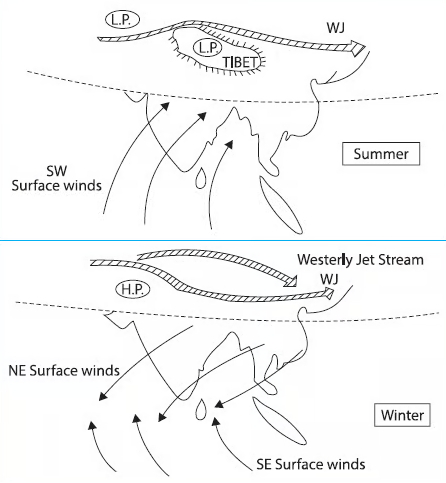
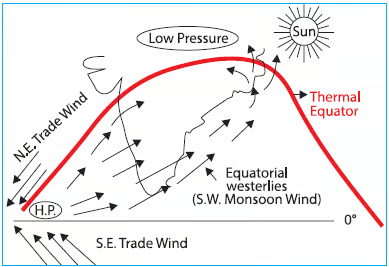
Formation of the Southwest Monsoon
- Differential Heating: The Indian landmass heats faster than surrounding oceans, creating a low-pressure area over northwest India during summer.
- Shift of ITCZ: The Inter-Tropical Convergence Zone (ITCZ) shifts northward, attracting moisture-laden winds from the Indian Ocean.
- Cross-Equatorial Winds: Southeast trade winds cross the Equator and get deflected due to the Coriolis force, becoming southwesterly winds.
- Role of Jet Streams and Tibetan Plateau: The heating of the Tibetan Plateau and changes in subtropical jet streams strengthen monsoon circulation.
Branches of the Southwest Monsoon
- Arabian Sea Branch: It strikes the Western Ghats first, and causes heavy rainfall along the west coast. It advances towards central and northern India.
- Bay of Bengal Branch: It moves towards northeast India and the Indo-Gangetic plains. It is deflected by the Himalayas westward across northern India.
El Niño and Its Impact on Indian Monsoon
- El Niño refers to the abnormal warming of sea surface temperatures in the Equatorial Pacific Ocean.
- It weakens monsoon circulation and often leads to below-normal rainfall in India.
- According to NOAA, 82% chance of El Niño developing during May–July.
- IMD predicted seasonal rainfall at 92% of the Long Period Average (LPA), indicating below-normal rainfall.
- A strong or ‘super’ El Niño could reduce agricultural productivity, trigger drought-like conditions, affect groundwater and reservoirs, and increase food inflation and rural distress.
- Regions like the Indo-Gangetic Plain are particularly vulnerable due to long-term drying trends.
Importance of the Indian Monsoon
- Agricultural Significance: Nearly 60% of Indian farmers depend on rainfall for sowing and irrigation.
- Economic Importance: Monsoon influences GDP growth, food production, rural demand, and inflation.
- Water Security: It replenishes rivers, groundwater, and reservoirs.
- Ecological Importance: Supports forests, biodiversity, and hydrological balance.
Previous article
Prime Minister’s Visit to Netherlands
Next article
CBSE Makes Third Language Mandatory For Class IX
