


Latvia
Syllabus: GS1/Places in News
Context
- Latvian Prime Minister Evika Silina announced her resignation after her coalition pulled support from the government.
About Latvia
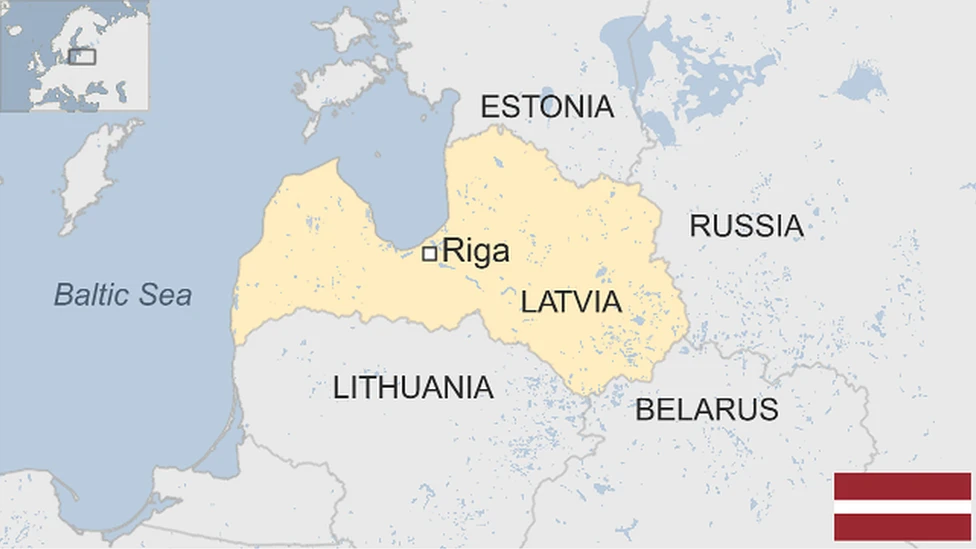
- Latvia is a small country in Northern Europe, one of the three Baltic states (along with Estonia and Lithuania).
- Latvia has borders with Estonia, Russia, Belarus and Lithuania.
- It has linguistic links with Lithuania to the south, and historical and religious ties with Estonia to the north.
- Its capital city Riga is the largest city, known for its beautiful Art Nouveau architecture and historic Old Town (a UNESCO World Heritage site).
- Latvia was admitted to the North Atlantic Treaty Organization (NATO) and the European Union (EU) in 2004.
Source: TH
Bhojshala
Syllabus: GS1/Art and Culture
In News
- The Madhya Pradesh High Court declared the Bhojshala complex in Dhar district a Hindu temple.
Bhojshala Complex
- Raja Bhoja, the greatest ruler of the Paramara dynasty, founded the famous Bhojshala at Dhar around 1000–1055 A.D. as a major center of learning dedicated to Goddess Saraswati.
- Later, the structure was converted into the Kamal Maula Mosque during Muslim rule.
- It served as a premier college and centre of Sanskrit learning. The mosque still contains carved pillars, ceilings, and stone inscriptions from the original Bhojshala.
- Important inscriptions include Sanskrit grammar tables, hymns to Vishnu, praises of Paramara kings, and the Sanskrit drama Karpuramanjari written by Madana during the reign of Arjunavarma Deva.
Source :Air
PM-SHRI Schools Scheme
Syllabus: GS2/Governance
Context
- The government in West Bengal signed an agreement with the Centre to implement the PM-SHRI schools scheme in the state.
Pradhan Mantri Schools for Rising India (PM SHRI) scheme
- Aim: The scheme aims to turn existing government schools into model schools.
- The scheme is for existing elementary, secondary, and senior secondary schools run by the central government and state and local governments around the country.
- Funding: It is a Centrally sponsored scheme with a total project cost of 27,360 crore for the period of five years from 2022-23 to 2026-27 for transforming nearly 14,500 schools across the country.
- It will showcase all components of the National Education Policy 2020, act as exemplary schools and also offer mentorship to other schools in their vicinity.
- A ‘School Quality Assessment Framework’ is being developed to measure the progress and performance of these schools.
Key features of PM SHRI Scheme
- Development of ‘Green schools’: These will be equipped with solar panels, LED lights, nutrition gardens, and waste management, water conservation and harvesting systems.
- Modern facilities: Schools will include ICT (information and communication technologies) facilities, smart classrooms, library, digital library, science labs and vocational labs etc.
- Schools will also get science and math kits and annual school grants for libraries or sports.
- Mother tongue and local languages to be encouraged.
Source: IE
Jaggery Sector in India
Syllabus: GS3/Economy
In News
- Jaggery production in India is a key agro-processing sector that is supporting rural livelihoods, farmer incomes, and value addition through cottage industries.
Jaggery
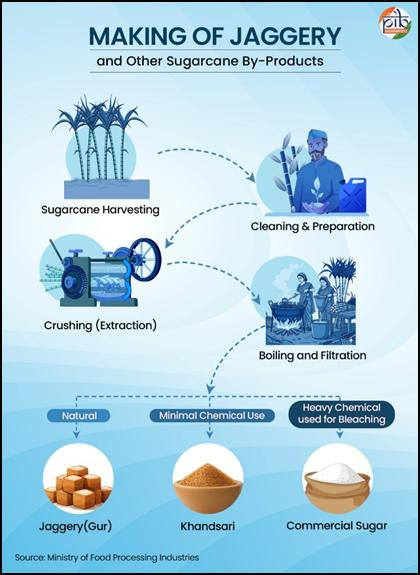
- It is commonly known as gur and is a traditional, unrefined, natural sweetener.
- It is produced by concentrating sugarcane juice without the use of chemicals.
- It is widely consumed across Asia, Africa, Latin America, and the Caribbean under various local names.
Ancient Roots of India’s Jaggery Tradition
- Jaggery is considered an indigenous product of India with origins tracing back to the Vedic period, linked to early sugarcane cultivation around 1400–1000 BCE.
- Sugarcane is believed to have first developed in northeastern India and later spread globally.
- Historical records also mention that in 647 AD, a Chinese mission visited Magadha to study sugarcane processing, showing early international transfer of Indian knowledge.
Jaggery Production in India
- India produces over 70% of the world’s jaggery, making it the largest global producer.
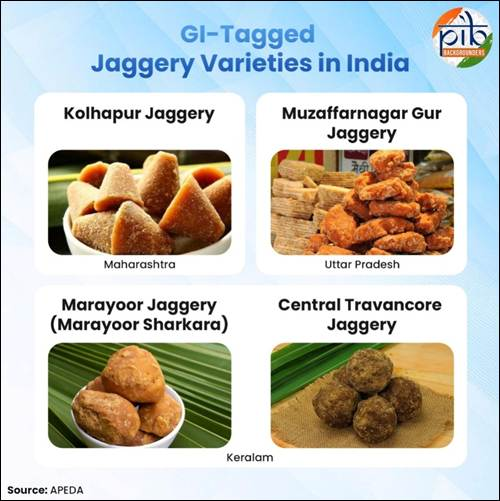
- Uttar Pradesh contributed 48.5 percent of total production, followed by Maharashtra (24.1 percent) and Karnataka (10.5 percent).
Exports destinations
- India is one of the leading exporters of jaggery and confectionery products (including traditional Indian sweets and candies).
- Major export destinations in 2024-25 included Indonesia, the USA, the UAE, Nigeria, and Nepal.
Source :PIB
Saranda Forest
Syllabus: GS3/Environment
In News
- The Jharkhand government has filed a review petition in the Supreme Court against its earlier order directing the state to notify the Saranda elephant forests as a wildlife sanctuary within three months.
- Jharkhand argues that declaring the sanctuary could affect tribal habitations, roads, and infrastructure, requiring further studies.
Saranda Forest
- It is located about 122 km from Jamshedpur in Jharkhand.
- It is the largest Sal forest in Asia and is known as the “land of seven hundred hills.”
- It is part of the Chhotanagpur biogeographic zone and connects with forests in Odisha and Chhattisgarh, creating a continuous wildlife habitat.
- The forest is home to diverse flora and fauna, including endangered flying lizards and large elephant populations, and forms an important migratory elephant corridor.
- Major tree species include Sal, Mahua, and Kusum.
Importance
- Saranda Forest supports the livelihoods of tribal communities including the Ho, Munda, Uraon, and Santhal peoples, who depend heavily on forest produce such as honey, mushrooms, mahua, sal leaves, medicinal plants, firewood, lac, fruits, and bamboo products.
- It holds deep cultural significance for local tribes, whose traditions, rituals, and sacred groves (“Sarna”) are closely tied to the forest ecosystem.
Source :IE
Sovereign Gold Bond (SGB) scheme
Syllabus: GS3/Economy
Context
- The government increased import duties on gold, silver, and platinum has revived debate over whether the discontinued Sovereign Gold Bond (SGB) scheme could have helped ease pressure on India’s foreign exchange reserves.
Sovereign Gold Bond (SGB) scheme
- Sovereign Gold Bonds (SGBs), launched in late 2015, are government securities denominated in grams of gold, issued by the Reserve Bank of India on behalf of the Government of India.
- The scheme allows individuals to invest in gold without purchasing physical gold.
- A holding certificate is issued to investors upon successful subscription, and the bonds can also be held in Demat form.
- SGBs are priced in multiples of one gram of gold, with a minimum investment of one gram.
- Denomination: Investors receive a fixed interest rate of 2.5% per annum, paid semi-annually.
- Returns: Investors also receive returns linked to the prevailing market price of gold at the time of redemption.
- Maturity period: The bonds have a maturity period of eight years, with premature redemption permitted after the fifth year on interest payment dates.
- Capital gains arising on redemption at maturity are exempt from long-term capital gains tax for individual investors.
Source: IE
Ebola Outbreak
Syllabus: GS2/Health
Context
- The World Health Organization (WHO) has declared an international health emergency after an Ebola outbreak in the Democratic Republic of Congo killed over 80 people.
About
- Ebola Virus Disease (EVD) is a zoonotic disease caused by the eponymic Ebola virus that can be severe and often fatal in humans. Ebola was first identified in 1976 in Central Africa.
- The virus initially spreads to humans from infected wild animals such as fruit bats and non-human primates. Human-to-human transmission occurs through direct contact with blood, body fluids, secretions, or contaminated surfaces.
- According to the WHO, three different viruses are known to cause large Ebola disease outbreaks: Ebola virus, Sudan virus and Bundibugyo virus.
- The current outbreak involves the Bundibugyo variant.
- Symptoms of the disease include fever, haemorrhaging and vomiting.
- Licensed vaccines and treatments are available for Ebola Virus Disease (EVD). However, no approved vaccines or therapies currently exist for Sudan Virus Disease (SVD) and Bundibugyo Virus Disease (BVD).
Source: TH
Solar Wind Magnetosphere Ionosphere Link Explorer (SMILE)
Syllabus: GS3/ Science and Technology
Context
- A joint mission of the European Space Agency and the Chinese Academy of Sciences named SMILE is being developed to study how Earth’s magnetic shield responds to solar storms and space weather events.
About SMILE Mission
- SMILE stands for Solar wind Magnetosphere Ionosphere Link Explorer.
- The mission will study the interaction between solar wind emitted by the Sun and Earth’s magnetosphere, ionosphere, and magnetic environment.
- Objectives: SMILE will study the fundamental modes of the solar wind/magnetosphere interaction, understand substorm cycles, and monitor coronal mass ejection (CME) driven storms to improve space weather forecasting.
- It is the first mission designed to image Earth’s magnetic environment, specifically the magnetopause and polar cusps, in soft X-rays.
- It will also capture ultraviolet images of the northern lights.
- Instruments: The payload includes a Soft X-ray Imager (SXI), an Ultraviolet Imager (UVI), a Light Ion Analyser (LIA), and a Magnetometer (MAG).
Source: PHYS.ORG
Previous article
President Approves Increase in Sanctioned Strength of Judges in SC
Next article
MoSPI’s Framework for India’s Knowledge Economy
