


Syllabus: GS2/ Governance, GS3/ Economy
Context
- India, with nearly 65% of its population below 35 years of age, is leveraging its demographic dividend to realise the vision of Viksit Bharat @ 2047.
Focus on Youth-led Development
- The National Youth Policy (NYP) 2014 provided the foundational framework for youth development in the country.
- It defined youth as individuals aged 15–29 years and identified key areas such as education, employment, skill development, health, sports, social participation, and empowerment.
- The proposed National Youth Policy 2025 framework further underscores emerging priorities such as future-ready skills, leadership, digital participation, and sustainable development.
- Youth are increasingly viewed as active partners in governance and nation-building rather than passive beneficiaries of government programmes.
Transforming Education for the Future
- Strengthening School Education: More than 1.49 lakh schools have been covered under ICT and digital education initiatives.
- Over 1.76 lakh smart classrooms and 1.79 lakh ICT laboratories have been sanctioned.
- Residential schooling initiatives such as Kasturba Gandhi Balika Vidyalayas and Netaji Subhash Chandra Bose Awasiya Vidyalayas have improved educational access for girls and disadvantaged communities.
- Hostel facilities under PM-JANMAN and Dharti Aaba Janjatiya Gram Utkarsh Abhiyan have expanded opportunities for tribal students.
- The National Education Policy, 2020:
- The National Credit Framework (NCrF), allows students to accumulate credits across academic, skill-based, and experiential learning.
- The Academic Bank of Credits (ABC) enables students to store, transfer, and redeem credits across institutions without losing academic progress.
- The Automated Permanent Academic Account Registry (APAAR ID) accumulates academic and skill credits earned throughout a student’s learning journey.
- Digital Learning and Innovation: SWAYAM hosts over 18,500 courses with more than 6 crore enrolments.
- DIKSHA (Digital Infrastructure for Knowledge Sharing) provides digital learning resources in multiple Indian languages.
- One Nation One Subscription has expanded access to academic and research resources.
- More than 10,000 Atal Tinkering Labs are nurturing innovation among school students.
Building a Skilled and Employable Workforce
- Skill India Mission (SIM): Launched in 2015, the Skill India Mission provides skill, re-skill, and up-skill training through an extensive network of skill development centres. Key schemes to ensure that the programme is implemented effectively:
- Pradhan Mantri Kaushal Vikas Yojana (PMKVY)
- Jan Shikshan Sansthan (JSS)
- National Apprenticeship Promotion Scheme (NAPS)
- Craftsman Training Scheme (CTS) in Industrial Training Institutes (ITIs).
- SOAR (Skilling for AI Readiness): Launched in 2025, SOAR introduces Artificial Intelligence awareness and foundational AI skills to school students from Classes 6 to 12.
- It also equips educators to integrate AI concepts into learning.
- Prime Minister Internship Scheme (PMIS): Launched in 2024, this initiative aims to provide structured, paid internship opportunities to youth across the country.
- Skill India Digital Hub (SIDH): Launched in 2023, SIDH serves as a unified Digital Public Infrastructure platform that integrates learners, training providers, employers, and Government programmes on a single digital platform.
Employment Generation and Economic Empowerment
- Rozgar Melas: Launched in 2022, it is a key step toward boosting employment generation and strengthening the workforce across the country.
- Pradhan Mantri Viksit Bharat Rozgar Yojana: It provides employment-linked incentives to both employers and first-time formal-sector employees.
- National Career Service (NCS) Portal: Launched in July 2015, it connects job-seeking youth with employers across sectors, reducing information asymmetry and bringing employment opportunities to youth across all geographies.
- Manufacturing as an Employment Engine: Make in India and Production Linked Incentive (PLI) Schemes have strengthened domestic manufacturing.
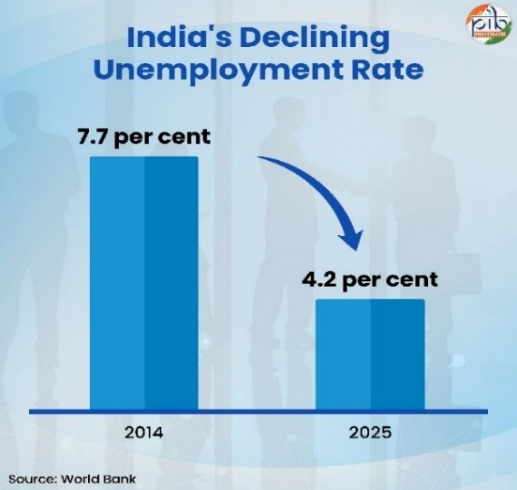
Promoting Entrepreneurship and Innovation
- Startup India Revolution: India has emerged as the world’s third-largest startup ecosystem.
- More than 2.3 lakh startups have been recognised under Startup India.
- Over 120 unicorns operate within the country.
- Nearly half of all recognised startups originate from Tier-II and Tier-III cities.
- The Funding Architecture:
- Pradhan Mantri MUDRA Yojana (PMMY): Launched in 2015, the PMMY is the flagship programme aimed at funding micro enterprises and small businesses.
- Credit Guarantee Scheme for Startups (CGSS): This scheme provides collateral-free loans to DPIIT-recognised startups through financial institutions.
- Startup India Investor Connect Portal: Launched in 2023, it enables young entrepreneurs to reach multiple investors through a single application.
Digital Youth Engagement
- Mera Yuva Bharat (MY Bharat): It combines physical engagement with digital connectivity to create a single, unified ecosystem for India’s youth aged 15 to 29.
- It offers learning, volunteering, mentorship, career services, and civic participation through a single platform.
- The Pradhan Mantri Gramin Digital Saksharta Abhiyan (PMGDISHA) was launched in 2017 to ensure digital literacy amongst citizens in rural India.
- It trained citizens, including the youth to use digital devices, navigate the internet, access Government services online, and conduct digital financial transactions.
Sports as a Vehicle of Youth Empowerment
- Khelo India – National Programme for Development of Sports: It aims to promote mass participation and sporting excellence in both rural and urban areas.
- Target Olympic Podium Scheme (TOPS): TOPS provides customised, athlete-centric support that includes foreign coaching, international training exposure, advanced sports science, equipment, and a monthly stipend.
- The Fit India Movement, launched in 2019, has transformed fitness from an individual effort into a national movement.
Health and Well-Being of Youth
- Rashtriya Kishor Swasthya Karyakram (RKSK): It addresses adolescent health through a holistic framework covering nutrition, mental health, reproductive health, and prevention of substance abuse.
- Mental Health Support (Tele-MANAS): To provide stigma-free mental healthcare, the Tele-MANAS 24/7 helpline offers professional tele-counselling services.
- The Ayushman Bharat Digital Mission (ABDM) launched in 2021, helps India’s youth by making healthcare more digital, accessible and affordable.
Youth Leadership and Global Engagement
- National Service Scheme and Nehru Yuva Kendra Sangathan continue to promote youth involvement in social service, environmental conservation, literacy, and disaster management.
- Youth exchange programmes and international platforms such as Y20, BIMSTEC Youth Summit, and SCO engagements are expanding India’s global youth footprint and fostering leadership skills.
What are the challenges?
- Quality-Quantity Gap in Skilling: Despite large training numbers, employability outcomes remain weak; industry often finds certified youth unprepared for actual job roles, indicating curriculum-industry misalignment.
- Credential-Job Mismatch: Graduate unemployment coexists with skill shortages in manufacturing and technology sectors, reflecting structural rigidity in education-to-employment pathways.
- Regional and Social Inequalities: Unequal access to education, skills, and opportunities persists across regions and social groups.
- Geographic Concentration: Economic opportunities, startup ecosystems, and quality education remain concentrated in a few states; aspirational districts and northeastern states remain significantly underserved.
- Gig Economy Vulnerability: Significant youth employment is in platform-based gig work without social security, EPF coverage, or career progression, raising concerns about formalisation quality versus quantity.
- Mental Health Burden: Rising competitive pressure, unemployment anxiety, and digital overexposure among youth create a growing mental health crisis inadequately addressed by existing healthcare infrastructure.
Concluding remarks
- India’s demographic dividend presents a historic opportunity to accelerate economic growth, foster innovation, and strengthen nation-building.
- Realising this potential requires empowering young people with the knowledge, skills, and opportunities needed to thrive in a rapidly changing world.
Source: PIB
Previous article
Protecting Indian Seafarers in the Gulf
Next article
India’s Space Economy
