


India Backs Two-state Solution for Palestine Issue
Syllabus: GS2/IR
In News
- Recently, India has reiterated its support at the United Nations for a two-state solution that allows Palestinians to live freely in an independent nation within secure borders, while also addressing Israel’s legitimate security concerns.
Background
- The two-state solution originated from the long conflict between Arabs and Jews in British-ruled Palestine.
- In 1947, the United Nations proposed dividing Palestine into separate Arab and Jewish states, but Arab nations rejected the plan.
- Israel was established in 1948, war broke out with neighbouring Arab states, leading Israel to control most of the territory
- In 1967, Israel captured the West Bank, East Jerusalem, and Gaza, leaving many Palestinians stateless and living under occupation or as refugees.
- The Oslo Accords, brokered by the United States and signed during the 1990s between Israel and the Palestine Liberation Organization (PLO), established the Palestinian Authority and granted it administrative control over parts of the West Bank.
What is the two-state solution?
- The two-state solution is a proposed peace plan for the conflict between Israel and Palestine, where both countries would exist independently and peacefully side by side.
- The idea emerged after the 1967 Arab-Israeli war, when Israel gained control of the West Bank and Gaza Strip.
- Under this plan, Israel would recognise Palestine as an independent state, while Palestine would accept Israel’s right to exist.
- The two states would have internationally recognised borders, with Palestine’s capital in East Jerusalem.
Global Recognition
- The UN Secretary-General strongly supported the two-state solution, describing it as the only realistic way to achieve lasting peace after years of conflict and violence.
- The US used its veto power to block a United Nations Security Council resolution aimed at granting statehood to Palestine.
India’s Stand
- India reiterated its support for a two-state solution, advocating for an independent Palestinian state while ensuring Israel’s security.
- Palestine’s UN membership bid would be reconsidered.
- India also pledged active participation in upcoming UN discussions on the issue.
Source:TH
Mizoram Ginger Mission
Syllabus: GS3/Economy
In News
- The Union Minister for Development of North Eastern Region (MDoNER) launched the Mizoram Ginger Mission.
About Mizoram Ginger Mission
- It is a ₹189.79 crore convergence-led initiative for Ginger Cultivation & Value Chain Development for the State of Mizoram.
- This mission is a key component of the broader “Brand North East” vision, which assigns specific USPs to states, such as Sikkim (Organic State), Arunachal Pradesh (Kiwi), Tripura (Queen Pineapple), Nagaland (Coffee), and Meghalaya (Lakadong Turmeric).
- The Mizoram Ginger Mission aims to improve farmer incomes by reducing price gaps, minimising post-harvest losses, and promoting better use of GI-certified ginger through coordinated efforts among multiple ministries.
- Mizoram is known for its Geographical Indication (GI)- certified ginger varieties.
- It seeks to integrate around 20,000 farming households into a global value chain through processing hubs, branding, exports, and market integration.
Ginger
- It is one of the oldest known spices, and is esteemed for its aroma and pungency.
- It originated in South – East Asia, but was under cultivation in India as well as in China from ancient times.
- Main ginger growing countries are India, China, Jamaica, Taiwan, Sierra Leone, Nigeria, Fiji, Mauritius, Indonesia, Brazil, Costa Rica, Ghana, Malaysia, Bangladesh, Philippines, Sri Lanka, Thailand, Uganda, Hawaii, Guatemala and many Pacific ocean islands.
Source :PIB
Why the Government Banned Sugar Exports?
Syllabus: GS3/ Economy
Context
- The Government of India, through the Directorate General of Foreign Trade, placed exports of raw, white, and refined sugar under the prohibited category till September 30, 2026.
- Earlier, sugar exports were only restricted, meaning exports were allowed within government-approved limits.
Reasons Behind the Sugar Export Ban
- El Niño and Monsoon Concerns: The government fears that a possible El Niño event may weaken the monsoon, reduce sugarcane cultivation, and affect future sugar production.
- Fertiliser Supply Risks: Geopolitical tensions in West Asia may disrupt fertiliser supplies, which is significant because sugarcane is a fertiliser-intensive crop.
- Maintaining Adequate Domestic Stocks: The ban aims to preserve sufficient sugar stocks to control prices, prevent shortages, and ensure domestic food security.
Sugar Production in India
- India has been the largest consumer and second largest producer of sugar in the world.
- In India, Sugar production in the 2025–26 sugar season is estimated at around 279 lakh tonnes (lt).
- Production process: Sugar is produced from sugarcane by crushing the crop, extracting the juice, boiling it to form a syrup, crystallizing it, and centrifuging the raw sugar crystals.
- Location of Sugar Industry in India: Sugar industry is broadly distributed over two major areas of production:
- Uttar Pradesh, Bihar, Haryana and Punjab in the north and
- Maharashtra, Karnataka, Tamil Nadu and Andhra Pradesh in the south.
Geographical Conditions for Sugarcane Growth
- Climate: Requires hot (21°-27°C) and humid (75-150 cm) conditions.
- Excess rainfall reduces sugar content; insufficient rain produces fibrous crops. Cool, dry winters aid ripening.
- South India has tropical climate which is suitable for higher sucrose content giving higher yield per unit area as compared to north India.
- Soil: Prefers moisture-retentive soil but depletes fertility over time.
- Sugarcane is a tropical and subtropical cash crop mainly used for sugar, jaggery, ethanol, and bioenergy production in India.
- India has two major sugarcane-growing zones: the tropical zone (peninsular India) with higher yields and the subtropical zone (northern India) with lower productivity.
Source: IE
Common Criteria Development Board (CCDB)
Syllabus: GS3/ Cyber Security
Context
- India has been nominated as the Chair of the Common Criteria Development Board for the period from April 2026 to April 2028, during the 1st Quarter Meeting of the Common Criteria Recognition Arrangement in Tokyo, Japan.
What is the Common Criteria Recognition Arrangement (CCRA)?
- The CCRA is an international arrangement that enables the mutual recognition of IT security certificates among member countries.
- It provides a common framework for evaluating and certifying the security of IT products.
- Under the arrangement, products certified in one member country are accepted by other member nations without the need for re-certification. This system facilitates seamless international trade in secure IT products.
- The CCRA comprises 20 certificate-authorizing nations and 18 certificate-consuming nations.
- The CCRA also maintains the Common Criteria Portal, which serves as the global repository for certified secure IT products.
What is the Common Criteria Development Board (CCDB)?
- The CCDB serves as the technical core of the Common Criteria Recognition Arrangement).
- It is the technical body responsible for developing and maintaining;
- Common Criteria (CC) standards, and
- Common Evaluation Methodology (CEM).
- The board develops and updates technical standards and evaluation methodologies for IT security certification.
- While other CCRA groups focus on policy matters, the CCDB concentrates on technical standards and evaluation criteria for secure IT products.
India’s Participation
- India became a member of the CCRA in 2013 as a Certificate Authorizing Nation.
- India participates in the arrangement through the Ministry of Electronics and Information Technology and the Standardisation Testing and Quality Certification (STQC) Directorate.
- The STQC Directorate acts as India’s official Certification Body for IT security evaluations.
Source: PIB
Assam Ships First Legal Agarwood Chips to West Asia
Syllabus:GS3/Economy
In News
- Assam achieved a major milestone by making its first legally approved export of agarwood chips to Saudi Arabia and the United Arab Emirates.
Agarwood
- It is also known as oud, is one of the world’s most valuable aromatic raw materials .
- It is produced from resin formed in infected Aquilaria and Gyrinops trees.
- Agarwood incense is produced from resin formed in trees of the Aquilaria and Gyrinops genera when they are stressed or infected by fungi, triggering a defensive resin response.
- Agarwood is a highly valued material used globally in luxury perfumes, incense, cosmetics, and traditional products.
- Agarwood is grown in countries such as India, Cambodia, Vietnam, Malaysia, Indonesia, Laos, and Bhutan. In India, key species like Aquilaria malaccensis and Aquilaria khasiana are found mainly in the Northeast, including Assam and surrounding states.
- Agarwood figured in Appendix II of the Convention on International Trade in Endangered Species of Wild Fauna and Flora (CITES), after international concern built up over the dwindling population of trees worldwide.
Source :TH
India’s Farm Exports have Grown Despite US Tariffs
Syllabus: GS3/Economy
Context
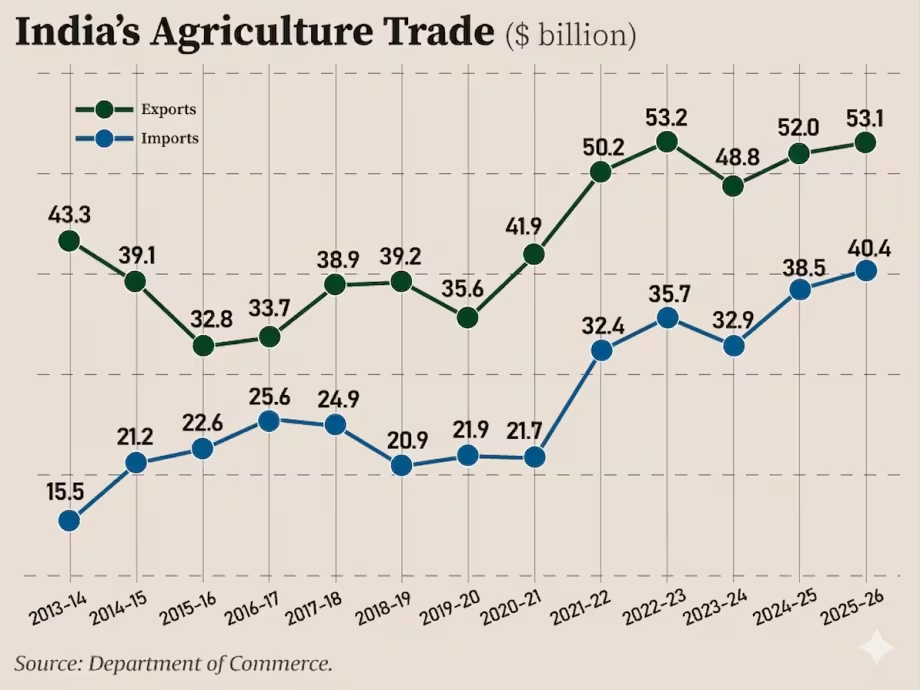
- India’s farm exports grew 2.3% year-on-year in 2025-26 (April-March), despite the steep tariffs imposed by the United States.
About
- The US imposed steep tariffs on several Indian exports:
- Initially 25%, later raised to 50%, before being reduced to 10%.
- Sectors affected included pharmaceuticals, garments, jewellery, leather, and some agricultural products like shrimp, spices, and basmati rice.
Reasons Associated with Growth
- Diversification of Markets: Indian exporters reduced dependence on the US and expanded exports to other countries.
- Exports of marine products rose nearly 14% to over $8.4 billion.
- Even though exports to the US declined, shipments increased significantly to countries such as China, Vietnam, Japan, Belgium, Thailand, Canada and the United Kingdom. This helped offset losses from the American market.
- Strong Growth in Buffalo Meat Exports: Buffalo meat exports rose by 25.6% to a record $5.1 billion. Major buyers included Vietnam, Egypt, Malaysia, United Arab Emirates and Saudi Arabia.
- Coffee Export Boom: India’s coffee exports crossed $2 billion for the first time. Reasons include high global coffee prices, falling global coffee stocks, weak production in major producers like Brazil and Vietnam.
- India benefited especially from exports of robusta coffee used in instant coffee and espresso blends.
- Rise in Fresh Fruits and Vegetable Exports: Exports of grapes, pomegranates, mangoes, bananas, onions, tomatoes, and other vegetables increased.
- Main markets included the United Arab Emirates, Iraq, Bangladesh and Malaysia.
Source: IE
Withholding Tax
Syllabus: GS3/Economy
Context
- Amid the West Asia conflict, the government is reportedly considering slashing the ‘withholding tax’ rate from 20% to the earlier 5% as it looks to revive overseas inflows.
Withholding Tax
- Withholding tax, or WHT, is a tax collected at the source of income.
- Instead of waiting for an investor or foreign company to pay taxes at the end of the financial year, the government requires the payer to deduct a portion of the income before it is remitted to the recipient.
- The deducted amount is then directly deposited with the government.
- In simple terms, whenever income is earned whether through employment, investments, royalties or other sources the government ensures tax collection in advance through withholding tax.
- Hong Kong and Singapore don’t have a withholding tax.
Significance of Slashing Withholding Tax
- Attracts Foreign Investment: Lower withholding tax increases returns for foreign investors, encouraging greater FDI and portfolio investments.
- Improves Ease of Doing Business: Reduces tax and compliance burden on companies engaged in cross-border transactions.
- Boosts Capital and Trade Flows: Encourages international trade, technology transfer, and movement of global capital.
- Supports Economic Growth: Increased investment and business activity can generate employment, innovation, and higher economic productivity.
Source: IE
Previous article
MSMEs: The Backbone of India’s Inclusive Growth
Next article
Prime Minister’s Visit to the UAE
