


Syllabus: GS3/Resources
Context
- As India aims to achieve SDG-6 (Clean Water and Sanitation) and realise its vision of becoming a developed nation by 2047, strengthening water governance will be critical for economic growth, food security, and social stability.
About India’s Water Paradox: Abundance Amid Scarcity
- India supports nearly 18% of the global population but possesses only about 4% of the world’s freshwater resources. According to the NITI Aayog Composite Water Management Index (2018):
- Around 600 million Indians face high to extreme water stress.
- Nearly 21 major cities risk groundwater depletion.
- Water demand is projected to exceed supply by 2030.
- At the same time, India receives substantial rainfall annually, nearly 4,000 billion cubic metres (BCM).
- But only around 1,100 BCM is considered utilisable because of inadequate storage infrastructure, uneven geographical distribution of rainfall, seasonal concentration of monsoon rains, and ecological and environmental limitations.
- Thus, the crisis is less about availability and more about efficient management.
Declining Per Capita Water Availability
- Growing Stress on Water Resources: India’s per capita water availability has sharply declined: above 5,000 cubic metres (1951); and around 1,400 cubic metres (present).
- This decline is driven by population growth, urbanisation, industrialisation, and climate variability.
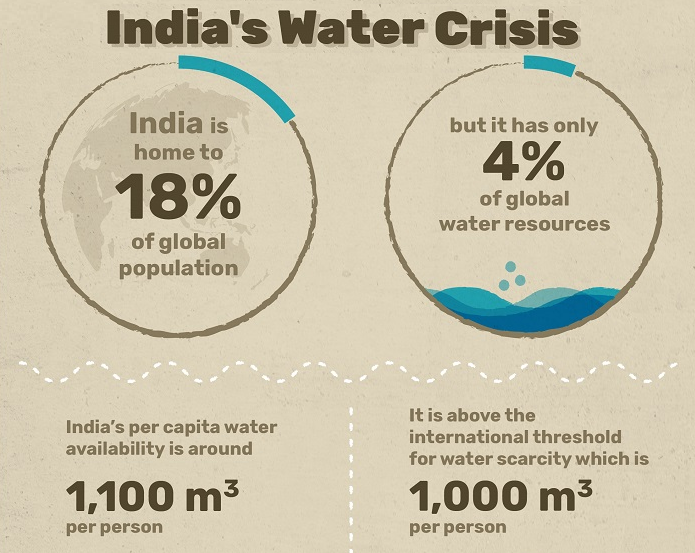
- India is approaching the threshold of water stress (1,700 cubic metres) and may soon enter the category of water scarcity (below 1,000 cubic metres).
- Crisis Related To Groundwater: India is the largest user of groundwater globally, accounting for nearly 25% of global extraction.
- Groundwater has enabled Green Revolution-led agricultural expansion, rural drinking water supply, and livelihood security.
- However, over-extraction has resulted in falling water tables, drying wells, land subsidence, and water quality deterioration.
- States such as Punjab, Haryana, Rajasthan, and parts of Karnataka face severe groundwater depletion.
- It highlights that India’s water challenge is fundamentally an institutional and governance crisis.
Institutional Architecture of Water Governance in India
- Constitutional and Federal Structure: Water is primarily a State subject under the Schedule VII of the Constitution. However, the Union government plays a coordinating and policy-support role.
- Key Institutions:
- Ministry of Jal Shakti: Nodal ministry for water resources, drinking water, and sanitation. It was formed by merging ministries dealing with water resources and drinking water.
- Central Water Commission (CWC): It focuses on surface water management, flood control, river basin planning, and dam safety.
- Central Ground Water Board (CGWB): It assesses groundwater resources, and provides scientific inputs for aquifer management.
- NITI Aayog: It introduced the Composite Water Management Index (CWMI) to promote competitive and cooperative federalism in water governance.
Major Government Initiatives
- Jal Jeevan Mission (JJM): It was launched in 2019 to provide functional household tap connections (FHTCs) to rural households.
- It enhances rural health and sanitation, reduces burden on women, and strengthens decentralised water management.
- The mission has now been extended till 2028.
- Atal Bhujal Yojana (ATAL JAL): It focuses on sustainable groundwater management in water-stressed regions. Its key features include community participation, water budgeting, aquifer mapping, and behavioural change.
- It marks a shift from supply-side to demand-side management.
- Pradhan Mantri Krishi Sinchayee Yojana (PMKSY): Its objective is ‘Per Drop More Crop’. Its components are micro-irrigation, drip and sprinkler systems, and water-efficient agriculture.
- Irrigation efficiency is vital since agriculture consumes nearly 80% of India’s freshwater.
- Atal Mission for Rejuvenation and Urban Transformation (AMRUT) Mission: It aims to improve urban water supply, develop sewage treatment systems, and promote wastewater reuse.
- Urban India faces increasing pressure from rapid population growth and pollution.
- Namami Gange Programme: Integrated river rejuvenation programme focusing on pollution control, sewage treatment, biodiversity conservation, and riverfront development.
- It reflects a basin-based approach to river governance.
Challenges in Water Governance
- Institutional Fragmentation: Multiple agencies handle irrigation, drinking water, groundwater, sanitation, and urban water supply.
- It creates policy overlaps, coordination failures, and weak accountability.
- Interstate Water Disputes: Conflicts such as Cauvery dispute, Krishna water dispute, and Ravi-Beas conflict show the limitations of cooperative federalism in water sharing.
- Climate Change: Changing rainfall patterns are increasing floods, droughts, and extreme weather events. It necessitates climate-resilient water governance.
- Pollution and Water Quality: According to CPCB reports, rivers are heavily polluted due to untreated sewage and industrial discharge; and groundwater contamination by arsenic and fluoride affects several States.
Way Forward: Towards a Circular Water Economy
- Need for Integrated Water Resource Management (IWRM): India needs to transition from a linear “use and discard” model to a circular water economy.
- Key measures include:
- Wastewater Recycling: Reuse treated wastewater in industry and agriculture; and reduce freshwater demand.
- Efficient Irrigation: Crop diversification, water-efficient crops, and precision agriculture.
- Rainwater Harvesting: Urban rooftop systems, and revival of traditional tanks and ponds.
- Technological Innovation: Smart metering, GIS mapping, IoT-based monitoring, and aquifer mapping.
- Community Participation: Panchayat-led water governance, local water budgeting, and participatory groundwater management.
- India’s water future depends not merely on rainfall but on governance reforms. The following steps are essential:
- Strengthening river basin management authorities
- Enhancing Centre-State coordination
- Promoting data-driven policymaking
- Encouraging behavioural change in water use
- Integrating climate adaptation into water planning
- Expanding wastewater reuse and recycling
- Improving urban water infrastructure
- A sustainable and equitable water governance framework is indispensable for achieving SDG-6, food security, public health, economic resilience, and environmental sustainability.
| Daily Mains Practice Question [Q] Discuss the major issues associated with water resources governance in India. Examine the effectiveness of recent government initiatives in ensuring sustainable and equitable water management. |
Previous article
A New Phase in the India-Vietnam Strategic Partnership
