


Appointment of New Deputy Election Commissioner
Syllabus: GS2/Polity and Governance
Context
- Prakash Rajpurohit, an IAS officer of the 2010 batch, has been appointed as a Deputy Election Commissioner in the Election Commission of India (ECI).
Deputy Election Commissioner (DEC)
- A Deputy Election Commissioner (DEC) is a senior officer who assists the Election Commission of India (ECI) in managing and supervising election-related work across the country.
- Five or Six Deputy Election Commissioners and Director Generals who are the senior officers in the Secretariat assist the Commission.
- Appointment: They are generally senior civil servants appointed by the Central government.
- Administrative position: They work under the overall supervision of the Election Commission of India and assist in implementing its decisions.
- Difference from Election Commissioners: The Chief Election Commissioner and Election Commissioners are constitutional authorities under Article 324, whereas Deputy Election Commissioners are supporting administrative officers.
The Election Commission of India (ECI)
- The Election Commission of India (ECI) is a constitutional body established under Article 324 of the Constitution.
- It comprises the Chief Election Commissioner (CEC) and such number of Election Commissioners (ECs) as the President may decide.
- ECI is responsible for managing the preparation of electoral rolls and conducting elections to Parliament, State Legislatures, and the offices of the President and Vice-President.
- The Constitution specifies that the President will appoint the CEC and ECs, subject to the provisions of an Act of Parliament.
Source: TH
National Human Rights Commission (NHRC)
Syllabus: GS2/Polity and Governance
Context
- The National Human Rights Commission (NHRC) celebrated its 33rd Foundation Day.
About
- NHRC is a statutory, autonomous body established to protect and promote human rights in India.
- It was established on 12 October 1993 under the Protection of Human Rights Act (PHRA), 1993.
- The Act was enacted in line with the Paris Principles (1991), which prescribe standards for the status and functioning of national human rights institutions.
- Headquarters: New Delhi.
- The NHRC is concerned with rights relating to life, liberty, equality and dignity guaranteed by the Constitution or embodied in international covenants enforceable by Indian courts.
- Composition of NHRC: The Commission consists of a Chairperson and other members as prescribed under the Protection of Human Rights Act, 1993, as amended in 2019.
- Appointment: The President of India appoints the Chairperson and members on the recommendation of a six-member committee headed by the Prime Minister.
- Tenure: The Chairperson and members hold office for three years or until they attain the age of 70 years, whichever is earlier.
- They are eligible for reappointment, subject to the provisions of the Act.
The NHRC performs the following functions
- Inquiry and Investigation: It investigates human rights violations and negligence in preventing such violations by public servants, either on its own or upon a petition.
- It can intervene in court proceedings involving human rights violations, with approval of the court.
- It undertakes visits to jails and other institutions under government control to monitor conditions.
- Promotion and Awareness: It promotes human rights awareness through educational programs, seminars, and other outreach initiatives.
- Research and Recommendations: It reviews safeguards for human rights under the Constitution and recommends measures for their effective implementation.
- It can recommend compensation or prosecution against guilty public servants and may approach the Supreme Court or High Court for directions.
- Other Key Functions: The NHRC can requisition public records and copies thereof from courts or offices.
- It submits annual reports to the Central and State governments.
- It monitors the functioning of mental hospitals and protection homes under Supreme Court remit.
Source: AIR
BIMSTEC’s Delhi Declaration
Syllabus: GS2/IR
Context
- India hosted the first-ever BIMSTEC Home Ministers’ meeting in New Delhi, which concluded with the adoption of the Delhi Declaration.
Delhi Declaration
- The declaration condemned terrorism, including cross-border terrorism, and called for stronger regional cooperation against terror financing, radicalisation, drug trafficking, human trafficking and money laundering.
What is BIMSTEC?
- The Bay of Bengal Initiative for Multi-Sectoral Technical and Economic Cooperation (BIMSTEC) is a grouping of seven Member States lying in the littoral and adjacent areas of the Bay of Bengal.
- The organization was formed in 1997 with the signing of the Bangkok Declaration.
- It unites South and Southeast Asian nations bordering the Bay of Bengal.
- Objective: To help countries in their economic growth, to support social development, and to encourage development in other areas, like science, technology, and economic development.
- Founding Members: Bangladesh, India, Sri Lanka, and Thailand.
- Current Members (7): Bangladesh, Bhutan, India, Myanmar, Nepal, Sri Lanka, and Thailand.
- The BIMSTEC region represents approximately 1.7 billion people, or 22% of the world’s population, with a combined GDP of around US$5 trillion.
- BIMSTEC Secretariat: Dhaka, Bangladesh.
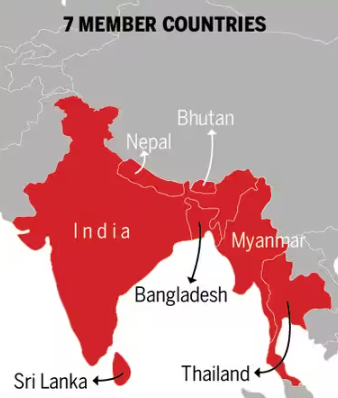
Source: TH
Long Term Capital Gains (LTCG) Tax Debate
Syllabus: GS3/ Economy
In News
- Long Term Capital Gains (LTCG) tax is back in debate as investors, markets and economists question whether it helps or hurts capital formation.
What is Long Term Capital Gains (LTCG) Tax?
- It is a tax on profit from selling a capital asset held beyond a specified period, which is 12 months for listed equity and 24 months for property and unlisted shares.
- Current regime (Budget 2024): LTCG on listed equity is 12.5% above Rs 1.25 lakh a year, up from 10% above Rs 1 lakh. Short term gains are taxed at 20%.
- Indexation removed: Property and other assets are taxed at a flat 12.5% without indexation. For property bought before 23 July 2024, resident individuals can choose the older 20% with indexation.
- Equity LTCG was exempt until 2018, when a 10% tax was introduced, partly offset by Securities Transaction Tax (STT) on trades.
Case for Reducing or Rationalising LTCG
- Double taxation: Gains arise from profits already taxed as corporate income, and STT is levied on top. Investors bear three layers of tax.
- Hurts long term investing: A higher rate lowers post tax returns and weakens the incentive to hold equity for long periods. This matters as household savings shift from gold and real estate to financial assets.
- Global competitiveness: Singapore, Hong Kong and the UAE levy no capital gains tax on equity, which pushes foreign portfolio investors toward them and can add to FPI outflows.
Source: TH
Improved Soybean Varieties NRC 268 and NRC 270
Syllabus: GS3/ Agriculture
In News
- The ICAR–National Soybean Research Institute, Indore, under the Indian Council of Agricultural Research (ICAR) showcased the yield potential of the improved soybean Varieties NRC 268 and NRC 270.
About
- Both varieties have shown yields of around 20 quintals per hectare, with the potential to reach 22–25 quintals under favourable conditions.
- NRC 270 has larger, heavier seeds that may fetch better market prices.
- They are designed to better withstand irregular rainfall, dry spells, pests and diseases.
Soybean Production in India
- Soybean (Glycine max) belongs to the Fabaceae family. It is an important Kharif oilseed crop grown mainly during the southwest monsoon season
- Madhya Pradesh is the leading soybean-producing state in India, followed by Maharashtra.
- Soybean grows well in warm conditions and requires adequate soil moisture. Soybean is a leguminous crop that forms a symbiotic association with Rhizobium bacteria in its root nodules.
- The government also announces a Minimum Support Price (MSP) for soybean, while ICAR develops improved varieties to enhance productivity and resilience.
Source: PIB
‘Nameri Wild Classroom’ Initiative
Syllabus: GS3/ Environment
In News
- The Assam Forest and Climate Change Department launched the ‘Nameri Wild Classroom’ initiative at Nameri Tiger Reserve to connect students with nature through hands-on learning.
About the Initiative
- It is a residential environmental education programme offering two- and three-day field camps inside Nameri Tiger Reserve.
- It aims to inculcate scientific curiosity, environmental awareness and a sense of responsibility towards wildlife conservation among school children from class 8 onwards.
- The initiative provides field learning like birdwatching, understanding of biodiversity & ecosystems and traditional practices of forest-dwelling communities.
About Nameri Tiger Reserve
- It is located in the Sonitpur district, Assam, in the foothills of the Eastern Himalayas.
- The Jia-Bharali River, known as the Kameng River in Arunachal Pradesh, flows through the region.
- In September 2026, Nameri Tiger Reserve received Conservation Assured | Tiger Standards (CA|TS) approved status for meeting prescribed norms for tiger conservation and protected area management.
- CA|TS is a global framework for assessing the effectiveness of tiger reserve management and protection.
- It was launched at the 1st Asian Parks Congress in Japan in 2013.
Source: TH
South Korea Tests Indigenous Hypersonic Glide Vehicle
Syllabus: GS3/Defence
Context
- South Korea has successfully test-fired its first domestically developed Hypersonic Glide Vehicle (HGV), marking a step towards acquiring a new high-speed strike capability amid rising tensions on the Korean Peninsula.
What Are Hypersonic Weapons?
- Hypersonic weapons travel at speeds of Mach 5 or higher, equivalent to over five times the speed of sound.
- They are broadly classified into two types:
- Hypersonic Glide Vehicles (HGVs): Rocket boosters propel them to high altitudes before they separate and glide towards their targets at hypersonic speeds, manoeuvring during flight.
- Hypersonic Cruise Missiles: Powered by high-speed, air-breathing engines such as scramjets, they sustain hypersonic flight within the atmosphere and can manoeuvre at low altitudes.
Do you know?
- India’s hypersonic programmes include the Hypersonic Technology Demonstrator Vehicle (HSTDV), which demonstrated flight at approximately Mach 6, and the proposed BrahMos-II, designed to achieve speeds of around Mach 7.
Source: TOI
Previous article
India’s Corporate Social Responsibility (CSR) Programme
Next article
News In Short 14-10-2026
