


Syllabus: GS3/Environment
Context
- A report on the performance of PM Surya Ghar Yojana has been jointly published by the Institute for Energy Economics and Financial Analysis (IEEFA) and JMK Research & Analytics.
Major Highlights
- Target Achieved: Despite a near four-fold increase in applications between 2024 and 2025, only 13.1% of the target 1 crore solar rooftop installations, has been achieved.
- In this scenario, the FY2027 target [of 1 crore installations] continues to be viewed as a considerable challenge.
- Subsidies Released: Just 14.1% of the allocated ₹65,700 crore in subsidies has been released till July 2025.
- Share in Total Capacity: As of July 2025, the 4.9 GW of installations added under the PMSGY accounted for approximately 44.5% of the country’s total residential rooftop capacity.
- Leading State: Gujarat leads all States with the highest installed residential rooftop solar capacity of 1,491 MW, followed by Maharashtra, Uttar Pradesh, Kerala, and Rajasthan.
- Concerns:
- Approval Delays: The procedural approval process is slow, taking 45–120 days, which causes project delays.
- Domestic Content Restriction (DCR): The scheme provides incentives only for solar systems fully manufactured in India.
- Higher Costs: Domestic DCR components are ₹12/watt costlier than imported ones, reducing the cost-effectiveness of installations.
- Supply Constraints: Domestic DCR module production is fragmented and limited, leading to delivery delays of up to two months.
- Consumer Behaviour: Due to high prices and long waits, many consumers prefer non-DCR systems, choosing faster installation over subsidy benefits.
- Recommendations
- Domestic Supply vs. Exports: Without stronger measures to prioritise domestic module supply for PMSGY instead of exports, and to mitigate anti-dumping-related cost pressures, the affordability and timely rollout of residential rooftop solar projects will remain uncertain.
- Need for State-Level Targets: Experts emphasize the need to set clear, time-bound rooftop solar capacity targets at the State level to create a coherent national vision and ensure effective policy execution across regions.
| PM Surya Ghar: Muft Bijli Yojana – It was launched in 2024 and aims to provide free electricity to households by facilitating the installation of rooftop solar panels. – Installation Targets: 1. By October 2025: Reaching 40 lakh, 2. March 2027: 1 crore households. – The scheme offers a subsidy of up to 40% to households, making renewable energy more affordable and accessible. – Eligibility: 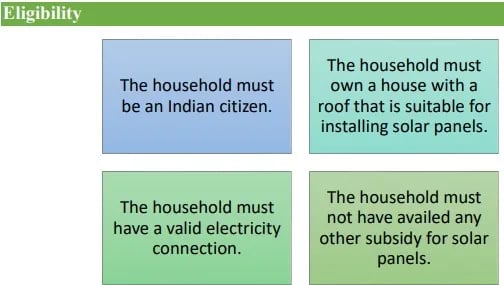 – Model Solar Village: 1. An allocation of ₹800 crore has been designated for this component, with ₹1 crore provided to each selected Model Solar Village. 2. To qualify as a candidate village, it must be a revenue village with a population of over 5,000 (or 2,000 in special category states). 3. This initiative aims to promote solar energy adoption and empower village communities to achieve energy self-reliance. 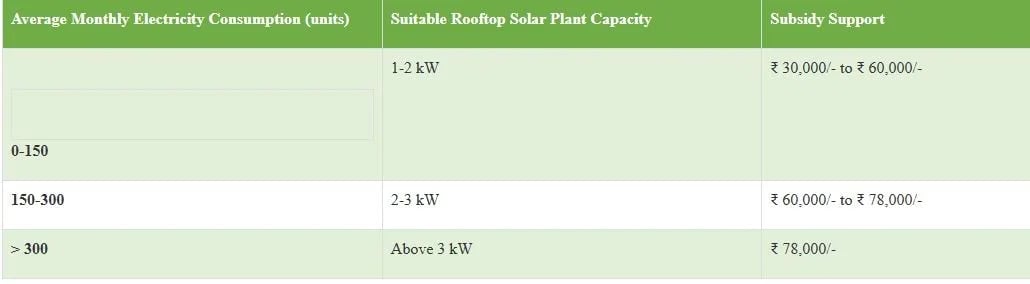 – Achievement: PM Surya Ghar: Muft Bijli Yojana (PMSGMBY) has achieved a historic milestone with 10 lakh homes now solar-powered as of March 2025. |
Source: TH
Previous article
Strengthening and Safeguarding Dams in India
Next article
News in Short – 14 October, 2025
