


El Niño
Syllabus: GS1/ Geography
Context
- The India Meteorological Department (IMD) has officially confirmed the onset of El Niño conditions over the equatorial Pacific Ocean.
What is El Nino?
- El Niño is the warming of seawater in the central-east Equatorial Pacific that occurs every few years.
- During El Niño, surface temperatures in the equatorial Pacific rise, and trade winds, east-west winds that blow near the Equator, weaken.
- Impact: El Niño causes dry, warm winters in the Northern U.S. and Canada and increases the risk of flooding in the U.S. gulf coast and southeastern U.S. It also brings drought to Indonesia and Australia.
- In El Niño years, India faces warmer temperatures and less rainfall, causing droughts in some regions. This affects agriculture, water resources, and ecosystems.
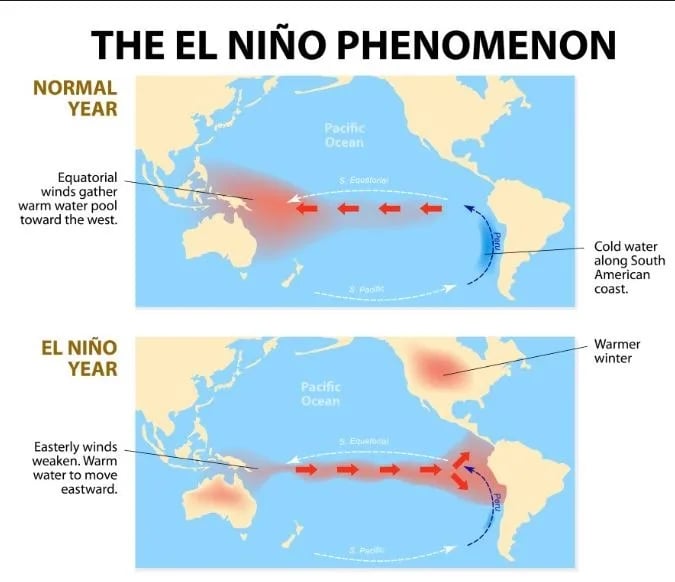
Source: HT
Estonia
Syllabus: GS1/Places in News
Context
- Estonian government and business executives are expressing greater interest in cooperation with India in defence and trade.
About
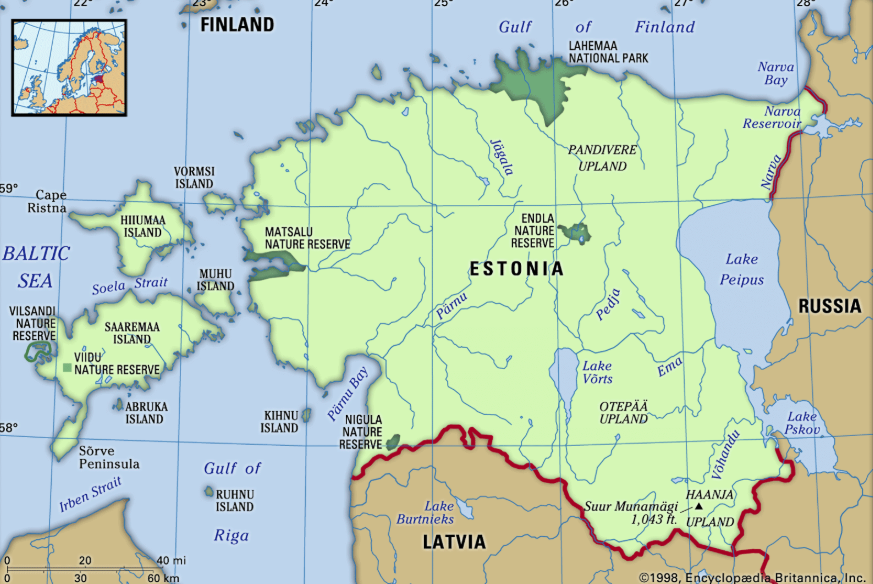
- Estonia is a country in northeastern Europe, the northernmost of the three Baltic states.
- Estonia’s area includes some 1,500 islands and islets; the two largest of these islands, Saaremaa and Hiiumaa, are off mainland Estonia’s west coast.
- To the east Estonia is bounded by Russia and to the south it is bounded by Latvia.
- Official language: Estonian.
- Estonia remained a Soviet republic until 1991, when, along with the other Baltic states, it declared its independence.
- It sought integration with greater Europe and in 2004 joined the North Atlantic Treaty Organization (NATO) and the European Union (EU).
- Estonia is often recognized as one of the world’s most digitally advanced countries, widespread online public services and electronic voting.
Source: TH
Project Kusha
Syllabus: GS3/Defence
Context
- Defence Minister Rajnath Singh has described the indigenous Project Kusha air defence system as a potential game changer for India’s security architecture.
What is Project Kusha?
- Project Kusha is a long-range indigenous surface-to-air missile (SAM) system being developed by DRDO to provide layered air defence against a range of aerial threats.
- The system is designed to rival advanced platforms such as Russia’s S-400 Triumf and will feature three interceptor variants:
- M1 interceptor with a range of around 150 km
- M2 interceptor with a range of around 250 km
- M3 interceptor with a range of 350-400 km
- The system is intended to counter fighter aircraft, including stealth platforms, drones, cruise missiles, precision-guided munitions and certain ballistic missile threats.
- The project is also linked to the broader “Mission Sudarshan Chakra”, an initiative aimed at building a multi-layered air and missile defence shield for India by 2035.
- Development Status
- The Defence Acquisition Council (DAC) granted Acceptance of Necessity (AoN) in 2023 for the procurement of five squadrons for the Indian Air Force.
- Operational deployment is expected between 2028 and 2030.
Source: TOI
Indigenous AI Model Varya
Syllabus: GS3/ Science and Technology
Context
- The IndiaAI Mission has supported the launch of Varya, an indigenous AI-powered video generation model developed by Avataar.
What is Varya?
- Varya is a distilled video generation model that converts text prompts and images into videos.
- Model Distillation is a machine-learning technique in which a smaller AI model is trained using the outputs of a larger AI model so that it can achieve similar performance with lower computational cost, faster processing, and reduced energy consumption.
- It is designed to generate culturally relevant visual content reflecting India’s regions, festivals, traditions, clothing, food, and everyday life.
- The platform follows the workflow, from Idea to Video to Story, allowing users to create and extend visual narratives through simple prompts.
- Key Features:
- Reduces video generation steps from 50 to 4, significantly improving efficiency.
- Generates videos at an estimated cost of ₹0.48 per second, and claims to be up to 10 times more cost-efficient than several leading global video-generation models.
Source: AIR
Four Sites on Nicobar West Coast Identified for Coral Translocation
Syllabus: GS3/Environment
Context
- Coral colonies and giant clams that will be impacted due to the work on the transhipment port proposed at Galathea Bay as part of the Great Nicobar Island (GNI) mega project will be translocated to four sites on the west coast.
Great Nicobar Island project
- The project received Stage-I clearance in 2022.
- Implementing authority: The project is being implemented by the Port Blair-based Andaman and Nicobar Islands Integrated Development Corporation Ltd (ANIIDCO).
- The Project involves developing an International Container Transshipment Terminal (ICTT), an international airport, township development, and a 450 MVA gas and solar-based power plant on the island.
- The site for the ICTT and power plant is Galathea Bay on the southeastern corner of Great Nicobar Island, where there is no human habitation.
What are Corals?
- Corals are invertebrates that belong to a large group of animals called Cnidaria.
- Corals are formed by multiple small, soft organisms known as polyps.
- They secrete a rocky chalk-like (calcium carbonate) exoskeleton around themselves for protection.
- Coral reefs are therefore created by millions of tiny polyps forming large carbonate structures.
- Appearance: Corals range in colour from red to purple and even blue, but are most commonly shades of brown and green.
- Coral are bright and colorful because of microscopic algae called zooxanthellae.
- There are three types of coral reefs – fringing reefs, barrier reefs and atolls.
- Fringing reefs form along shorelines, barrier reefs form in open water and atolls are circular reefs that have formed around sunken volcanoes.
- Coral reefs in India: Gulf of Kutch, Gulf of Mannar, Andaman & Nicobar, Lakshadweep Island and Malvan.
- Significance: They provide food, shelter, resting and breeding grounds to a quarter of all marine life, acting as nurseries and refuges to protect critical biodiversity.
- They also support more than 1 billion people living in coastal regions around the world by providing food, livelihoods and recreation.
Source: IE
Previous article
Mapping India’s Employment Landscape
