


Syllabus: GS3/ Economy
Context
- India and the United Kingdom announced that the Comprehensive Economic and Trade Agreement (CETA) will enter into force on 15th July 2026.
Background
- The India–UK FTA negotiations were formally launched in 2022, as part of efforts to deepen economic cooperation and boost bilateral trade.
- Following fourteen intensive rounds of negotiations, CETA was concluded in May 2025 and officially signed on 24 July 2025.
- To complete the framework, the companion Double Contribution Convention (DCC) was subsequently signed on 10 February 2026.
Key Highlights and Benefits of the Agreement
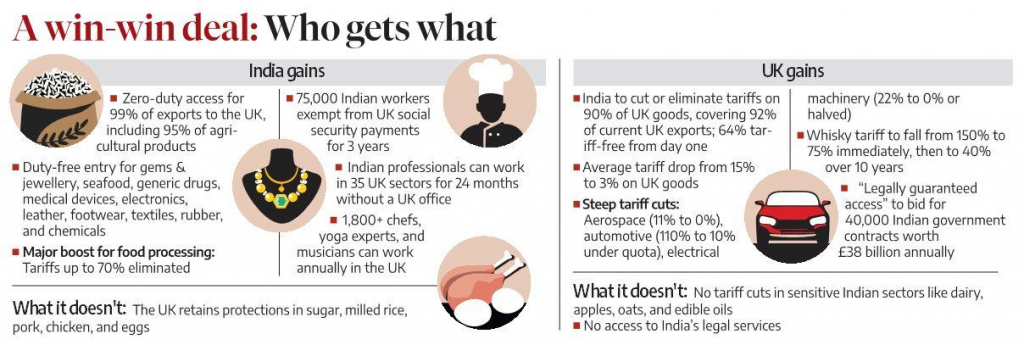
- For India:
- Duty-free access to the UK market for 99% of Indian products: This is a huge win for Indian exports, especially in labour-intensive sectors like textiles, footwear, gems and jewellery, and engineering goods, which previously faced duties of 4% to 16%.
- Easier entry for Indian professionals: The agreement provides assured temporary access to the UK market for Indian professionals like chefs, yoga instructors, and IT specialists.
- Boost for Manufacturing: Sectors like electronics, pharmaceuticals, chemicals, food processing, and plastics are expected to see a boost in exports.
- Boost for Agriculture and Fisheries: Indian farmers and the fisheries sector will benefit from duty-free access for many agricultural and marine products, allowing them to compete better in the UK market.
- For the UK:
- Reduced tariffs on nearly 90% of UK goods entering India: This will make British products more affordable in India.
- Big cuts on duties for British whisky and gin: Tariffs on popular British products like whisky and gin will drop significantly, from 150% to 75% immediately and then gradually to 40% within ten years. This gives UK distillers a significant advantage in the large Indian market.
- Lower tariffs on certain UK-made automobiles: Car duties will be reduced, improving the competitiveness of British car manufacturers in India.
- Access to Indian federal government procurement tenders: UK firms can bid for government contracts in India worth over a certain amount, opening up a large market.
- Benefits for financial and professional services: The agreement includes commitments that benefit UK companies in IT, financial services, and professional services like consulting and engineering.
Overall Impact
- The deal is expected to significantly increase bilateral trade with projections aiming to double it to around $120 billion by 2030.
- Zero or reduced tariff for 99 percent of Indian exports to the UK, which is a stronger position for India vs. other leading export markets such as Bangladesh, Vietnam, and China.
- Export boost in leading manufacturing clusters in Tiruppur, Surat, Ludhiana, Pune, Chennai, Gujarat, West Bengal, Assam, etc.
- It’s seen as a major economic win for both countries, creating jobs, boosting wages, and driving growth.
- The FTA is also accompanied by a UK-India Vision 2035 roadmap, aiming to deepen ties in areas like defence, climate solutions, and education.
UK-India Vision 2035 Roadmap
- Increased ambition: Since elevating the relationship to a Comprehensive Strategic Partnership, India and the UK have catalysed significant partnerships and growth across all sectors. The new vision builds on this momentum, setting ambitious goals to deepen and diversify bilateral cooperation.
- Strategic Vision: The India-UK Vision 2035 sets clear strategic goals and milestones, tracking a path for sustained future collaboration and innovation.
Key Economic Gains
- Agreement on Social Security also referred to as the Double Contribution Convention (DCC), entering into force alongside the Agreement, exempts Indian workers and employers from making dual social security contributions in the United Kingdom during temporary assignments.
- The period of exemption has been increased from 3 years to 5 years.
- Interests of Steel Exporters Protected: Following constructive deliberations regarding the UK’s upcoming steel measures effective from July 1, 2026, both sides mutually agreed to protect commercial interests, minimize market disruptions, and ensure an overall balanced and stable trading environment for exporters.
- 85% of India’s exports are out of the Steel measures.
- On the lines under the Steel measures India’s interest has been protected through a mix of CSQ, residual quota and access under Authorised Use Scheme (AUS).
Challenges of the Agreement
- Compliance with Global Standards: Indian exporters may face difficulties in meeting stringent UK quality, safety, sanitary and technical standards, particularly in sectors such as food processing, pharmaceuticals, textiles, and engineering goods.
- Pressure on Domestic Industries: Increased market access for UK products, particularly in sectors like automobiles, premium goods, and machinery, may intensify competition for Indian manufacturers.
- Persistence of Non-Tariff Barriers: Despite tariff reductions, issues such as regulatory differences, certification requirements, technical barriers to trade, and sustainability norms may continue to restrict export growth.
Way Ahead
- Improve productivity, technology adoption, and quality standards to enable Indian firms to compete effectively in the UK market.
- Provide training, digital platforms, and institutional support to help MSMEs understand Rules of Origin, certification processes, and FTA benefits.
- Expand testing laboratories, certification facilities, and regulatory frameworks to align Indian products with international standards.
- Encourage diversification of exports, promote high-value manufacturing, and integrate Indian industries into global value chains to fully leverage CETA benefits.
Source: PIB
Previous article
India–Oman Bilateral Relations
Next article
Crackdown on Cybercrime
