


Syllabus: GS3/Renewable Energy
Context
- India’s reservoirs can host about 102 gigawatt (GW) of floating solar capacity, according to the first comprehensive national assessment by the National Institute of Solar Energy (NISE).
Major Highlights
- Report: Solar PV Potential of India (Floating Solar).
- Total FSPV Potential: It estimates India’s total floating solar (FSPV) potential at around 102.18 GW, with a constraint of using only 20% of the reservoir area.
- Region wise Potential: High concentrations in Maharashtra, Madhya Pradesh, Karnataka, Odisha, Telangana and Gujarat, reflecting the availability of large, technically suitable reservoirs and inland water bodies.
- Complimentary to Ground-mounted PV: Floating solar is a significant and scalable complement to ground-mounted PV in India’s renewable energy portfolio.
- Water Conservation: FSPV also contributes to water conservation by shading water bodies, thereby reducing evaporation by 30–60%. Large scale projects demonstrate the impact of saving nearly 19.5 million cubic meters of water per year.
- Economically, FSPV systems are currently approximately 25% more expensive upfront than land-based solar due to floating structures, anchoring, and waterproofing.
- However, higher efficiency, land savings, water conservation, reduced transmission costs, and hybrid integration improve long-term financial viability.
- Comparison to Ground-mounted solar systems: Ground-mounted solar systems dominate India’s roughly 100 GW of installed solar capacity, requiring three to four times more area per megawatt than the panels themselves occupy.
- Land acquisition, which is costly, prone to conflict with agriculture and habitation, has historically and continues to be a chokepoint as India pursues 500 GW of non-fossil capacity by 2030.
India’s Energy Targets
- Emissions Intensity Reduction: India has committed to reducing the emissions intensity (CO₂ per unit of GDP) of its GDP by 47% by 2035 from 2005 levels.
- India has already reduced its emissions intensity by about 36% between 2005 and 2020.
- Expansion of Non-Fossil Fuel Capacity: India has committed to achieving 60% of its installed electric power capacity from non-fossil fuel sources by 2035.
- India has already achieved more than 50% non-fossil fuel capacity by 2026, ahead of its earlier target.
- Creation of Carbon Sink: India has committed to creating a carbon sink of 3.5 to 4 billion tonnes of CO₂ equivalent through forest and tree cover by 2035.
Floating Solar Photovoltaic (FSPV)
- Also known as “floatovoltaics,” is a technology where solar panels are installed on buoyant structures floating on water bodies like reservoirs, lakes, and dams.
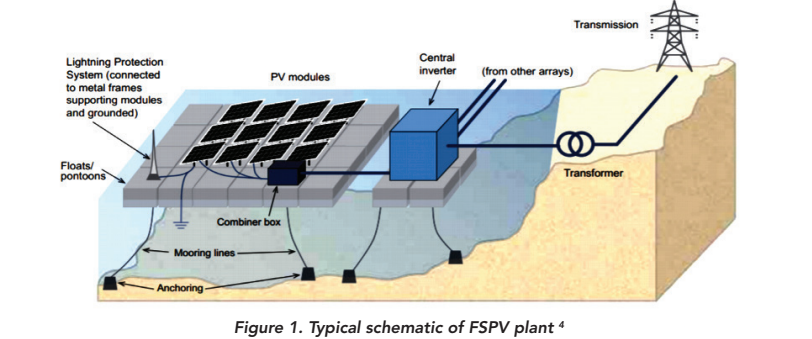
- Globally, floating solar reached about 9.6 GW by 2024, nearly 90% of it in Asia.
- China leads, with installations such as a 120 MW plant on a fish farm in Poyang Lake.
- The Netherlands accounts for roughly three-fourths of Europe’s capacity, built largely on quarry lakes.
- India’s flagship is the Omkareshwar floating solar park on the Narmada river in Madhya Pradesh — at 278 MW, the country’s largest, with plans to scale to 600 MW.
Key factors Driving the rise of FSPV:
- Land-use Advantages: FSPV uses water surfaces that typically have low competing demands. This reduces land acquisition challenges and minimises social conflicts compared to large GMPV installations .
- Enhanced Energy Performance: Water bodies provide a cooling effect on PV modules, which can reduce operating temperatures and potentially increase energy yield.
- Synergy with Hydropower: FSPV can be co-located with hydropower reservoirs, allowing shared infrastructure and enabling hybrid generation strategies.
- Rapid Market Growth and Policy Momentum: Countries like China, the Netherlands, Singapore, and South Korea have established dedicated guidelines. This standardisation effort is improving investor confidence and supporting utility-scale deployments.
Challenges
- Despite the rapid growth, FSPV still faces challenges related to system reliability, wave-induced stress, environmental uncertainties, and a lack of long-term performance datasets.
- The report underscores the need for better modelling frameworks, and robust degradation assessments.
Way Ahead
- Development of a Dedicated Solar Potential Portal: To enable more informed, transparent, and actionable planning, NISE is committed to developing a dedicated Solar Potential Portal.
- Integration with National and State-Level Energy Planning: NISE’s periodic assessments and portal-based data will be directly linked to national and state energy planning frameworks.
- This will enable: Prioritisation of high-potential zones for ultra-mega solar parks.
- Strategic allocation of resources for grid strengthening and infrastructure development.
- Through a combination of continuous potential updates, a dedicated geospatial portal, and application-specific assessments, NISE aims to provide a scientific, transparent, and policy-relevant foundation for India’s solar roadmap.
Source: TH
Next article
News In Short 11-06-2026
