


Mahatma Jyotirao Phule
Syllabus: GS1/History and Personality in News
Context
- Prime Minister Narendra Modi paid tributes to Mahatma Jyotirao Phule on his birth anniversary.
About Jyotirao Phule
- Birth: On 11th April, 1827 in Khatgun village which is today in the Satara district of Maharashtra.
- Title: His family belonged to the ‘mali’ caste and their original title was ‘Gorhay’. On May 11, 1888, he was bestowed with the title of Mahatma by a Maharashtrian social activist Vithalrao Krishnaji Vandekar.
- Ideology and influence: His ideology centered around liberty, egalitarianism, and socialism. He drew inspiration from Thomas Paine’s book The Rights of Man.
- Marriage: He was married off when he was only 13 with Savitribai. The couple went on to establish the country’s first school for girls in Bhidewada, Pune, in 1848.
- Balhatya Pratibandhak Griha: In 1863, Jyotirao and Savitribai began Balhatya Pratibandhak Griha, India’s first home dedicated to prohibiting infanticide and supporting pregnant Brahmin widows and rape victims.
- Satyashodhak Samaj: Phule along with his followers formed Satyashodhak Samajin 1873 which meant ‘Seekers of Truth’ and was dedicated towards the removal of the socio-economic backwardness of Dalits.
- It is believed that it was Phule who first used the term ‘Dalit’ for the depiction of oppressed masses often placed outside the ‘varna system’.
- Literary works: Gulamgiri (Slavery), Shetkarayacha Aasud (Cultivator’s Whipcord), and Tritiya Ratna.
Source: PIB
Project Glasswing
Syllabus: GS/ Science & Technology
Context
- Anthropic has launched Project Glasswing, a global cybersecurity initiative linked to its advanced AI model Claude Mythos.
What is Project Glasswing?
- Project Glasswing is a global cybersecurity initiative led by Anthropic.
- It is a consortium of around 40 global technology firms and open-source contributors aimed at securing critical digital infrastructure, using advanced Artificial Intelligence.
- The project provides early access to the Claude Mythos model to selected partners. It is backed by;
- $100 million in AI usage credits,
- $4 million support for open-source security.
- Major participating firms include: Amazon Web Services, Apple, Google, Microsoft, NVIDIA etc.
Role of Claude Mythos
- Claude Mythos is an advanced Large Language Model (LLM) with exceptional coding and vulnerability detection capabilities. It can;
- Detects zero-day vulnerabilities (previously unknown flaws).
- Identify decades-old bugs in widely used systems.
- Combine vulnerabilities to gain system-level control.
Source: TH
Zoroastrianism
Syllabus: GS1/ Culture
Context
- The decline of the gray wolf in Iran is deeply rooted in ancient Zoroastrian ethos, where the wolf was viewed as an evil creature.
What is Zoroastrianism?
- Zoroastrianism is one of the world’s oldest monotheistic religions, founded by Zarathustra (also known as Zoroaster).
- It originated in ancient Persia (modern-day Iran) around 1500–1000 BCE.
- Centered on the worship of one supreme God, Ahura Mazda (Wise Lord), it emphasizes a cosmic struggle between good and evil, promoting an ethical life based on “Good Thoughts, Good Words, Good Deeds”.
- Holy Book: The Avesta, which contains the Gathas (hymns written by Zoroaster).
- Worship & Purity: Fire is a central symbol of purity and divine light, representing Ahura Mazda’s wisdom. Fire temples are used for worship.
Decline and Contemporary Presence
- Following the Islamic conquest of Persia in the 7th century CE, Zoroastrianism gradually declined as the dominant religion in Iran.
- At present, small Zoroastrian communities continue to reside in Iran.
- Presence in India: Between the 8th and 10th centuries CE, groups of Zoroastrians migrated from Persia to India and came to be known as the Parsis.
- They are an officially recognized religious minority in India, comprising one of the smallest, yet most influential, communities with roughly 57,264 members as of 2011.
Source: DTE
Indus River Dolphin
Syllabus: GS3/Species in News
Context
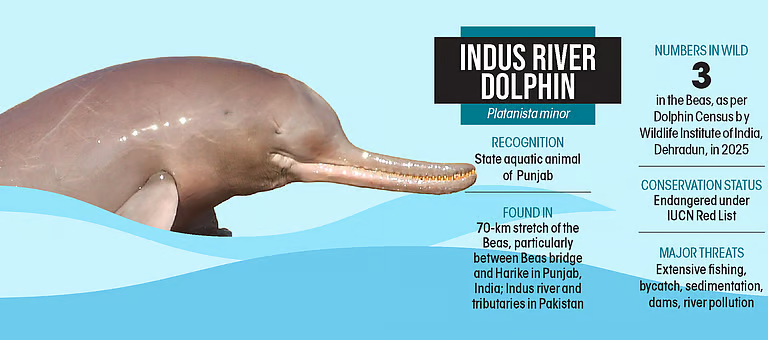
- The dolphin is one of the world’s most endangered freshwater cetaceans and a flagship species of the Indus river system.
Indus River Dolphin
- Cetaceans are aquatic mammals which include whales, dolphins and porpoises.
- Indus River Dolphin was once distributed across the Indus and its tributaries in Pakistan and northwestern India.
- But its range has drastically contracted due to flow regulation, loss of connectivity, pollution, climate change and entanglement in fishing gears.
- The Indus river dolphin is functionally blind, it relies entirely on echolocation to navigate, hunt and avoid obstacles.
Source: DTE
Microbial Methane
Syllabus: GS3/Environment
Context
- As per a new study, Microbial methane leaking from non-producing oil and gas wells is being emitted at rates nearly 1,000 times higher than previously estimated.
About
- Microbial methane (or biogenic methane) is methane gas produced by microorganisms, specifically archaea known as methanogens.
- It is produced through the decomposition of organic matter in oxygen-depleted (anaerobic) environments.
- It is a major component of the global carbon cycle, generated in wetlands, rice paddies, landfills and digestive systems of ruminants.
- Methane is a powerful greenhouse gas when released into the atmosphere, regardless of its origin.
Source: DTE
