


Dr. Syama Prasad Mookerjee
Syllabus: GS1/Personalities in News
Context
- The Ministry of Culture announced a two-year official commemoration of the 125th birth anniversary of Dr. Syama Prasad Mookerjee.
About
- Initially a member of the Indian National Congress; later joined the Hindu Mahasabha in the 1930s.
- He became the youngest Vice-Chancellor of Calcutta University at age 33 in 1934.
- He served as Finance Minister of Bengal (1941–42) in the Fazlul Haq ministry.
- 1944: He founded an English daily,”Nationalist.”
- Presided over the Bilaspur session of the All-India Hindu Mahasabha.
- Met M.A Jinnah to find out a solution of Hindu-Muslim problems.
- He was a strong critic of the Muslim League and the partition of India.
- He joined the cabinet of the interim government as Minister for Industry and Supply after independence (1947–1950), but resigned over differences.
- Founder of Bharatiya Jana Sangh: In 1951, founded the Bharatiya Jana Sangh, the ideological predecessor of today’s Bharatiya Janata Party (BJP).
- Advocated for national unity, cultural nationalism, and economic self-reliance.
- Legacy: He is remembered as a staunch nationalist, educationist, and advocate of cultural unity.
- The Syama Prasad Mookerjee Port in Kolkata and several institutions are named in his honor.
Source: PIB
PM Modi Conferred with Namibia’s Highest Civilian Award
Syllabus: GS1/Geography
Context
- The President of Namibia conferred on Prime Minister Modi the highest civilian award of Namibia – Order of the Most Ancient Welwitschia Mirabilis.
- He is the first Indian leader to be given this award.
About
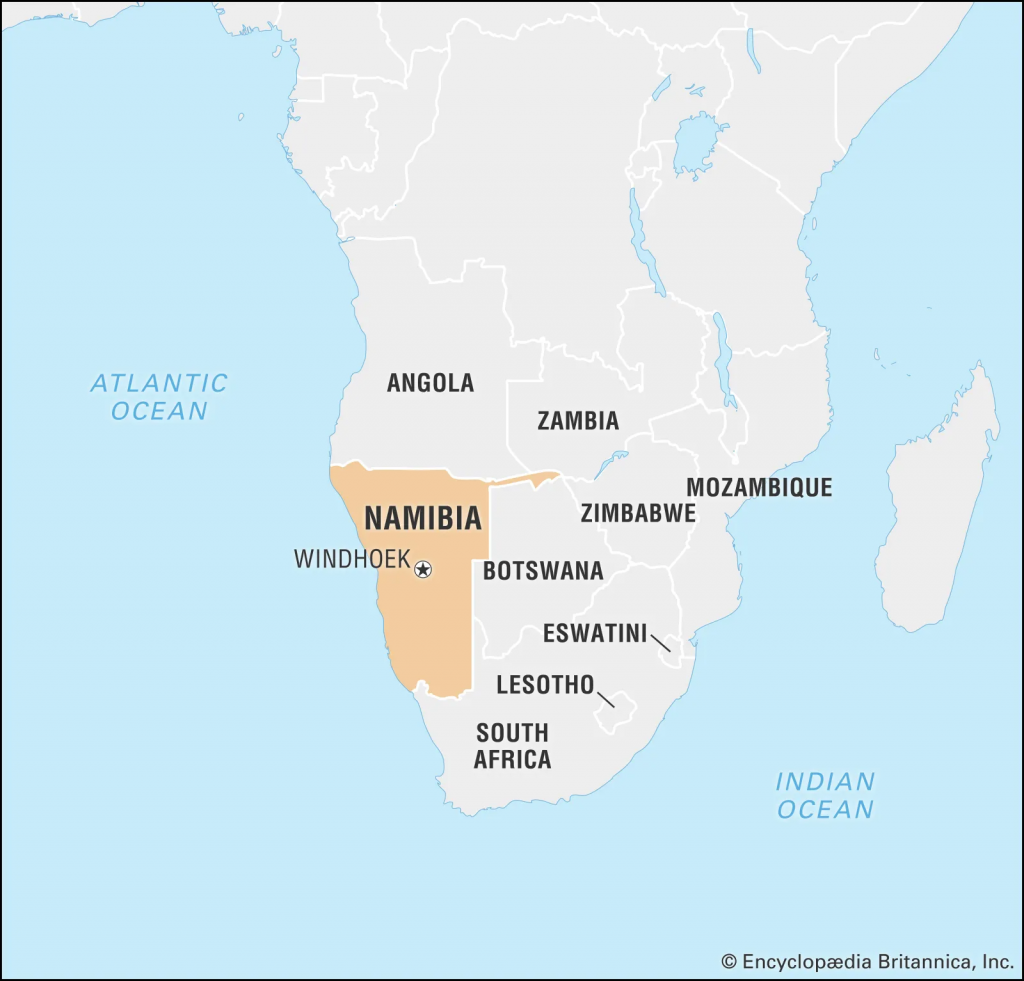
- Namibia is a country located on the southwestern coast of Africa.
- It is bordered by Angola to the north, Zambia to the northeast, Botswana to the east, South Africa to the southeast and south, and the Atlantic Ocean to the west.
- The country’s name comes from the Namib Desert, which is considered to be the oldest desert in the world.
- Major rivers: Four large rivers flow along Namibia’s borders: the Zambezi, Orange, Cunene and Okavango/Cubango.
Do You Know?
- Namibia has become the first African country to sign a licensing agreement to adopt India’s Unified Payments Interface (UPI) system for real-time digital payments.
Source: TH
Eklavya Model Residential Schools (EMRS)
Syllabus: GS2/Welfare Scheme
Context
- More than 600 students from government-run Eklavya Model Residential Schools (EMRS) cleared the IIT-JEE and NEET exams this year, according to an assessment by the Tribal Affairs Ministry.
About Eklavya Model Residential Schools (EMRS)
- The EMRS is a Central Sector Scheme implemented by the Ministry of Tribal Affairs to provide quality education to the tribal children.
- The government aims to establish one EMRS in every block having more than 50% ST population and at least 20,000 tribal persons (as per Census 2011).
- The target is to set up 728 EMRSs across the country by 2026.
- To promote sports, 15 Centres of Excellence for Sports (CoE for Sports) will be set up in EMRSs.
- The National Education Society for Tribal Students (NESTS), an autonomous body, has been created to manage and implement the scheme.
Do you Know?
- EMRSs were first introduced in 1997-98 and revamped in 2018-19.
- Up to 10% of seats can be filled by non-ST students (but the total must not exceed 480).
Source: TH
Ministry of Mines Launches ‘Aspirational DMF Programme’
Syllabus: GS2/ Governance
In News
- The Union Ministry of Coal and Mines has released the operational guidelines for the ‘Aspirational DMF Programme’, aiming to align District Mineral Foundation (DMF) initiatives with the Aspirational District Programme (ADP) and Aspirational Block Programme (ABP).
Key Highlights
- Purpose: The guidelines ensure that DMF funds—collected from mining companies for the benefit of mining-impacted communities—are used in sync with central flagship schemes and local development needs, especially in areas of health, nutrition, education, agriculture, and rural infrastructure.
- Approach: District Collectors and State Nodal Officers are urged to treat DMF as a mission for holistic development, ensuring 100% saturation and impactful, community-centered activities.
- Recognition: States such as Jharkhand, Maharashtra, Odisha, Gujarat, Himachal Pradesh, Rajasthan, and Goa were felicitated for adopting revised PMKKKY 2024 guidelines into DMF rules.
Aspirational DMF Programme
- The programme is built on the framework of the Pradhan Mantri Khanij Kshetra Kalyan Yojana (PMKKKY) and aims to maximize the developmental impact of DMF funds in India’s most underserved and mining-affected regions.
- Priority Sectors include Health and Nutrition, education, agriculture and water resources, basic Infrastructure & skill development.
District Mineral Foundation (DMF)
- DMFs are non-profit bodies established under Section 9(B) of the MMDR Act, 1957 (amended in 2015), with the mandate to work for the benefit of people and areas affected by mining operations, as prescribed by state governments.
Source: PIB
Bulgaria Becomes 21st Member to Adopt Euro
Syllabus: GS3/ Economy
Context
- Recently the EU finance ministers officially approved Bulgaria’s adoption of the euro, set to take effect from January 1, 2026.
- This makes Bulgaria the 21st member of the eurozone.
About the Eurozone
- The Eurozone refers to EU member states that have adopted the euro (€) as their official currency and are subject to the monetary policy of the European Central Bank (ECB).
- The euro was launched on January 1, 1999 (electronic form) and came into physical circulation in 12 countries on January 1, 2002.
- Bulgaria had previously delayed euro adoption due to high inflation, which prevented it from meeting the Maastricht convergence criteria.
What are the Maastricht convergence criteria?
- Price Stability: A country’s inflation rate must be close to that of the three best-performing member states in terms of price stability, with a maximum deviation of 1.5 percentage points.
- Sound Public Finances:
- Government Deficit: The annual government deficit (the difference between government spending and revenue) must not exceed 3% of GDP.
- Government Debt: The gross government debt (total debt accumulated by the government) must not exceed 60% of GDP.
- Exchange Rate Stability: Countries must stay in the ERM-II (Exchange Rate Mechanism) for at least 2 years without severe tensions.
- Interest Rate Convergence: Should not exceed by more than 2 percentage points the average of top 3 performing member states.
Source: TH
Earth Intelligence
Syllabus: GS3/ S&T
In News
- The cumulative direct revenue from Earth intelligence for technology product and service providers is projected to reach $20 billion between 2025 and 2030, according to Gartner.
What is Earth Intelligence?
- Earth intelligence refers to the use of AI and advanced analytics on Earth observation data—such as satellite images, drone footage, and IoT sensor data—to generate actionable insights for industries and governments.
- For Example this technology enables:
- Identifying fallen trees blocking railroad tracks after storms
- Monitoring temperatures of metal refineries to assess global production
- Counting vehicles to analyze traffic patterns and consumer trends
- In India, Earth intelligence is already being used for mineral exploration, disaster management, and agricultural productivity, with initiatives like AI-driven mineral targeting and drone-based land surveys.
Source: TH
Polycyclic Aromatic Hydrocarbons (PAHs)
Syllabus: GS3/Space
Context
- Researchers studied the indenyl cation, C9H7+ to study the PHA molecules survival in Taurus Molecular Cloud 1 (TMC1).
What is PAH?
- Polycyclic aromatic hydrocarbons (PAHs) are flat, ring-shaped molecules of carbon and hydrogen.
- Astronomers think they make up a fifth of all carbon in interstellar space.
- There is a hypothesis that meteors brought PAHs from space to young earth and created the first building blocks of life, attaching important value to their ability to survive in space.
- On Earth, PAHs are also known to form during incomplete combustion of organic matter, like burning fossil fuels.
Taurus Molecular Cloud 1 (TMC1)
- Taurus Molecular Cloud 1 (TMC1) is a cold, dark cloud of gas, dust, and plasma in the Taurus constellation.
- It is located about 430 light-years from Earth.
- In TMC1, small PAHs (with paired electrons or “closed-shell”) are found in large amounts, even though starlight should destroy them.
- This raised a major question: How do these molecules survive in such harsh space conditions?
- Scientists studied a PAH fragment called C₉H₇⁺ (indenyl cation).
- They found it has a fast cooling method, which helps it survive instead of breaking apart.
Why Is This Important?
- It explains how small PAHs (less than 50 carbon atoms) can survive and grow in space.
- These molecules might carry prebiotic carbon to planets — possibly helping to start life.
- Helps improve our understanding of astrochemistry and how life may have begun.
Source: TH
Kerala Fisheries Department’s Excellence Award 2025
Syllabus: Miscellaneous
Context
- Kasaragod district in Kerala has been awarded the Fisheries Department Excellence Award 2025 by the Kerala Fisheries Department for outstanding implementation of fisheries schemes at the grassroots level.
About
- These awards are part of the Annual State Farmer Awards, instituted to acknowledge exceptional contributions to aquaculture in the state.
- Individual Recognitions:
- Ravi P.P. from Padanna secured second place in the Best Backwater Fish Seed Production Farmer category.
- Sea Pearl Aquafarm, Kumbala, won third place for Best Innovative Fish Farming.
Source: TH
Previous article
Optical Atomic Clock
