


Syllabus: GS3/Environment, GS3/Economy
Context
- BRICS nations have “condemned and rejected” the Carbon Border Adjustment Mechanisms (CBAM) of the European Union (EU) and similar restrictive trade measures, saying they undermine their transition to a cleaner economy.
CBAM
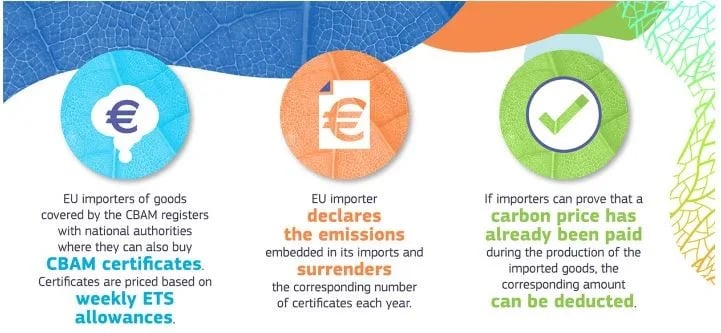
- CBAM is an import duty imposed by the European Union (EU) on goods produced by processes that lead to more carbon emissions than domestic European manufacturers are allowed to emit.
- It is introduced to put a “fair price” on carbon-intensive goods imported from non-EU countries.
- It is to create a level playing field with EU companies that account for their carbon emission through the bloc’s Emission Trading System (ETS).
- Application: To be imposed from January 1, 2026, on six items: steel, aluminium, cement, fertilizer, hydrogen, and electricity.
Concerns of Developing Nations
- Environmental Compliance: Discussions on CBAM are happening under the Trade and Technology Council (TTC), with India and developing nations arguing that environmental issues shouldn’t be tied to trade.
- Impact on Exports: The policy hurts the export competitiveness of developing countries such as China and India.
- CBAM could affect 43% of India’s exports to the EU, including metals, textiles, chemicals, electronics, and vehicles.
- CBAM could impose a 20-35% tax on specific imports like steel and aluminium.
- India’s metal sector is most vulnerable, with exports worth over $8 billion at risk.
- Violation of International Agreements: The Paris Agreement adopted in 2015 protects developing countries from the social and economic impacts of “response measures” against climate change.
- Dubai climate meeting (COP28) in 2023 acknowledged that “measures taken to combat climate change, including unilateral ones, should not constitute a means of arbitrary or unjustifiable discrimination or a disguised restriction on international trade”.
- Benefits Developed World: Industries in developed economies with emissions standards comparable to the EU’s stand to benefit from a CBAM-like measure.
- CBAM, therefore, can have the net effect of helping industries in the developed world, while putting those in developing countries at a disadvantage.
Way Ahead for India on CBAM
- Strengthen Global Negotiations through Alliances: India can actively collaborate with other developing countries, especially under platforms like the Trade and Technology Council (TTC), G77, and BASIC group, to push for a fair and equitable global carbon policy.
- Build Domestic Carbon Competitiveness: Invest in green technologies, cleaner industrial processes, and carbon accounting mechanisms to align with global emission norms.
- Establish a Carbon Market Framework: Developing a robust carbon market domestically, as India has already proposed, can help internalize carbon pricing and provide a benchmark that can be negotiated internationally.
- Sectoral Support for Affected Industries: Provide financial, technological, and policy support to vulnerable sectors such as steel, aluminium, and chemicals to help them reduce emissions intensity and comply with international standards.
- Develop a Counter-Policy Framework: India can consider formulating its own carbon border policy or tax incentives for green manufacturing, ensuring a level playing field domestically while signaling its readiness for fair environmental trade practices.
- Leverage EU–India Trade Talks: Use ongoing Free Trade Agreement (FTA) negotiations with the EU to seek exemptions, transitional arrangements, or mutual recognition mechanisms for Indian exporters under CBAM.
Source: IE
Previous article
Gujarat Bridge Collapse: Fragility of Public Infrastructure in India
Next article
Catastrophe Bonds (Cat Bonds)
