


Syllabus: GS2/ Governance/ Social Justice
Context
- The National Crime Records Bureau’s Prison Statistics 2024 report highlighted serious structural deficiencies in Delhi’s prison system, with jails recording the country’s highest occupancy rate of 194.6%.
Reasons Behind Rising Prison Overcrowding in India
- Judicial Delays: Large pendency of criminal cases results in prolonged incarceration of undertrial prisoners.
- Overcriminalization: Excessive use of imprisonment for minor offences contributes to congestion in prisons. Preventive detention laws and frequent arrests also increase the prison population.
- Bail-Related Challenges: Economically weaker sections often fail to secure bail due to financial constraints. Lack of awareness and inadequate legal assistance further prolong the detention.
- Inadequate Prison Infrastructure: Prison infrastructure expansion has not kept pace with the growing inmate population.
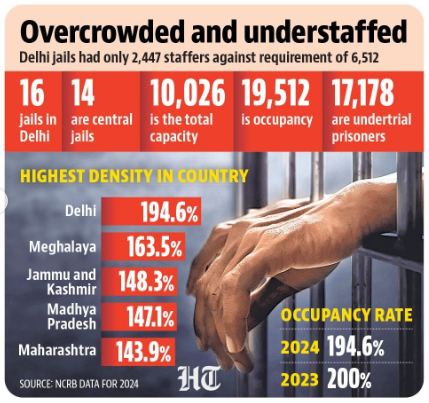
Concerns Associated with Prison Overcrowding
- Human Rights Concerns: Severe overcrowding results in poor living conditions, lack of sanitation, and inadequate healthcare facilities.
- Reports of violence, suicides, and custodial deaths tend to rise in highly congested prison systems.
- Impact on Reformative Justice: Indian prisons are constitutionally expected to function as reformative institutions rather than merely punitive spaces.
- However, overcrowding and administrative shortages weaken the reformative objective of prisons.
Committees on Prison Reforms
- Justice A.N. Mulla Committee: Formally the All India Committee on Jail Reforms (1980–83) recommended Separation of undertrial prisoners from convicts and improvement of prison conditions, nutrition, and sanitation.
- Justice Amitava Roy Committee: It recommended decongestion of prisons, speedy trials and legal aid reforms and use of technology for prison management.
- Krishna Iyer Committee: It advocated for separate jail facilities for women to prevent exploitation.
Judicial Interventions
- Hussainara Khatoon v. State of Bihar: The Supreme Court held that the right to a speedy trial is a fundamental right under Article 21.
- In State of Rajasthan vs. Balchand, the Supreme Court of India, established the foundational legal principle that “bail is the rule and jail is the exception,” reinforcing Article 21 regarding personal liberty.
Measures taken for Prison Reforms
- The State Legal Services Authorities have established Legal Service Clinics in jails, who provide free legal assistance to persons in need.
- The Ministry of Home Affairs had prepared a ‘Model Prisons and Correctional Services Act’ in the year 2023.
- The Model Act has appropriate provisions for reformation, rehabilitation and integration of prisoners in the society.
- It also has provision for ‘Welfare Programs for Prisoners’ and ‘After-Care and Rehabilitation Services’, as an integral part of institutional care.
Way Ahead
- Technology Integration: Digital prison management systems must be implemented for better record-keeping, monitoring, and transparency.
- Video conferencing must be expanded to facilitate court hearings and reduce delays.
- Social reintegration of prisoners: Prison systems must prioritize vocational training and skill development programmes to enhance employability of inmates after release.
- Strengthening Legal Aid: Legal aid mechanisms must be strengthened to ensure timely and effective representation for prisoners, particularly undertrials and economically weaker sections.
- Alternatives to Imprisonment: Community service, probation, and non-custodial punishments should be encouraged for minor offences.
- Open prison models should be expanded across states to reduce congestion and support rehabilitation.
Source: TOI
Previous article
NITI Aayog Report on School Education System in India
Next article
India-Canada Cooperation
