


Syllabus: GS2/Governance; GS3/Economy
Context
- The Union Budget 2026-27 proposes to build a ‘strong care ecosystem’ by training 1.5 lakh multiskilled caregivers in geriatric, core care and allied skills through programmes aligned with the National Skills Qualification Framework (NSQF).
What is Care Work?
- It mainly consists of two overlapping activities: direct, personal, and relational care activities, such as feeding a baby; and indirect care activities, such as cooking and cleaning.
- Unpaid care and domestic work, such as nursing an ill partner or cooking for a family member, is care work provided without monetary compensation.
- Paid care work such as domestic services provided by domestic workers is performed by care workers in exchange for some form of remuneration.
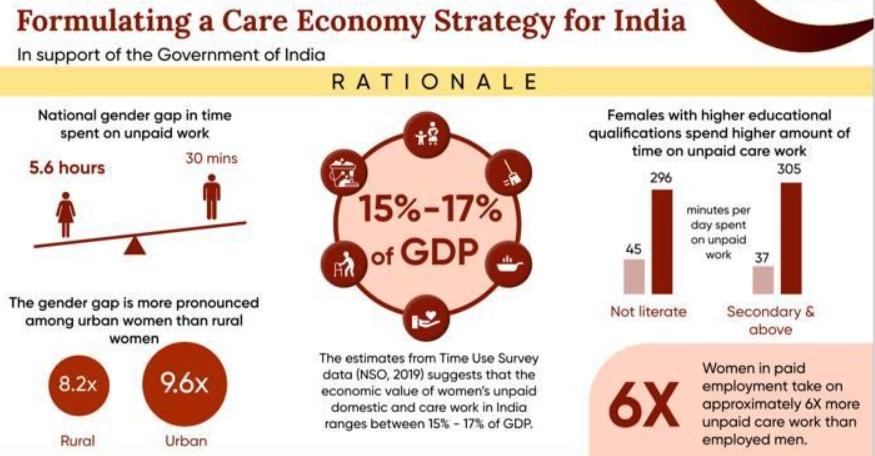
- Future Projections: Evidence from the International Labour Organisation suggests that increasing investments in the care services sector have the potential to generate 475 million jobs globally by 2030.
- For India specifically, direct public investment equivalent to 2% of GDP can potentially generate 11 million jobs, nearly 70% of which will go to women.
Challenges faced by Care Work Economy in India
- Informal and Unregulated Sector: A large share of paid care work (domestic workers, caregivers, childcare workers) operates in the informal sector.
- These care workers lack job security, minimum wages, and social protection.
- Inadequate Public Infrastructure: There is a shortage of childcare centres, elderly care facilities, and disability support services.
- Skill and Training Gaps: Many caregivers lack formal training and professional certification and there are limited skill development initiatives for the care workforce.
- Demographic Pressures: Ageing population and rising healthcare needs increase demand for care services and existing systems are not prepared to meet future care demands.
Government Initiatives
- Integrated Child Development Services (ICDS): Launched in 1975 to provide early childhood care, nutrition, health services, and preschool education through Anganwadi centres.
- Targets children (0–6 years), pregnant women, and lactating mothers.
- Provides supplementary nutrition, immunization, health check-ups, and preschool education.
- POSHAN Abhiyaan (National Nutrition Mission): Focuses on reducing stunting, undernutrition, and anaemia among women and children.
- Promotes behavioural change, use of technology (POSHAN Tracker), and convergence of health and nutrition services.
- Mission Shakti: Umbrella programme for women empowerment and safety.
- It includes schemes supporting childcare services and economic empowerment of women.
- Palna Scheme (National Crèche Scheme): It provides day-care facilities for children aged 6 months to 6 years.
- It offers nutrition, health care, and early learning support, helping mothers participate in the workforce.
- Operates under Mission Shakti with Centre–State funding support.
- Mission Vatsalya: Focuses on child protection services including adoption, foster care, and rehabilitation of vulnerable children.
- Strengthens institutional and non-institutional childcare systems.
- National Health Mission: Strengthens maternal and child healthcare services, including immunization and institutional deliveries.
- Improves health outcomes for women and children.
Way Ahead
- The need for a Care Economy Strategy in India is evident as India’s demographic landscape is expected to change between 2020 to 2050, necessitating more elderly care alongside continuing levels of childcare.
- By 2050, the proportion of elderly persons is expected to increase to 20.8% of the population, i.e. about 347 million persons.
- Enhancing investments in the care economy has the potential to not only bridge gender gaps in women’s labour force participation, but also unlock a new economic segment for emerging economies, creating increased economic output and jobs in the care work services sector.
Source: TH
Previous article
News In Short 07-03-2026
Next article
India’s ‘leaky pipeline’ Problem
