


Syllabus: GS1/Women Empowerment; GS2/Governance
Context
- India stands at a defining moment of her development journey with the narrative shifting decisively from women’s development to women-led development.
Status of Women in India
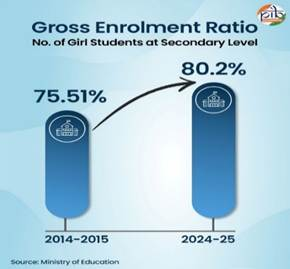
- Early Education: India has achieved gender parity index with gross enrolment reaching 1.0 at the foundational, preparatory, middle, and 1.1 at the secondary level.
- Higher Education: Female enrolment rose from 1.57 crore to 2.18 crore and Female GER improved from 22.9 to 30.2.
- The National Sex Ratio improved to 1020 for the first time (National Family Health Survey -5).
- Permanent commission granted to Women Officers in 12 Arms and Services.
- Entry of women as Agniveers commenced in all the three Services.
- Women in STEM Education: 43% of total enrolment at the higher education level is among one of the highest proportions of women STEM graduates globally.
- Women in Research: Female Ph.D. enrolment has more than doubled, with a remarkable 135.6% increase (from 2014-2015 to 2022-2023).
- Fellowship: Participation trends also reflect that women accounted for over 53% of STEM fellows under the UGC NET–Junior Research Fellowship during 2024–25.
Barriers to Women Led Development
- Gender Discrimination: Persistent cultural biases and stereotypes that limit opportunities for women in various sectors.
- Lack of Access to Education: Limited access to quality education, especially in rural areas, affecting girls’ future opportunities.
- Economic Inequality: Women often face wage gaps, limited job opportunities, and unequal financial independence.
- Safety and Security: High rates of gender-based violence, including sexual harassment, domestic violence, and trafficking.
- Health and Reproductive Rights: Limited access to healthcare, reproductive rights, and maternal health services.
- Child Marriage: Prevalence of child marriage, particularly in rural areas, which affects women’s health, education, and autonomy.
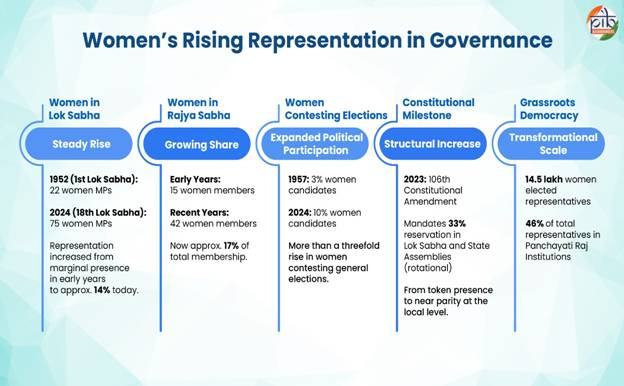
- Political Representation: Underrepresentation in political offices and decision-making roles.
- Social Norms and Expectations: Rigid societal roles that limit women’s freedom and opportunities for self-expression and growth.
- Workplace Harassment: Gender-based harassment and lack of proper support structures in workplaces.
India is a signatory to international treaties such as
- Universal Declaration of Human Rights (1948).
- International Covenant on Civil and Political Rights (ICCPR, 1966).
- Convention on the Elimination of All Forms of Discrimination Against Women (CEDAW, 1979).
- Beijing Declaration and Platform for Action (1995).
- United Nations Convention Against Corruption (2003).
- Agenda 2030 for Sustainable Development.
International Women’s Day
- Every Year International Women’s Day is celebrated on the 8th March.
- Vladimir Lenin declared March 8 as International Women’s Day in 1922 to recognise the women’s role in the 1917 Russian Revolution.
- It was officially recognized by the United Nations in 1977.
- The 2026 theme is “Rights. Justice. Action For ALL Women and Girls.”
Key Constitutional Provisions Supporting Gender Equality
- Article 15: Prohibits discrimination on grounds of religion, race, caste, sex or place of birth, while enabling the State to make special provisions for women and other disadvantaged groups to promote substantive equality.
- Article16: Guarantees equality of opportunity in public employment, ensuring that all citizens have equal access to government positions without discrimination on grounds such as religion, race, caste, sex or place of birth.
- Article 39: Directs the State to ensure equal livelihood opportunities for men and women.
- Article 51(a)(e) encourages citizens to renounce practices derogatory to women’s dignity.
- Article 42: Mandates provision for maternity relief and humane working conditions
- Article 243: One-third of all directly elected seats and chairperson positions in Panchayats and Municipalities are reserved for women (including SC/ST women), with rotation among constituencies, and SC/ST reservations as provided by state law.
Source: PIB
Previous article
Women in Indian Armed Forces
Next article
AI & Future of Work: Anthropic’s Labour Market Study
