


Syllabus: GS3/Role of IT
Context
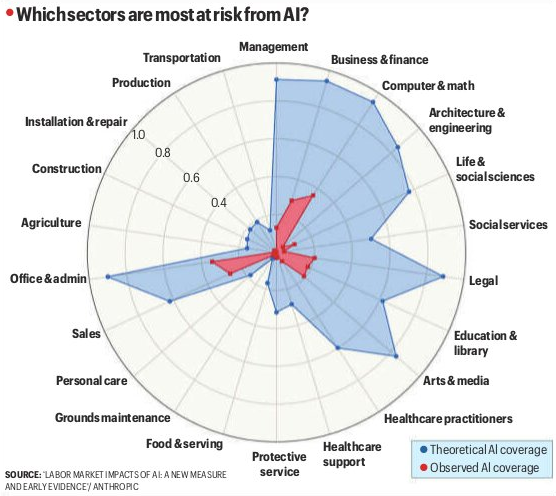
- A recent labour market study by Anthropic highlights the growing gap between the theoretical capabilities of AI and its actual workplace usage, and reveals early signals of structural shifts in employment.
Key Highlights of Anthropic’s Labour Market Study
- Introduction of a New Metric: A new measure called ‘Observed Exposure’ to assess the impact of AI on jobs.
- It combines task-level occupational data, academic estimates of AI capability, and real-world usage data from the Claude AI system.
- Large Gap Between AI Capability and Actual Usage: The study found that AI’s theoretical ability to perform job tasks is much higher than its current use in professional settings.
- For example, Large Language Models (LLMs) could theoretically perform around 94% of tasks for computer and mathematics workers, but real-world usage currently covers only about 33% of those tasks.
- Knowledge-Based Occupations Most Exposed to AI: Jobs involving data analysis, coding, writing, and documentation show the highest exposure to AI. Key occupations identified include computer programmers, financial analysts, customer service representatives, legal professionals, business analysts, office and administrative workers.
- Decline in Entry-Level Hiring: Since the launch of ChatGPT, hiring in AI-exposed occupations has shown noticeable changes.
- Entry into high-exposure jobs among workers aged 22–25 has fallen by about 14%.
- Companies are reducing recruitment in entry-level positions such as junior developers, graduate trainees, and analysts.
- AI Impact Seen More in Hiring Than Layoffs: Instead of large-scale layoffs, firms are slowing down new hiring while evaluating how much work AI systems can perform.
- It suggests that the early impact of AI is on labour market entry rather than existing employment.
- Implications for Global Economies: Although the study focuses on the United States, its findings have global relevance.
- Countries with large IT, business services, and knowledge-work sectors, such as India may face significant labour market shifts due to AI-driven automation.
- Early Stage of AI-Induced Labour Market Transformation: The report concludes that while AI has strong potential to transform work, current adoption remains limited.
- However, the trends in hiring patterns suggest early structural changes that could reshape future employment markets.
Demographic Patterns in AI Exposure
- Gender: 54.4% of workers in the most AI-exposed occupations are female, compared with 38.8% in less exposed roles.
- It reflects the concentration of women in sectors such as administration, business services, and knowledge work where AI tools are rapidly expanding.
- Education: Workers with Bachelor’s or graduate degrees are disproportionately represented in high-exposure jobs.
- Individuals with graduate degrees are nearly four times more likely to be in highly exposed occupations compared with low-exposure groups.
- It suggests that AI disruption may initially affect highly skilled knowledge workers rather than manual labour sectors.
- Ethnicity: The data indicates demographic variation:
- White workers constitute about 65.1% of the highly exposed group.
- Asian workers are nearly twice as likely to be in high-exposure occupations.
- Black and Hispanic workers are comparatively underrepresented in these categories.
Sectors Relatively Insulated from AI
- Occupations requiring physical labour, manual dexterity, or real-world interaction remain less vulnerable. It includes construction, agriculture, protective services, personal care services, and skilled trades.
- These roles depend heavily on physical presence, situational awareness, and human interaction, making them harder for current AI technologies to automate.
Implications for India (Large IT Services & Knowledge-work Economy)
- Risk to the IT Services Sector: India’s IT services industry, dominated by companies such as Tata Consultancy Services (TCS), Infosys, Wipro relies heavily on services like data processing, contract analysis, compliance monitoring, and customer support.
- These are precisely the areas where AI tools are advancing rapidly.
- Recent developments highlight growing concerns:
- The Nifty IT index and major IT stocks have fallen by around 20% over the past year.
- Analysts at Motilal Oswal estimate that 9–12% of IT services revenues could disappear over the next four years, translating to about 2% annual revenue growth loss.
- These concerns intensified after Anthropic launched AI workplace automation tools capable of performing tasks such as contract review, legal compliance monitoring, financial analytics, sales data analysis.
- Such tools challenge the outsourcing-based service model on which much of India’s IT sector depends.
Structural Challenges For India
- Skill Gaps: A significant portion of the population lacks strong mathematical and scientific skills.
- Low R&D Investment: India’s spending on research and development remains far lower than the US and China.
- Education System Limitations: Insufficient emphasis on advanced technology training and innovation.
- Without significant improvements in these areas, India risks falling behind in the global AI-driven economic transition.
Way Forward
- While AI presents risks to certain job categories, it does not necessarily imply widespread unemployment. Instead, it signals a structural shift in the nature of work.
- For policymakers and economies like India, key priorities include:
- Skilling and reskilling programmes;
- Investment in AI research and innovation;
- Education reforms focused on STEM and digital skills;
- Encouraging AI-driven entrepreneurship;
- Adapting early to these changes will be crucial in ensuring that AI becomes a tool for productivity and growth rather than a source of economic disruption.
Previous article
From Women’s Development to Women-led Development
Next article
News In Short 09-03-2026
