


Supreme Court’s Victim Protection Plan for Human Trafficking Survivors
Syllabus: GS2/ Polity and Governance
Context
- The Supreme Court of India in the Prajwala vs. The Union of India case framed a comprehensive Victim Protection Plan for survivors of trafficking for commercial and sexual exploitation (CSE), citing a legislative vacuum and inadequate rehabilitation.
Key Elements of the Victim Protection Plan
- Fundamental Right to Rehabilitation: The Court affirmed that the right to rehabilitation is an integral component of Article 21 (Right to Life with Dignity) and Article 23 (Right against Exploitation).
- Relying on Bandhua Mukti Morcha v. Union of India and Neerja Chaudhary v. State of Madhya Pradesh, the Court held that rescue alone is insufficient; rehabilitation is an essential part of justice.
- Consent-Centered Approach: The court drew a strict distinction between victims of coercive trafficking and consenting adult sex workers, holding that the latter cannot be detained or rehabilitated against their will.
- Institutional Coordination: The ruling integrates provisions of the Juvenile Justice Act and POCSO into a uniform protocol.
- It should improve coordination between Child Welfare Committees (CWCs), Anti-Human Trafficking Units (AHTUs), and District Legal Services Authorities (DLSAs).
- Systemic Support Infrastructure: The Centre and State governments must establish standardized safehouses, legal aid, medical and psychological care facilities, and vocational training programmes.
Source: IE
Economic Advisory Council to the Prime Minister (EAC-PM)
Syllabus: GS2/Governance
Context
- The Prime Minister chaired a meeting of the Economic Advisory Council to the Prime Minister (EAC-PM) during which members discussed measures to sustain and accelerate India’s economic growth amid an uncertain global environment.
Economic Advisory Council to the Prime Minister (EAC-PM)
- The EAC-PM, an independent body constituted to advise the Prime Minister on economic and related issues, is currently chaired by S. Mahendra Dev.
- Members: At present, there are a Chairman, 3 Full-Time Members and 11 Part-Time Members in the EAC-PM.
- Functions: Analyzing any issue, economic or otherwise, referred to it by the Prime Minister and advising him thereon, addressing issues of macroeconomic importance.
- These could be either suo-motu or on reference from the Prime Minister or anyone else.
- They also include attending to any other task as may be desired by the Prime Minister from time to time.
Source: PIB
PM E-DRIVE
Syllabus: GS3/ Energy/ Environment
Context
- The Delhi Government has announced the induction of 2,800 new low-floor electric buses under the PM Electric Drive Revolution in Innovative Vehicle Enhancement (PM E-DRIVE) scheme to strengthen public transport and accelerate the transition towards sustainable urban mobility.
About the Scheme
- The PM E-DRIVE Scheme was launched by the Government of India in 2024 to accelerate the transition towards electric mobility.
- The scheme has a total financial outlay of ₹10,900 crore.
- Duration: Initially approved for two years (2024–26), its duration has now been extended to 31 March 2028, while retaining the same outlay.
- Objectives:
- To accelerate the adoption of electric vehicles (EVs) across the country.
- To develop a robust EV charging infrastructure.
- To strengthen the domestic EV manufacturing ecosystem.
- To reduce dependence on fossil fuels and lower vehicular emissions.
- To promote the Make in India initiative through the Phased Manufacturing Programme (PMP).
- The scheme supports the procurement of 14,028 electric buses across nine major cities with populations exceeding 40 lakh.
Source: IE
Pyroprocessing
Syllabus: GS3/Science & Technology
Context
- Pyroprocessing has been the subject of study in Japan, South Korea, and the United States and is being explored as part of advanced fast reactor programmes.
What is pyroprocessing?
- Pyroprocessing is a high-temperature process used to bring about physical or chemical changes in materials.
- It is a dry and energy-intensive process widely used in industries such as cement manufacturing, metallurgy, and nuclear energy.
Applications of Pyroprocessing
- Cement Industry: Used to convert limestone and other raw materials into clinker, the key ingredient in cement.
- Metallurgy: Employed in processes such as roasting, smelting, and calcination to extract metals from ores.
- Nuclear Sector: Used for reprocessing spent nuclear fuel through electrochemical separation in molten salts, enabling the recovery of valuable materials for reuse.
Source: TH
Major Abhilasha Barak Conferred UN Award
Syllabus: GS2/IR
Context
- Prime Minister congratulated Major Abhilasha Barak on being conferred the UN Military Gender Advocate of the Year Award.
About
- Major Barak is currently serving with the United Nations mission in Lebanon, has been honoured with the award for her outreach efforts with women and girls during her deployment in the West Asian nation.
- She is also the first woman combat helicopter pilot of the Indian Army.
- Each year, the awardee is selected from among candidates nominated by force commanders and heads of mission from all peace operations.
- India is among the largest troop and police contributing countries to UN peacekeeping missions.
United Nations Peacekeeping Missions
- The United Nations Peacekeeping Missions are operations deployed by the United Nations to maintain international peace and security in conflict-affected regions.
- First peacekeeping mission was established in 1948, to monitor the armistice between Israel and its Arab neighbors.
- It was established and tasked by the UN Security Council.
- It serves as an important instrument of collective security and aims to prevent conflicts, protect civilians, support political processes, and assist countries in transitioning from conflict to peace.
- Key UN Peacekeeping Missions:
- MINUSTAH (Haiti): Worked for political stabilisation, security and humanitarian assistance in Haiti (2004–2017).
- UNMISET (East Timor): Supported stability, governance and security in East Timor (2002–2005).
- UNMIL (Liberia): Assisted peacebuilding, disarmament and post-conflict recovery in Liberia (2003–2018).
- MINURCAT (Central African Republic & Chad): Focused on civilian protection and regional stability (2007–2010).
- UNMOGIP (India–Pakistan): Monitors the ceasefire situation between India and Pakistan in Jammu & Kashmir (since 1949).
- The United Nations Peacekeeping Forces were awarded the Nobel Peace Prize in 1988.
Principles of UN Peacekeeping
- Consent of the Parties: Peacekeeping operations require acceptance from major conflicting parties to operate effectively.
- Impartiality: Peacekeepers must remain neutral and unbiased among parties.
- Non-use of Force Except in Self-defence and Defence of Mandate: Force may be used only in self-defence, to protect civilians, and to implement the mission mandate.
Source: TH
Department of Consumer Affairs Prescribes Standard Pack Sizes for Edible Oils
Syllabus: GS3/Economy
Context
- The Centre has introduced standard pack sizes for edible oils under the Legal Metrology framework, bringing greater transparency and uniformity to the marketplace.
About
- Under the revised rules, standard pack sizes have been prescribed for major edible oils, including palm oil, palmolein, soyabean oil, sunflower oil, mustard oil, groundnut oil, sesame oil, rice bran oil, cotton seed oil and corn oil.
- The approved pack sizes are 200 g, 500 g, 1 to 5 kg, 15 kg, and 20 kg.
- The initiative seeks to address the growing proliferation of varying package sizes in the market, which often makes it difficult for consumers to compare prices and make informed purchasing decisions.
- Significance:
- This will also help consumers make more informed and transparent purchasing decisions.
- The initiative will also benefit the edible oil industry by bringing greater uniformity in packaging practices.
Legal Metrology
- Legal Metrology is the application of legal requirements to measurements and measuring instruments.
- The objective of Legal Metrology is to ensure public guarantee from the point of view of security and accuracy of the weightments and measurements.
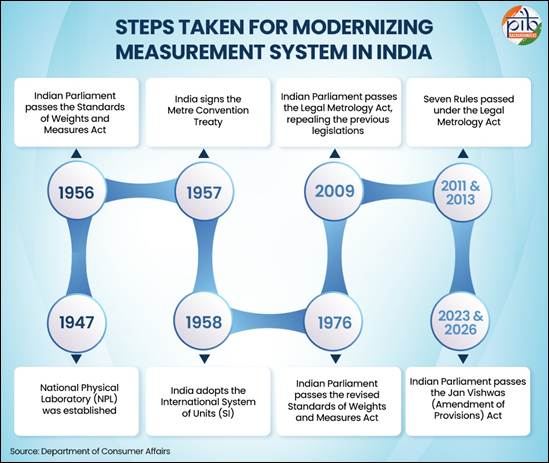
- India became a member of the International Organization of Legal Metrology (OIML) in 1956.
- In 2023, it became the 13th country globally authorized to issue internationally accepted OIML approval certificates for weighing and measuring instruments.
- This recognition enables Indian manufacturers to export instruments worldwide without additional international testing costs, while also strengthening India’s role in global trade, standard-setting, and Legal Metrology governance.
Source: AIR
Food Planet Prize 2026
Syllabus: Miscellaneous
Context
- The Andhra Pradesh Community Managed Natural Farming (APCNF) programme has won the Food Planet Prize 2026.
About the Prize
- The Food Planet Prize was established in 2019 by the Curt Bergfors Foundation, Sweden.
- It is regarded as the world’s largest environmental award dedicated to transforming global food systems.
- The award carries a prize of US$ 1.5 million (about ₹14 crore).
- APCNF’s selection marks the first time an Indian initiative has won the award.
APCNF Programme
- Launched in 2016 through Rythu Sadhikara Samstha (RySS), the programme promotes natural farming by reducing dependence on chemical fertilisers and pesticides.
- Today, it covers over 8,000 villages and nearly 18 lakh farmer families, making it one of the world’s largest community-led agroecology initiatives.
- The programme works through women’s self-help groups and a network of more than 10,000 community resource persons, helping farmers reduce cultivation costs and improve incomes.
- The Andhra Pradesh model is now being studied and replicated in several Indian states, as well as countries like Sri Lanka and Zambia.
Source: TH
Previous article
Ease of Doing Business: Strengthening India’s Business Framework
Next article
India’s New Bilateral Investment Treaty (BIT) Model
