


Syllabus: GS2/Governance; GS3/Science and Technology
Context
- In 2026, the Union Cabinet approved the Mission for Cotton Productivity with an outlay of Rs 5,659 crore, to run from 2026-27 to 2030-31.
About
- The intent of the Mission for Cotton Productivity is to raise lint productivity from 441 kg per hectare (in triennium ending (TE) 2025-26) to 755 kg/ha by 2031.
- Experts argue that India’s Mission for Cotton Productivity may struggle to revive yields and exports unless next-generation genetic technologies and science-led reforms are adopted.
Introduction of BT Cotton in India
- In 2002, the government approved the commercial cultivation of Bt cotton as cleared by the Genetic Engineering Appraisal Committee (GEAC).
- The first Bt hybrids incorporating the cry1Ac gene were approved to resist the bollworm complex.
- By 2006, GEAC had approved Bollgard II, a second-generation hybrid with two stacked genes.
Bt Cotton
- Bt cotton has two alien genes from the soil bacterium Bacillus thuringiensis (Bt) that allows the crop to develop a protein toxic to the common pest pink bollworm.
- Till now, it is theonly Genetically Modified (GM) crop that is allowed in India.
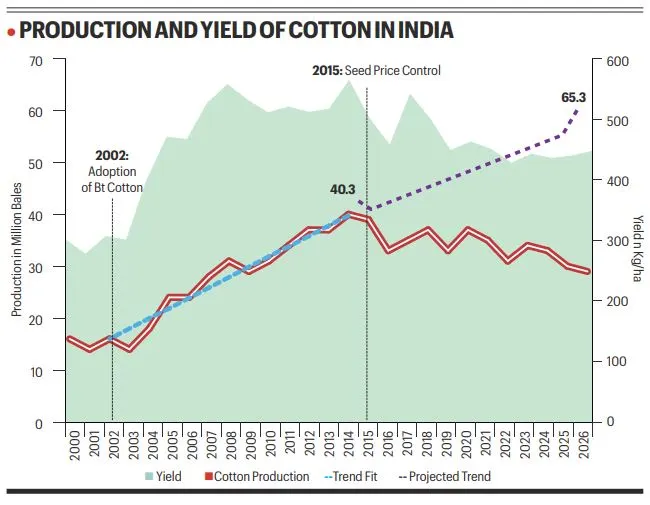
- Impact on Cotton production: It rose from 13.6 million bales in 2002-03 to 39.8 million bales in 2013-14, a 193% increase.
- Annual output grew at 10%, and area expanded by 56%, from 7.6 million hectares (mha) to 11.9 mha.
- India became the largest producer and second-largest exporter of cotton.
- Further Hybrids: After Bollgard II, India developed the next generation: Bollgard II with Roundup Ready Flex, and Bollgard III.
- These variants incorporate three stacked genes with herbicide-tolerant traits designed to address evolving pest resistance and rising weed-management costs. But they were not released.
- Decline in Production: Since 2014-15, production has declined at an average annual rate of 2%. India went from a net cotton exporter to importing 4 million bales in 2025-26.
Reasons for Decline in Cotton Production and Related concerns
- Regulatory hurdles for GM technology: New-generation cotton technologies were not commercialized due to regulatory uncertainties and delays.
- Price controls on cotton seeds: Government-imposed seed price caps and reduction of trait fees reduced incentives for private-sector R&D and innovation.
- Declining productivity: Cotton yields have stagnated due to pest resistance, climate stress, and lack of access to advanced technologies.
- Increasing imports: India has shifted from being a major exporter to importing cotton because domestic production growth has slowed.
Way Ahead
- Develop Climate-Resilient Cotton Varieties: Invest in research for drought-tolerant, pest-resistant, and high-yielding cotton varieties suited to changing climatic conditions.
- Strengthen Public-Private R&D Partnerships: Encourage collaboration between research institutions, universities, and the private sector to accelerate the development and dissemination of advanced technologies.
- Enhance Seed Quality and Availability: Ensure timely access to certified, high-quality seeds through robust seed production and distribution systems.
- Strengthen Extension Services: Improve last-mile delivery of scientific knowledge, best practices, and weather advisories to cotton farmers.
- Improve Cotton Value Chains: Modernise ginning, processing, storage, and marketing infrastructure to enhance cotton quality and global competitiveness.
- Implement the Cotton Productivity Mission Effectively: Focus on outcome-based implementation, regular monitoring, and convergence with existing agricultural schemes to achieve productivity and income gains.
Conclusion
- A combination of technological innovation, supportive regulation, climate resilience, and efficient value chains is essential to restore India’s cotton productivity and strengthen its position in the global textile economy.
Source: IE
Previous article
Reforms to Expand Foreign Participation in G-Secs
