


Syllabus: GS3/Economy
Context
- An inter-ministerial group (IMG) has recommended asset monetisation proposals worth over Rs 1,100 crore for consideration and approval by the Cabinet-delegated Alternative Mechanism (AM).
About
- The IMG reviewed proposals primarily involving surplus land and building assets of Central Public Sector Enterprises (CPSEs).
- The recommendations are aimed at facilitating the productive use of surplus and underutilised public assets while generating economic value for government entities.
- The proposals will now be placed before the Cabinet-delegated Alternative Mechanism for consideration and approval.
Asset Monetization
- Asset Monetization involves creation of new sources of revenue by unlocking the value of hitherto unutilized or underutilized public assets.
- These assets could be categorized, broadly, into the following classes:
- Land and Buildings, brown-field operational assets such as pipelines, roads, mobile towers etc., financial assets like equity shares, debt securities, other hybrid/ structured finance asset units etc.
- Decision-making bodies:
- An Alternative Mechanism (AM), comprising Union Finance Minister, Minister of Road Transport and Highways and Minister of the concerned Administrative Ministry.
- An Inter-Ministerial Group (IMG) Chaired /Co-Chaired by Secretary, DPE and Secretary of the Administrative Department.
- Representatives of the Department of Expenditure, Department of Legal Affairs, Ministry of Corporate Affairs and Financial Advisor (DPE) not below the rank of JS shall be members of the IMG.
- IMG can co-opt any other member as per its discretion.
Asset Monetisation Programme
- The initiative forms part of the government’s broader asset monetisation programme, which seeks to help CPSEs and other government entities realise the economic potential of surplus assets through systematic assessment, professional transaction preparation and competitive price discovery.
- The National Land Monetization Corporation (NLMC), the government’s specialised agency for monetising surplus land and other non-core assets, plays a key role in facilitating the process.
- It works with concerned ministries, departments and asset-owning entities.
- It undertakes asset assessment, due diligence, valuation, transaction structuring and market-oriented monetisation activities.
- The government aims to improve public asset management, ensure transparency in monetisation and maximise the value of surplus assets to support investment and economic development.
About NLMC
- The National Land Monetization Corporation (NLMC) is a wholly owned Government of India company under the administrative control of the Department of Public Enterprises, Ministry of Finance.
- It was established following an announcement in the Union Budget 2021-22.
- NLMC facilitates the monetisation of surplus land and other non-core assets of CPSEs and Government entities through professional transaction advisory, due diligence, valuation and transparent, competitive monetisation processes.
About National Monetisation Pipeline 2.0
- The Union Budget 2025-26, identified monetisation of operating public infrastructure assets as a key means for sustainable infrastructure financing.
- The Budget provided for preparation of a ‘National Monetisation Pipeline 2.0 (NMP 2.0)’.
- NMP 2.0 aims to provide a medium-term roadmap of the programme for public asset owners; along with visibility on potential assets to the private sector.
- Framework: Asset monetisation shall comprise elements such as transfer of assets for a limited period, divestment of portions of listed entities to unlock additional capital, securitisation of cash flows or strategic commercial auctions.
- NMP 2.0 is divided into five stages:
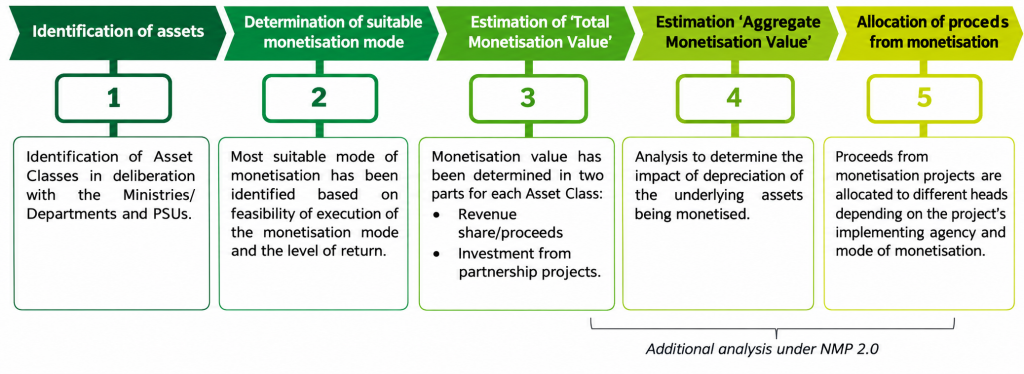
The proceeds from asset monetisation projects are allocated to four different heads:
- Consolidated Fund of India: Any type of Government revenue from a monetisation project that is implemented by a Central Ministry (for example, revenue share, premium, lease rental, royalty) shall flow to the Consolidated Fund of India.
- PSU/Port Authorities allocation: Proceeds from monetisation activities undertaken by PSUs shall accrue to the concerned PSU (similar norm shall be followed for Major Port Authorities).
- State Consolidated Fund: Certain projects under NMP 2.0 are expected to generate revenues to the State Governments, especially those belonging to the mines and coal sectors (royalty payments). These proceeds shall accrue to the State Consolidated Fund.
- Direct investment (private): This head shall record the investment by the private sector in monetisation projects that involve construction and/or major maintenance components.
Source: DD
Previous article
Entry of Private Players in Nuclear Sector and Related Concerns
