


Syllabus: GS3/Economy
In News
- The Union Budget 2026–27 has introduced a new scheme to assist States in setting up three dedicated Chemical Parks with a budgetary allocation of Rs 600 crore in BE FY 2026–27.
What are Chemical Parks?
- Chemical parks are planned industrial clusters explicitly designed for chemical and petrochemical manufacturing, where multiple units operate together, sharing world-class infrastructure and common services.
- They are envisaged as cluster-based, plug-and-play manufacturing ecosystems, supported by common infrastructure and shared facilities.
- They are intended to strengthen domestic manufacturing capabilities, enhance supply-chain integration, and reduce import dependence in the chemicals sector.
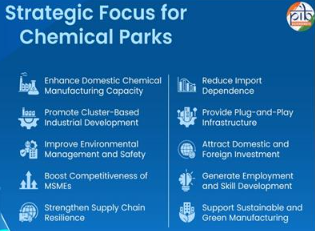
Importance
- India’s chemical industry is increasingly moving toward cluster-based, integrated development, building on the success of Plastic Parks, Bulk Drug Parks, and Petroleum, Chemicals and Petrochemicals Investment Regions (PCPIRs).
- The proposed Chemical Parks aim to extend this model across the entire chemical value chain, offering plug-and-play infrastructure, shared utilities, logistics support, and streamlined regulatory facilitation.
- These parks are expected to reduce project timelines and costs, enable economies of scale, strengthen value chain integration, and improve environmental and safety management.
Status of Chemical Industry in India
- India ranks as the world’s sixth-largest chemical producer and third in Asia.
- India’s chemical industry contributes about 7 percent to national GDP.
- The Economic Survey 2025–26 notes that the chemical sector accounted for 8.1 percent of manufacturing Gross Value Added in FY24, alongside a steady rise in output over the past decade.
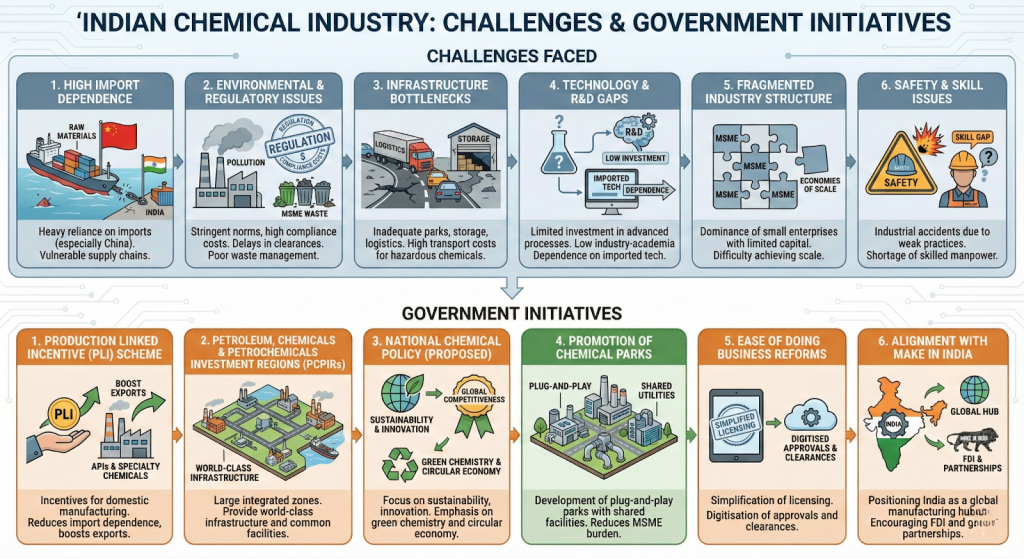
Source :PIB
Next article
Strengthening India’s Textile Value Chain
