


Syllabus: GS 2/Governance
In News
- President Joe Biden granted an unconditional pardon to his son, Hunter Biden, for tax and gun convictions.
U.S. President’s Pardon Procedure
- The U.S. President has the power to grant pardons for federal criminal offenses under the U.S. Constitution, except in cases of impeachment.
- Does not erase the criminal record but alleviates penalties and restores certain rights.
- Discretionary Nature: The president has unilateral clemency authority, independent of Congressional approval.
Pardoning Power in Indian system
- Article 72 and Article 161 of the Indian Constitution grant the President and Governors the power to pardon or alter sentences, based on the advice of the council of ministers.
- A pardon in India absolves the offender from conviction, punishment, and disqualifications.
- Scope of Pardon Power: Article 72 (President’s Power): The President can grant pardons, reprieves, respites, or remissions for federal offenses, including death sentences and cases involving Union laws.
- Article 161 (Governor’s Power): Governors can grant similar powers for state offenses and matters under the State’s executive authority.
Comparison of US and Indian Pardon Powers
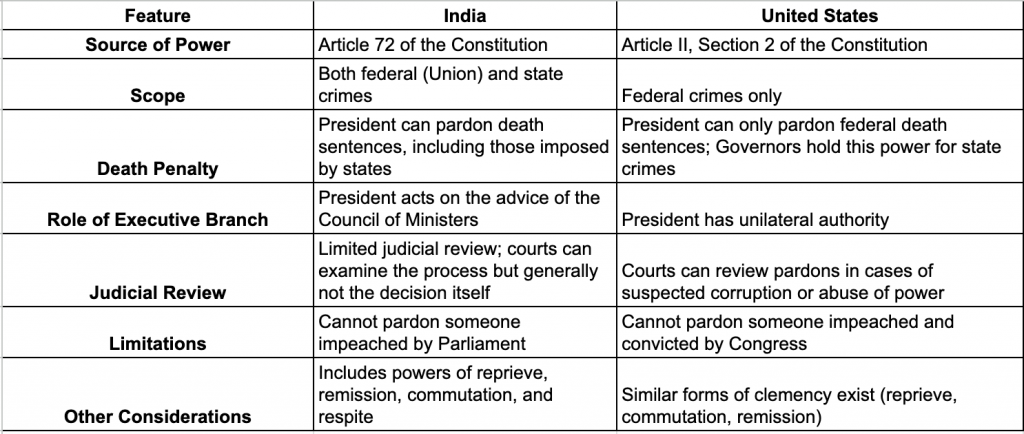
Legal and Ethical Concerns
- Arbitrariness: Critics argue that the power can be exercised arbitrarily, leading to perceptions of favoritism or political bias.
- Lack of Transparency: The decision-making process behind granting pardons is often opaque, leading to calls for greater transparency and accountability.
- Impact on Justice System: Pardons can undermine the judiciary’s authority and the principle of equal justice under the law.
What can be the way forward?
- The power to pardon is a vital tool for justice and mercy, but its use must be carefully balanced to avoid undermining the rule of law and public trust in the justice system.
- For modern democracies, pardoning power should be exercised transparently, without nepotism or arbitrariness, to maintain public trust in constitutional offices.
| Difference Between Statutory and Constitutional Power – Statutory Power: Under the CrPC (Sections 432-435), the “appropriate government” can grant remission or commutation. For cases investigated by Central agencies like the CBI, the State must consult the Central government. – Constitutional Power: Under Articles 72 and 161, the President and Governor act on the advice of the government to grant clemency, not independently. The two powers (statutory and constitutional) are separate, as clarified by the Supreme Court in cases like Maru Ram (1980) and Kehar Singh (1988). 1. The Supreme Court has ruled it can be subject to judicial review in cases of arbitrariness or improper motives. |
Source: TH
Previous article
News In Short 03-12-2024
Next article
Nano Bubble Technology
