


Syllabus: GS3/ Energy and Infrastructure
Context
- India is expanding its pumped storage hydropower capacity to support renewable energy integration, grid stability, and energy security.
Need for Pumped Storage Hydropower
- As of September 2026, India has 308.027 GW of installed non-fossil fuel-based electricity generation capacity.
- During FY 2025–26, India added around 55.29 GW of non-fossil fuel capacity. It has also set a target of 500 GW of non-fossil fuel capacity by 2030.
- However, renewable energy generation varies, and this variability creates a growing need to store electricity when renewable generation exceeds demand.
- The Central Electricity Authority (CEA) projects 73.93 GW of storage capacity by 2031–32.
- This includes 26.69 GW from Pumped Storage Projects (PSPs) and 47.24 GW from Battery Energy Storage Systems (BESS).
What is Pumped Storage Hydropower (PSH)?
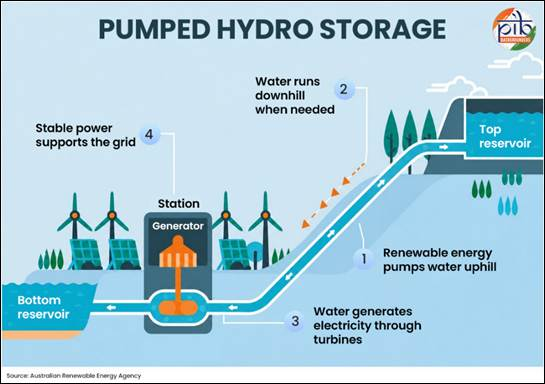
- Pumped Storage Projects (PSPs) are large-scale energy storage systems that use water and gravity to store electricity. They are often described as “water batteries”.
- A typical PSP consists of two reservoirs at different elevations.
- During periods of surplus electricity, water is pumped from the lower reservoir to the upper reservoir.
- When demand rises, the stored water is released through turbines to generate electricity.
- PSPs help balance fluctuations in solar and wind power generation, meet peak electricity demand, and improve grid reliability.
Classification of Pumped Storage Power Plants
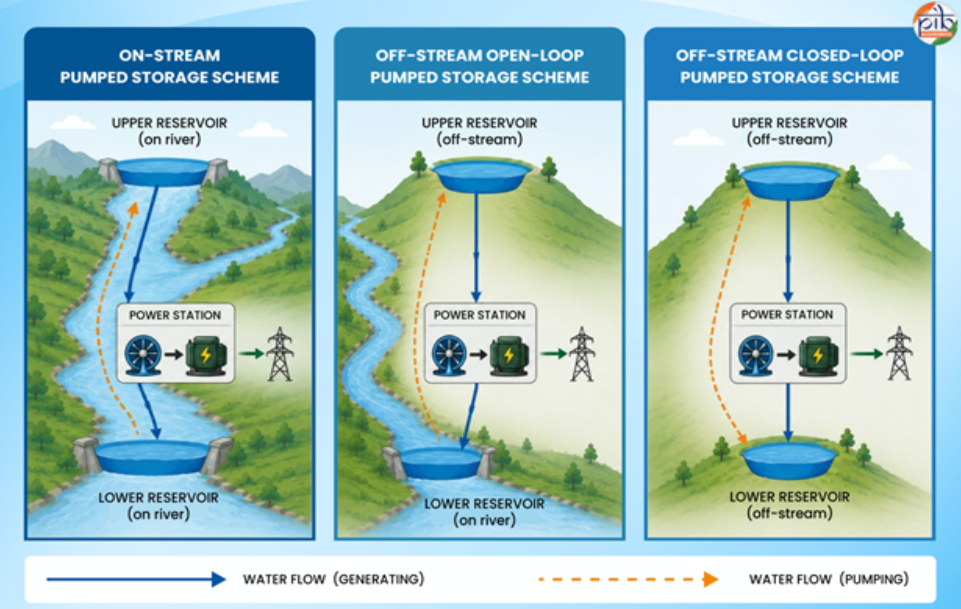
- PSPs are classified according to how their reservoirs are connected to, or in relation to, natural watercourses.
- They are grouped into three types: on-stream, off-stream open-loop and off-stream closed-loop schemes.
India’s Pumped Storage Momentum
- Operational Capacity: As of August 2026, India has 7.43 GW of operational PSP capacity across 10 projects. The projects have installed capacity above 25 MW.
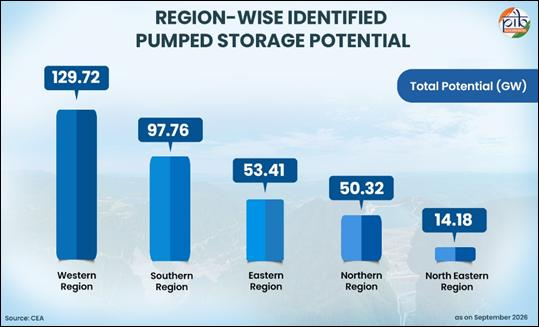
- India has identified 320 pumped storage projects with a combined potential of 345.38 GW.
- This includes 62 on-stream projects with 56.67 GW and 258 off-stream projects with 288.71 GW.
Global Installed Capacity PSPs
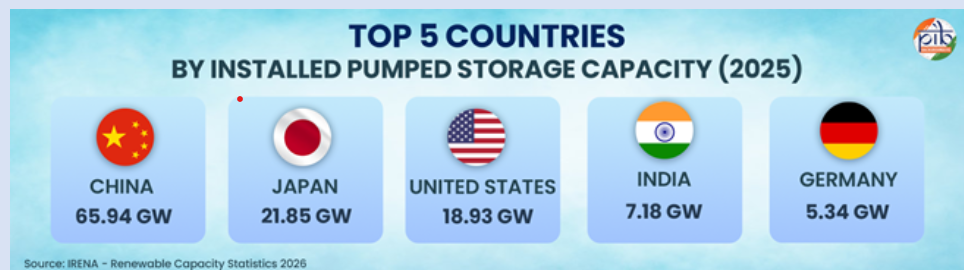
- Global installed pumped hydro capacity stood at 159.8 Gigawatts at the end of 2025, according to the International Renewable Energy Agency (IRENA).
Initiatives taken by India
- Dedicated PSP Development Guidelines: The Ministry of Power notified the Guidelines to Promote Development of Pumped Storage Projects in India in April 2023.
- Tariff-Based Competitive Bidding: Guidelines notified in 2025 provide a framework for procuring storage capacity and stored energy.
- Transmission charge waiver: Eligible PSPs awarded for construction by 30 June 2028 can receive a 100% Inter-State Transmission System (ISTS) charge waiver for 25 years from commercial operation.
- Faster approvals: The CEA’s timeline for Detailed Project Report concurrence has been reduced from 90 days to 50 days.
- Integrated planning: The government is integrating energy storage and transmission planning to improve grid flexibility and accommodate greater renewable energy capacity.
What are the Challenges?
- High initial capital costs and long construction periods.
- Geographical constraints, including suitable elevation differences, geology and water availability.
- Potential environmental impacts on forests, aquatic ecosystems and local communities.
- The need for transmission connectivity, clearances and coordinated project execution.
Concluding Remarks
- Pumped storage hydropower can play an important role in India’s clean energy transition by providing long-duration storage, improving grid flexibility and enabling greater integration of renewable energy.
- Its successful expansion will depend on balancing infrastructure development with environmental safeguards and efficient project implementation.
Source: PIB
Previous article
Need for a National Urbanisation Policy in India
Next article
News In Brief 04-11-2026
