


Syllabus: GS2/Polity & Governance
Context
- The World Day Against the Death Penalty is observed annually on October 10 to advocate for the abolition of capital punishment.
- It was designated and first organized by the World Coalition Against the Death Penalty in 2003.
About
- In Bachan Singh v. State of Punjab (1980), the Constitution Bench upheld the death penalty, but imposed specific conditions in the shape of guidelines for the exercise of judicial discretion.
- Now in Section 393(3) of the Bharatiya Nagarik Suraksha Sanhita (BNSS), 2023, life imprisonment was to be the norm, and death sentence could be imposed only for “special reasons”.
- Courts were to weigh the circumstances of the crime alongside those of the accused, and impose death only where life imprisonment was “unquestionably foreclosed”.
Death Sentence in India
- In 2024, for the second consecutive year, the Supreme Court of India didn’t confirm any death sentence, revealed a report from Project 39A of the National Law University Delhi.
- Prisoners on Death Row in India
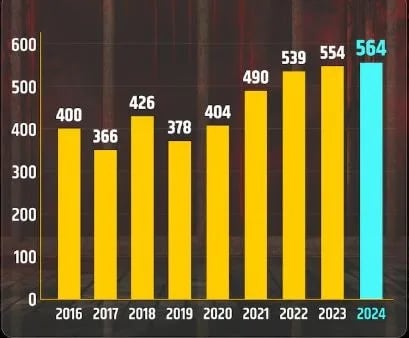
- In India, capital punishment, also known as the death penalty, is carried out by “hanging by the neck until death”.
- Several countries like Portugal, the Netherlands, France and Australia have moved towards abolishing executions, countries like the US, Iran, China and India have retained a legal framework to enable the death penalty.
- Capital punishment, which the Supreme Court has repeatedly stated should be used only in the rarest of rare cases, was last carried out in 2020 in the Nirbhaya case.
- In 2025, trial courts sentenced 128 people to death. In 95.18% of the cases where compliance could be assessed, the procedure prescribed in Manoj v. State of Madhya Pradesh (2022) was not followed.
‘Rarest of rare’ Doctrine in India:
- 1972 – Jagmohan Singh vs. State of U.P.: The Supreme Court upheld the constitutionality of the death penalty.
- 1980 – Bachan Singh vs. State of Punjab: The Court introduced the ‘rarest of rare’ doctrine, stating the death penalty should be imposed only in exceptional cases.
- 1983 – Machhi Singh vs. State of Punjab: The Supreme Court clarified the ‘rarest of rare’ doctrine and identified five categories of crimes where the death penalty may be justified:
- Manner of committing the murder: Extremely brutal and dastardly murders.
- Motive of the murder: Committed for a motive showing total depravity.
- Socially abhorrent nature of the crime: When a murder targets a minority community and raises social wrath.
- Magnitude of the crime.
- Victim: When the victim is particularly vulnerable, such as a child, woman, or elderly person.
- In Manoj v. State of Madhya Pradesh (2022), it prescribed ‘practical guidelines’ to operationalise the collection of information on the accused, requiring the state to produce mental health evaluations, reports on conduct in custody, and a probation officer’s report.
- In Vasanta Sampat Dupare v. Union of India (2025), it held that a sentencing hearing which is compliant to Manoj flows from Articles 14 and 21.
- A death sentence imposed without one is unconstitutional and can be reopened under Article 32 even after it has attained finality.
Concerns Related to Death Penalty
- Risk of wrongful convictions: There is a possibility of executing innocent individuals due to faulty investigations, unreliable evidence, false testimonies or judicial errors.
- Lack of conclusive deterrence: There is no conclusive evidence that the death penalty deters crime more effectively than life imprisonment.
- Irreversibility of punishment: Unlike other punishments, a death sentence cannot be reversed once carried out, even if new evidence later establishes the person’s innocence.
- Psychological suffering: Prolonged uncertainty, repeated appeals and years spent on death row can cause severe psychological distress to prisoners.
Global Framework on Death Penalities
- Article 6 of the International Covenant on Civil and Political Rights (ICCPR): Allows the death penalty in limited circumstances but stresses that nothing in this article should delay or prevent the abolition of capital punishment by any State Party.
- 1984 – UN Safeguards: The UN Economic and Social Council adopted Safeguards guaranteeing the rights of individuals facing the death penalty.
- 1989 – Second Optional Protocol to the ICCPR: The UN General Assembly adopted this protocol, urging member states to abolish the death penalty.
- States that ratified agreed not to execute anyone within their jurisdiction.
- UN General Assembly Resolutions (2007-2018): It urged countries to:
- Respect international standards protecting the rights of those facing the death penalty.
- Progressively restrict its use.
- Reduce the number of crimes punishable by death.
- For the first time, more than two thirds of all UN member states voted in favour of the tenth General Assembly resolution on a moratorium on the use of the death penalty.
Conclusion
- Over the past decade, nearly a third of the death sentences decided by the High Courts and the Supreme Court have ended in acquittals.
- In 2025 alone, the Supreme Court acquitted the accused in 10 of the 19 death penalty cases it decided, repeatedly noting seriously flawed investigations and prosecution.
- The Law Commission of India, in its 262nd Report (2015), highlighted concerns regarding arbitrariness, discrimination, wrongful convictions and the absence of conclusive evidence of deterrence.
- It recommended abolishing the death penalty for all crimes except terrorism-related offences and waging war against the State.
- The safeguards developed from Bachan Singh to Dupare are not obstacles to justice; they are the conditions on which the constitutionality of the death penalty rests.
Source: TH
Previous article
PACs Ensure Efficient use of Public Money: Lok Sabha Speaker
Next article
Need for a National Urbanisation Policy in India
