


Cyberattack on Binance
Syllabus: GS3/Cyber Security
In News
- Binance, one of the world’s largest cryptocurrency exchanges, reportedly suffered a major cyberattack, resulting in estimated losses of $6.3 billion.
Cyberattack
- It is a deliberate attempt to gain unauthorized access to a computer network, computer system, or digital device.
- The goal is to steal, expose, alter, disable, or destroy data, applications, or other assets.
India’s Cybersecurity Framework
- Information Technology Act, 2000 serves as the bedrock of India’s cyber law framework.
- It addresses offences like identity theft, impersonation, cheating by personation through computer resources, and dissemination of obscene or harmful material.
- These provisions are vital in prosecuting fraudsters who exploit digital platforms for financial gain, while also empowering authorities to block malicious websites and fraudulent applications.
- Information Technology (Intermediary Guidelines and Digital Media Ethics Code) Rules, 2021 ensure accountability of social media intermediaries, digital platforms, and online marketplaces.
- It addresses emerging misuse of technologies, including AI, and mandates the removal of unlawful content from platforms.
- Digital Personal Data Protection Act, 2023: requires that all personal data be handled lawfully and with user consent, making India’s digital landscape safer and more accountable for everyone.
- The Act places strict obligations on data fiduciaries to ensure security safeguards, thereby reducing the risks of unauthorised access or misuse.
- Indian Computer Emergency Response Team (CERT-In) is the national agency for responding to cybersecurity incidents.
- It monitors cyber threats, detects vulnerabilities, and issues necessary advisories.
- National Critical Information Infrastructure Protection Centre (NCIIPC), designated under Section 70A of the Information Technology Act, 2000, is the national nodal agency for the protection of critical information infrastructure in India.
- Samanvaya Platform: The Samanvaya Platform strengthens cyber fraud investigations by providing analytics-based interstate linkages of criminals and crimes.
- Its ‘Pratibimb’ module maps locations of criminals and crime infrastructure, giving officers actionable visibility.
- Sahyog Portal: Sahyog Portal provides a centralized platform for addressing unlawful online content.
- It enables the automated issuance of removal notices to intermediaries, ensuring swift action against harmful material circulating in cyberspace.
Source: TH
India’s Private Nuclear Fusion Push
Syllabus: GS3/Science and Technology
Context
- Bengaluru-based startup Pranos Fusion has created a small doughnut-shaped tokamak, called PRAGYA to test plasma management and superconducting magnets.
How Does a Tokamak Work?
- A tokamak is a doughnut-shaped device that uses powerful magnetic fields to confine extremely hot, electrically charged gas called plasma.
- The magnetic confinement prevents the plasma from coming into contact with the reactor walls, allowing it to maintain the high temperatures required for fusion.
- Superconducting magnets help generate strong magnetic fields while reducing energy losses.
- Significance: This experiment is a gateway to building PRANIK, a much larger tokamak that will have plasma heated up to millions of degrees — more than the interior of the Sun — necessary to fuse hydrogen atoms and create energy.
About Nuclear Energy
- Nuclear energy is the energy released during nuclear reactions, either through fission (splitting of atomic nuclei) or fusion (merging of atomic nuclei).
- Nuclear fusion is the process in which two light nuclei merge to generate a heavier nucleus with the release of a large amount of energy. This is the same process that powers stars, including our sun.
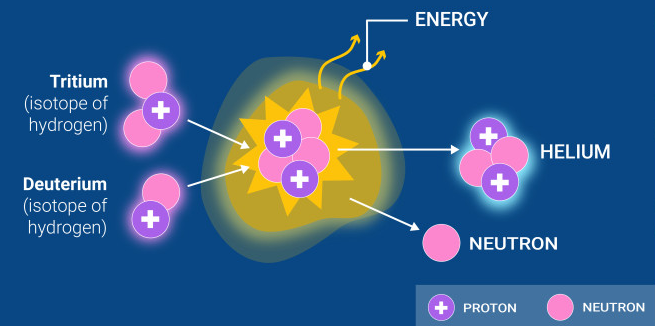
- The most common fusion reaction involves the isotopes of hydrogen: deuterium and tritium. When these isotopes fuse, they form helium and release a neutron, along with a large amount of energy.
- The most common fusion reaction is between the isotopes of hydrogen, deuterium and tritium. When these isotopes combine, they make helium, a neutron and a large amount of energy.
Source: TH
IAF Chief Outlines VAYU Framework
Syllabus: GS3/Defence
Context
- Air Chief Marshal Ashutosh Dixit, who took charge as the 29th Chief of the Air Staff, outlined the Indian Air Force’s priorities under the VAYU Framework.
About the VAYU Framework
- The framework outlines four key priorities for strengthening the Indian Air Force (IAF):
- V – Vigilance, Victory and Readiness: Maintaining the highest state of operational preparedness across all formations, while restoring combat strength to sanctioned levels.
- A – Aatmanirbharta: Accelerating indigenous capabilities across platforms, sensors, weapons and technologies, with a focus on operational self-reliance and sustained combat capability.
- Y – Yukti: Harnessing ingenuity and innovation in doctrine, technology and operational procedures, including AI-enabled command and control, counter-drone capabilities, resilience and emerging operational domains.
- U – Unity of Effort: Strengthening jointness with the Army, Navy and national agencies, in consonance with the national vision of JAI – Jointness, Aatmanirbharta and Innovation.
About Air Chief Marshal Ashutosh Dixit
- He is an alumnus of the National Defence Academy near Pune, the Defence Services Staff College in Bangladesh, and the National Defence College, New Delhi.
- Commissioned: 6 December 1986, in the fighter stream of the Indian Air Force.
- Experience: An Experimental Test Pilot and Qualified Flying Instructor. He has more than 3,500 hours of flying experience on aircraft, including the Mirage 2000, various MiG variants, Kiran, Jaguar, IL-78, Hawk, and Tejas.
- Operational experience: During his four-decade-long service career, he has been actively involved in several operations and exercises, including Operation Safed Sagar, Operation Rakshak and Operation Sindoor.
Do you know?
- The Chief of the Air Staff (CAS) has been the title of the professional head of the Indian Air Force since 1955. Prior to 1955, the position was known as the Commander in Chief, Indian Air Force.
- The CAS is a permanent member of the Chiefs of Staff Committee, National Security Council and Defence Planning Committee and serves as a senior advisor to the Minister of Defence, Prime Minister and the President, who is the supreme commander of the Defence Forces.
- The position is customarily held by a four-star air chief marshal and is usually the highest ranking air force officer on active duty unless the Chief of Defence Staff is an air force officer.
Source: PIB
Previous article
Gene Therapy Offers to Beat Hepatitis B Virus by Muting its DNA
Next article
News In Brief 02-11-2026
