


Syllabus: GS3/ Economy
Context
- A recent assessment by the US Department of State on the investment climate in India identified a number of issues that impact the country’s capacity to attract foreign direct investment (FDI).
Status of Foreign Investment in India
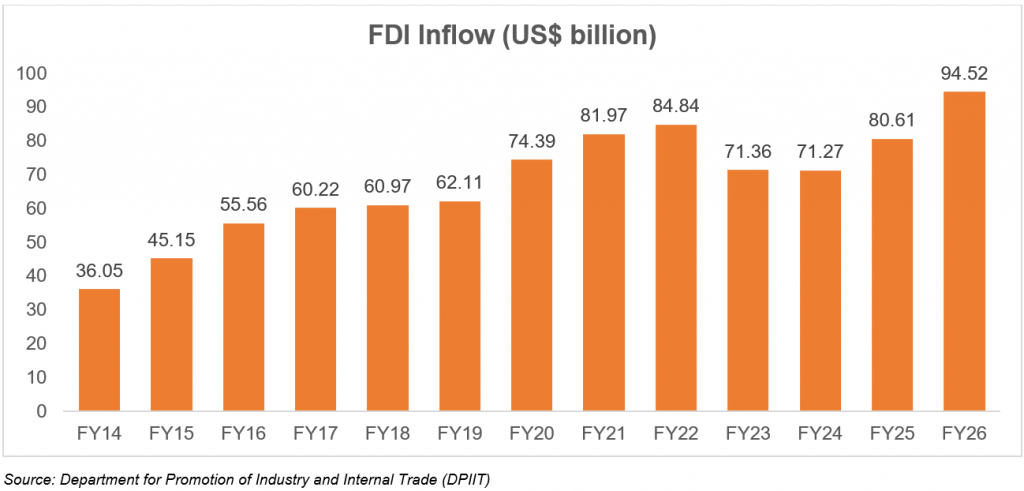
- India’s overall FDI inflow hit a new high of USD 94.53 billion in FY 2025–26, up 17% from USD 80.62 billion in FY 2024–25. It comprises equity inflows, reinvested earnings, and other capital.
- FDI equity inflow was USD 58.85 billion in 2025-26.
- Reinvested earnings rose to USD 25.56 billion in FY 2025-26.
- In all, India attracted total FDI inflows of USD 1.166 trillion between April 2000 and March 2026.
Strengths of India’s Investment Climate
- Large domestic market: India’s huge population, rising consumption and increasing need for infrastructure give considerable prospects for the market expansion to foreign investors.
- Macroeconomic fundamentals: India’s relatively strong economic growth, growing domestic demand and ongoing investment in infrastructure underpin its appeal as an investment destination.
- Demographic dividend: A big population of working age people, a rising technical workforce and an expanding pool of qualified professionals offer chances for labour-intensive and technology intensive investments.
- Digital public infrastructure: Platforms like Aadhaar, UPI and the Account Aggregator framework have facilitated digital payments, financial inclusion and the emergence of new business models.
- Strategic geographical position: Being located in the Indo-Pacific region and close to major emerging markets and global supply chains provide opportunities to India for international business.
Major Investment Barriers in India
- Sectoral Restrictions on FDI: India allows 100% FDI under the automatic route in most sectors. However, certain sectors remain subject to government approval or sector-specific restrictions.
- The report highlighted restrictions affecting sectors such as multi-brand retail, private banking, pharmaceuticals, defence, print and digital media, and satellites.
- Restrictions on Concurrent FDI and FPI: The Foreign Exchange Management Act (FEMA) framework restricts certain instances of concurrent foreign direct investment (FDI) and foreign portfolio investment (FPI) in the same company.
- The report argued that these restrictions create additional compliance burdens, particularly for large investment groups managing multiple funds.
- Import Management Restrictions: India’s Import Management System (IMS), introduced in 2023 and subsequently extended, it regulates imports of certain products through authorisation requirements and import limits.
- Higher Tax Burden on Foreign Banks: The report highlighted a difference in the effective tax burden between foreign and domestic banks in India.
- It stated that foreign banks face an effective tax rate of 38.22%, which is 4.63 percentage points higher than that of domestic banks.
- Concerns over corruption: US businesses have identified actual and perceived corruption, particularly in regulatory systems, as a barrier to investment in India.
Initiatives to Promote Foreign Investment
- Liberalised FDI policy: India has progressively liberalised its FDI regime, allowing up to 100% FDI under the automatic route in several sectors to facilitate foreign investment.
- Ease of Doing Business Reforms:
- Business Reforms Action Plan (BRAP): It encourages states and Union Territories to implement business regulatory reforms, simplify procedures and improve the delivery of public services.
- National Single Window System (NSWS): Launched in 2021, it provides a unified digital platform through which investors can identify, apply for and track various regulatory approvals.
- Manufacturing and Investment Promotion:
- Make in India: The initiative seeks to promote domestic manufacturing, attract foreign investment, enhance technological capabilities and integrate India into global value chains.
- Production Linked Incentive (PLI) Scheme: The scheme provides incentives to eligible manufacturers across selected sectors to enhance domestic production, attract investment and improve competitiveness.
- PM Gati Shakti National Master Plan: It promotes integrated infrastructure planning through a geospatial digital platform to improve multimodal connectivity and reduce logistics inefficiencies.
- Financial and Taxation Reforms:
- Goods and Services Tax (GST): GST has replaced several indirect taxes with a unified indirect tax framework.
- Insolvency and Bankruptcy Code (IBC), 2016: It provides a time-bound insolvency resolution framework intended to improve credit discipline and facilitate the reallocation of capital.
- Digital governance and anti-corruption measures: Initiatives such as the Government e-Marketplace (GeM), e-procurement and digital delivery of public services seek to reduce discretionary decision-making and improve transparency.
Way Ahead
- India needs to come out with clear guidelines, sufficient transition times and consistent application of legislation to remove uncertainty for long-term investors.
- Greater use of digital permissions, open procurement, objective inspection systems and effective grievance redressal can limit discretion.
- Investment limitations should be transparent, appropriate and subject to periodic review to preserve national security without imposing undue hurdles to productive investment.
Source: IE
Next article
Southwest Monsoon Ends with 12% Deficit
