


Syllabus: GS3/ Economy/ Science & Technology
Context
- The government notified the Semicon 2.0 scheme with an outlay of Rs 1.27 lakh crore to boost the chip manufacturing ecosystem in the country.
India Semiconductor Mission 1.0
- India Semiconductor Mission 1.0 is a flagship programme launched in 2021 under the Ministry of Electronics and Information Technology (MeitY) to develop a comprehensive semiconductor and display manufacturing ecosystem in India.
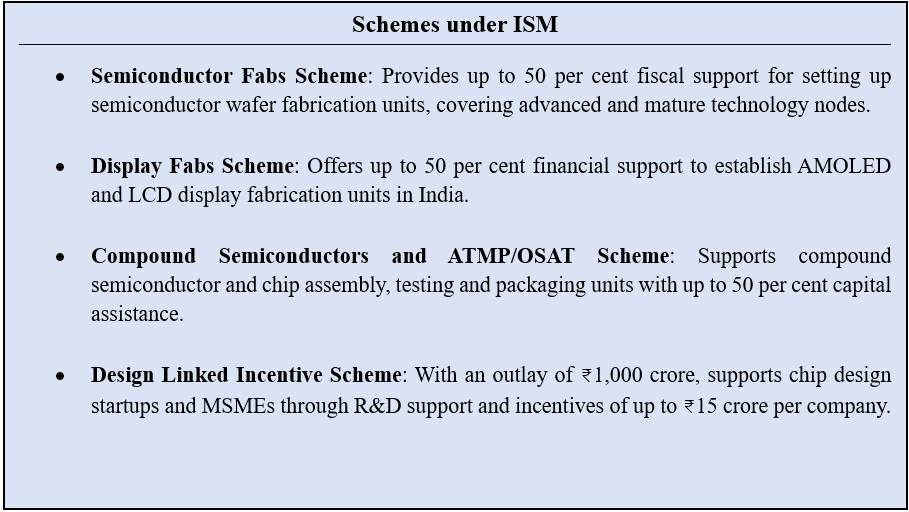
- The Mission is supported by an incentive framework of ₹76,000 crore, offering fiscal support of up to 50 percent for silicon fabs, compound semiconductor facilities, assembly and testing units, and chip design.
- As many as 12 semiconductor manufacturing projects have been approved with an investment pipeline of about ₹1.64 lakh crore under the mission.
- These include silicon fabrication units, silicon carbide fabs, advanced and memory packaging facilities, and specialised assembly and testing infrastructure.
India Semiconductor Mission 2.0
- It was announced in the Union Budget 2026–27.
- ISM 2.0 will focus on producing semiconductor equipment and materials in India, designing full stack Indian semiconductor intellectual property, and fortifying both domestic and global supply chains.
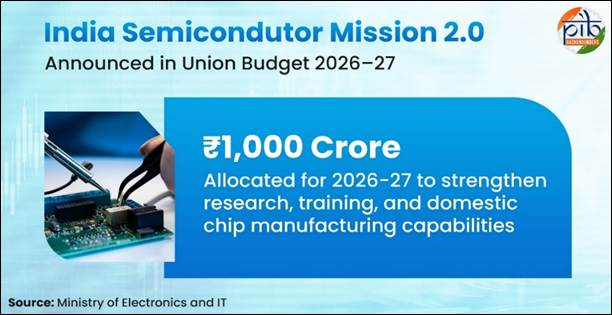
- Semicon 2.0 seeks to build the semiconductor ecosystem through six pillars- Design, Machines and materials, Setting up more fabs, Further strengthening the ATMP-OSAT industry, Research and Development and Talent development.
Pillars of Semicon 2.0
- First pillar: Expand India’s semiconductor design capabilities by promoting chip IPs, system designs, and innovation, building on the success of around 105 chip-design startups.
- Second pillar: Incentivize manufacturing and R&D of semiconductor equipment, materials, chemicals, and gases to create a robust domestic ecosystem.
- Third pillar: Efforts will be made to attract more manufacturers to come to India and set up fabs to manufacture chips. This will include silicon fabs, compound semiconductor fabs, discrete component fabs, display fabs, etc.
- Fourth pillar: Encourage advanced Assembly, Testing, Marking, and Packaging (ATMP) and Outsourced Semiconductor Assembly and Test (OSAT) units to strengthen backend manufacturing.
- Fifth pillar: Move beyond 28–110 nm technology nodes by developing advanced process nodes and next-generation semiconductor technologies.
- Sixth pillar: With 315 universities training students on complex chip design using the latest EDA tools, around 68,000 students have already been trained. It will be developed further and deepen the level of training while in college.
Why are Semiconductors Strategically Important?
- Foundation of the Digital Economy: Semiconductors form the core component of almost every modern electronic device and digital technology.
- National Security: Semiconductor chips are indispensable for defence equipment, surveillance systems, satellites, cybersecurity infrastructure and strategic communication networks.
- Industrial Competitiveness: Countries with strong semiconductor manufacturing capabilities are leveraging technological leadership and industrial competitiveness.
- Technological Sovereignty: Domestic semiconductor production is necessary to reduce the dependence on foreign suppliers and strengthen self-reliance.
Indigenous Microprocessors and Core Semiconductor Technologies
- Microprocessors form the foundational layer of modern digital infrastructure, powering devices and systems across telecommunications, mobility, healthcare, industry, defence, and space.
- India has made focused investments to build sovereign capabilities in advanced processor design as a core pillar of semiconductor self-reliance.
- A key milestone in this journey is the launch of DHRUV64, a fully indigenous 64-bit microprocessor developed by C-DAC under the Microprocessor Development Programme (MDP).
What are the Challenges?
- High Capital Investment: The establishment of semiconductor fabrication plants requires investments of several billion dollars and long gestation periods.
- Technology-Intensive Industry: Semiconductor manufacturing requires highly sophisticated technologies that are continuously evolving.
- Dependence on Imported Equipment: India remains dependent on foreign suppliers for advanced semiconductor manufacturing equipment and specialised machinery.
- Infrastructure Requirements: Semiconductor fabrication requires uninterrupted electricity, ultra-pure water and highly reliable logistics infrastructure.
- Skill Gaps: The industry requires a highly specialised workforce trained in semiconductor engineering, fabrication processes and chip design.
Conclusion
- India Semiconductor Mission 2.0 marks a decisive shift from ecosystem creation to ecosystem consolidation and global integration.
- By deepening support for manufacturing, design, and advanced skills, ISM 2.0 positions semiconductors as a strategic national capability—central to economic resilience, digital infrastructure, and technological sovereignty.
Source: AIR
Previous article
Problem of Food Adultration in India
Next article
N-E Models of Waste Management
