


Syllabus: GS2/Governance
In News
- The Supreme Court urged Parliament to reconsider its reliance on Assembly Speakers and Chairmen to fairly and promptly handle disqualification cases under the anti-defection law.
- The Court criticized delays and bias in such proceedings and directed the Telangana Speaker to decide long-pending disqualification petitions against 10 BRS MLAs who defected to the Congress in 2024.
What is the Anti-defection law?
- Aaya Ram Gaya Ram was a phrase that became popular in Indian politics after a Haryana MLA Gaya Lal changed his party thrice within the same day in 1967.
- The anti-defection law (Tenth Schedule of the Constitution) was inserted by the 52nd Amendment in 1985 to prevent political defections.
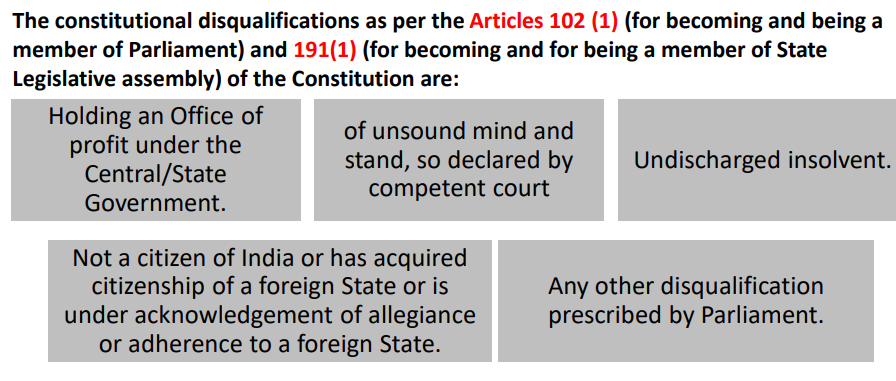
Features of the Anti-Defection Law
- Disqualification on ground of defection: A legislator belonging to a political party will be disqualified if he: (i) voluntarily gives up his party membership, or (ii) votes/abstains to vote in the House contrary to the direction issued by his political party.
- A member is not disqualified if he has taken prior permission of his party, or if the voting or abstention is condoned by the party within 15 days.
- Independent members will be disqualified if they join a political party after getting elected to the House. Nominated members will be disqualified if they join any political party six months after getting nominated.
- The decision to disqualify a member from the House rests with the Chairman/Speaker of the House.
Exceptions
- The Tenth Schedule originally provided for two exceptions that would not render the members liable for disqualification.
- One-third members of the ‘legislature party’ split to form a separate group.
- Merger of their ‘political party’ with another party that is approved by two-third members of its ‘legislature party’.
- However, the first exception (one-third split) was removed in 2003 to strengthen the law.
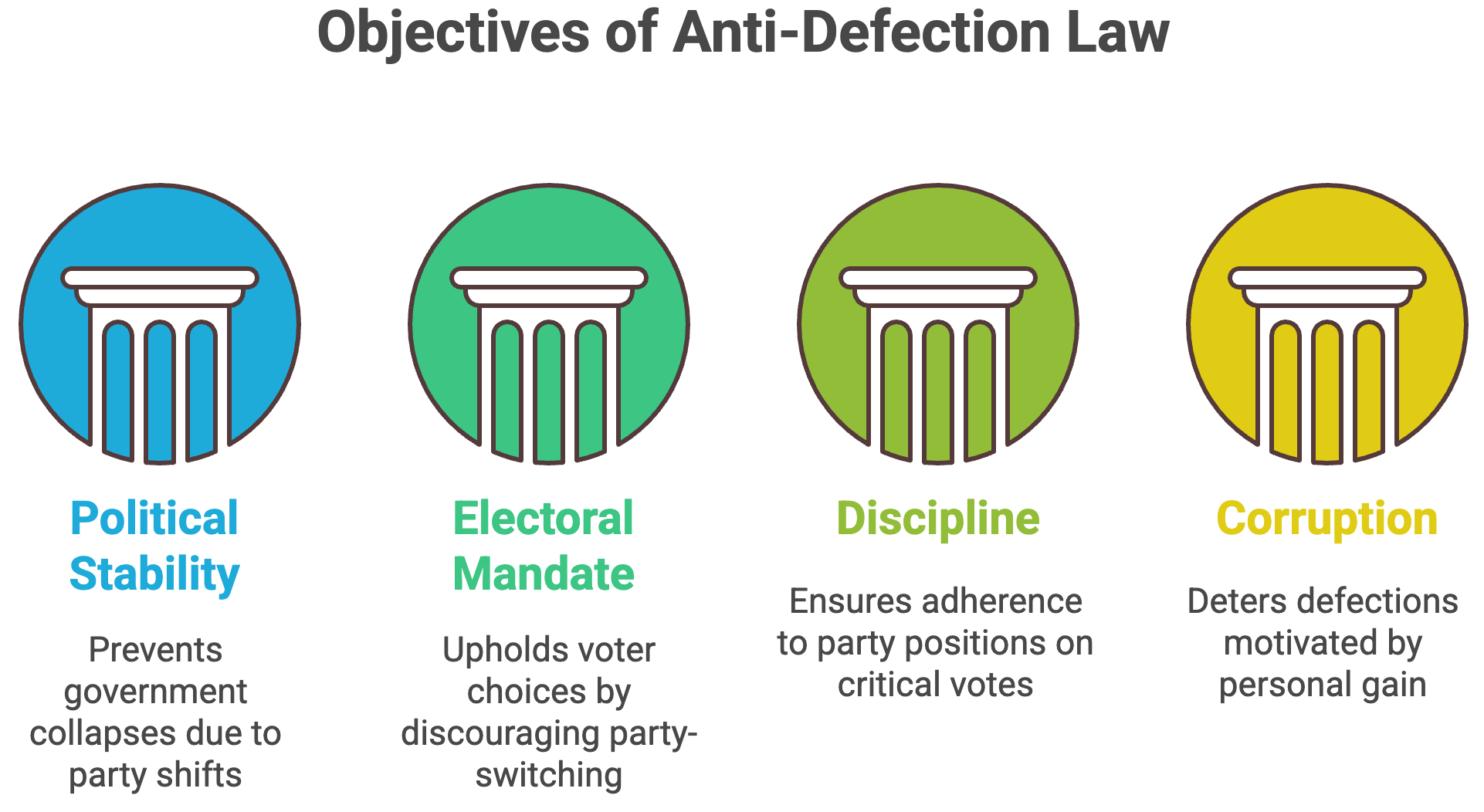
Supreme Court Judgments
- Kihoto Hollohan v. Zachillhu (1992): The decisions of the Speaker regarding disqualification under the Tenth Schedule (Anti-defection Law) are subject to judicial review by the High Courts and the Supreme Court.
- Keisham Meghachandra Singh v. Speaker, Manipur (2020): The Supreme Court set a clear outer limit of three months for the Speaker to decide on a disqualification petition.
Key Issues and Challenges
- The Speaker decides defection cases, often with no fixed timeline, leading to delays and potential bias.
- Judicial review exists but courts are reluctant to intervene, citing legislative autonomy.
- It is argued that the law curbs legislators’ freedom of expression and debate.
- The whip system enforces rigid party control, leaving little room for intra-party debate or dissent.
Conclusion and Way Forward
- The Anti-Defection Law has helped reduce political instability but suffers from implementation flaws and overreach, weakening its democratic purpose.
- Reforms are needed to balance party discipline with accountability, ensure unbiased adjudication, and promote internal party democracy to strengthen India’s parliamentary system.
| Do you know? – The Representation of the People Act, 1951 governs elections in India and sets rules for qualifications, disqualifications, and election-related offences. – Disqualification of lawmakers is covered under Section 8. 1. Section 8(1) lists offences like promoting enmity, bribery, and electoral fraud. 2. Section 8(2) covers offences like hoarding, adulteration, and dowry-related crimes. 3. Section 8(3) disqualifies anyone convicted and sentenced to at least two years in prison, with disqualification lasting through the sentence and six years after release 4. Earlier, Section 8(4) allowed a three-month window to appeal before disqualification, but the Supreme Court struck it down in Lily Thomas v Union of India (2013), enabling immediate disqualification after conviction. |
Source :IE
Previous article
Impact of Flash Floods in India
