


Syllabus:GS3/Economy
In News
Cotton production in the current marketing season, which began on October 1, is projected at 248.66 lakh bales, significantly below the textile industry’s estimated requirement of 350-360 lakh bales.
India’s Cotton sector: Strength
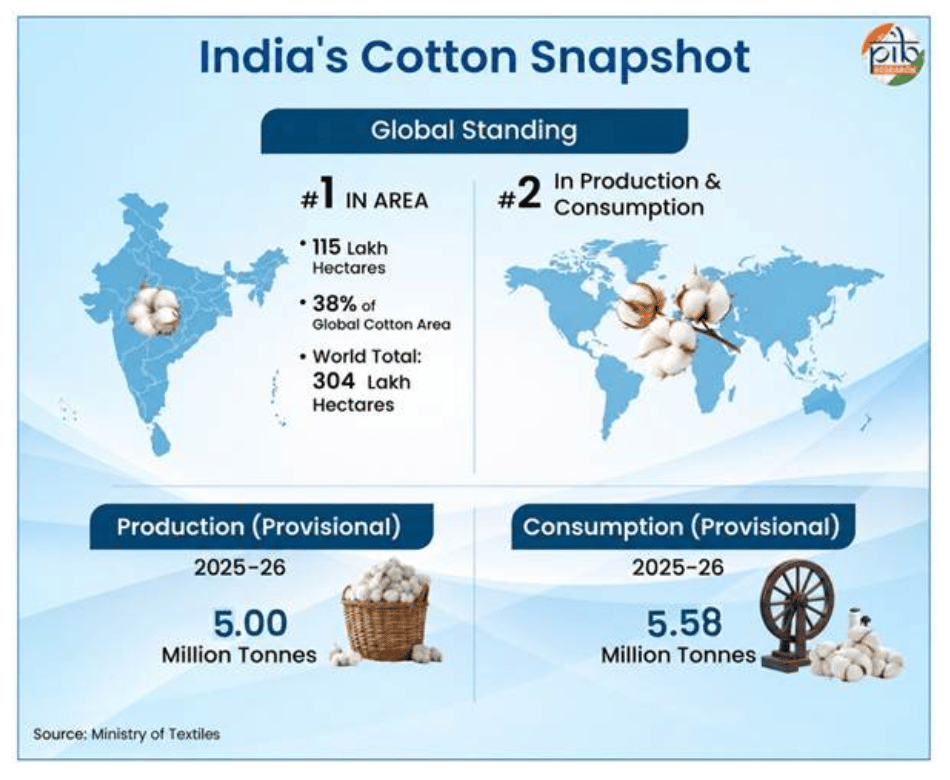
- Production: India ranks first in the world in cotton cultivation area (in hectares), with 114.84 lakh hectares devoted to the crop. This accounts for around 38 percent of the global cotton area of 304.08 lakh hectares.
- Cotton production in India is largely concentrated in 9 major states, grouped into 3 distinct agro-ecological zones:
- Northern Zone comprising Punjab, Haryana, and Rajasthan
- Central Zone comprising Gujarat, Maharashtra, and Madhya Pradesh
- Southern Zone comprising Telangana, Andhra Pradesh, and Karnataka
- Types :
- India is the only country that cultivates all four recognized cotton species.
- These include G. Arboreum and G. Herbaceum, commonly referred to as Asian cotton. The other species are G. Barbadense, known as Egyptian cotton, and G. Hirsutum, known as American upland cotton. Among these, G. Hirsutum accounts for nearly 90 percent of hybrid cotton production in India. All Bt cotton hybrids currently cultivated in the country belong to this species.
- India is the only country that cultivates all four recognized cotton species.
- Exports: India continues to maintain a strong presence in the global cotton trade. In 2024-25, the country exported an estimated 18 lakh bales, equivalent to 0.31 million metric tonnes. This accounts for about 3.37 percent of total world exports, amounting to 541.69 lakh bales (9.21 million metric tonnes).
- In value terms, cotton exports reached US$ 11.49 billion in FY25. The United States of America emerged as the largest destination for Indian cotton fabrics and made-up exports, accounting for 26.35 percent of cotton exports. This was followed by Bangladesh at 19.81 percent and Sri Lanka at 5.11 percent.
- Other important destinations included the United Kingdom, with a share of 2.38 percent, and the United Arab Emirates, at 2.32 percent.
- In value terms, cotton exports reached US$ 11.49 billion in FY25. The United States of America emerged as the largest destination for Indian cotton fabrics and made-up exports, accounting for 26.35 percent of cotton exports. This was followed by Bangladesh at 19.81 percent and Sri Lanka at 5.11 percent.
Importance of Cotton Sector
- Major commercial crop: Cotton is one of the most important commercial crops cultivated in India.
- It accounts for around 23 percent of global fibre production.
- It provides the basic raw material (cotton fibre) to the cotton textile industry.
- Medical Applications: Cotton fibres have medical applications. Short-staple fibres unsuitable for spinning are processed into absorbent or surgical cotton.
- These are therefore used in healthcare due to their high absorbency and purity.
- Valuable by-products: Cotton is far more than a source of fibre for clothing.
- The crop also generates valuable by-products that contribute to food, feed, and rural energy needs.
- Raw cottonseed comprises roughly one-third lint and two-thirds seed.
- The seed contains about 18 percent edible oil, while the remaining meal is widely used as nutritious feed for cattle, poultry, and fish.
- Cottonseed oil is often referred to as “heart oil”. It contains nearly 50 percent essential polyunsaturated fatty acids compared to about 30 percent in many traditional oils.
- Employment: The crop supports the livelihoods of around 6 million cotton farmers.
- It also sustains employment for another 40-50 million people engaged in related activities such as cotton processing and trade.
- Foreign reserves: It plays a vital role in earning foreign exchange through exports of fibre, yarn, fabrics and garments.
- It is also termed as “White-Gold” due to its economic importance in India
Challenges Faced by the Sector
- Low Productivity: India’s cotton productivity remains constrained by fragmented landholdings, inadequate irrigation, poor-quality seeds in some areas, and limited adoption of modern farming practices.
- Climate Change: Erratic monsoons, rising temperatures, droughts, and unseasonal rainfall affect cotton yields and fibre quality.
- Pest and Disease Attacks: Pink bollworm, whiteflies, and other pests cause significant crop losses and increase farmers’ expenditure on pesticides.
- Quality Issues: Contamination during harvesting, storage and transportation, along with inconsistent fibre quality, reduces the competitiveness of Indian cotton in premium markets.
- Issues with Seed Technology: Limited availability of high-yielding, pest-resistant and climate-resilient varieties, along with concerns over the cost and effectiveness of existing seed technologies, affects productivity.
Various Steps of the government
- Bt. cotton is the only Genetically Modified (GM) crop approved in 2002 by the Genetic Engineering Appraisal Committee (GEAC) of the Ministry of Environment, Forest and Climate Change for commercial cultivation in the Country.
- The Union Cabinet has approved a Mission for Cotton Productivity (2026–27 to 2030–31) to address bottlenecks, declining growth, and quality concerns in India’s cotton sector.
- The mission aligns with the 5F vision (Farm to Fibre to Factory to Fashion to Foreign) of the Government of India.
- It focuses on enhancing cotton productivity through development of high-yielding variety (HYV) seeds resistant to disease and pests, and scaling up of existing and latest crop production technologies.
- MSP Support: Cotton and Jute are also procured by the Government at MSP through the Cotton Corporation of India (CCI) and the Jute Corporation of India (JCI), respectively.
- Kasturi Cotton India’s brand has been registered as a trademark to give a unique identity to premium-quality Indian Cotton.
Conclusion
- India’s cotton sector is a key element of its agricultural and industrial past, vital for employment generation, textile manufacture and export profits. But there are still challenges of low productivity, climate change, pest infestations, and quality that need to be addressed.
- Research needs to be strengthened.
- Climate-resilient seeds need to be promoted. Irrigation needs to be improved, and remunerative prices need to be ensured through MSP.
- Mission for Cotton Productivity and Kasturi Cotton are some of the initiatives that can be taken to improve the income of farmers, promote sustainability and improve India’s position in the global cotton market.
Source : TH
Previous article
Union Cabinet Clears Delimitation Bill
Next article
News In Brief 28-11-2026
