


Syllabus:GS2/IR
In News
At the 25th Meeting of the Council of Ministers of the Indian Ocean Rim Association (IORA), the External Affairs Minister stressed the importance of the Indian Ocean for global trade, energy security, connectivity, and economic growth.
Indian Ocean Rim Association (IORA)
- It is an intergovernmental organisation established on 7 March 1997.
- It strives to promote regional cooperation in the Indian Ocean region across six Priority Areas and two Cross-Cutting Issues.
- Members: Australia, Bangladesh, Comoros, France, India, Indonesia, Iran, Kenya, Madagascar, Malaysia, Maldives, Mauritius, Mozambique, Oman, Seychelles, Singapore, Somalia, South Africa, Sri Lanka, Tanzania, Thailand,United Arab Emirates and Yemen
Indian Ocean Region
- The Indian Ocean Region (IOR) is bordered by Africa to the west, the Straits of Malacca and Australia to the east, India to the north, and Antarctica to the south
- The Indian Ocean covers approximately one-fifth of the total ocean area of the world.
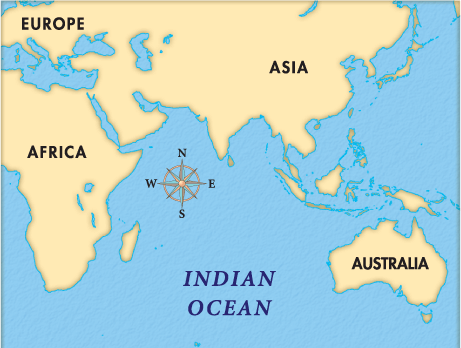
Significance of the Indian Ocean Region (IOR)
- Geostrategic Importance: The Indian Ocean is the third largest ocean, linking the Middle East, Africa, South Asia, and Southeast Asia.
- It is home to crucial maritime chokepoints — Strait of Hormuz, Bab-el-Mandeb, Malacca Strait, Lombok Strait — which together handle a bulk of global energy and trade flows.
- Economic Significance: The Indian Ocean is a major global maritime hub, handling about 30% of container traffic, 80% of sea-borne oil trade, and nearly 9.84 billion tonnes of cargo annually, along with key blue economy activities like shipping, fisheries, seabed mining, and tourism.
- Energy Security: The IOR is the lifeline of global energy flows: oil and gas from West Asia transit to East Asia via its sea lanes.
- Countries like India, China, Japan, and South Korea are energy-import dependent, making stability of the IOR vital.
Why is it important for India?
- Economic & Trade Significance: About 95% of India’s trade by volume and 68% by value moves through the Indian Ocean, which also supports key blue economy sectors like fisheries, ports, shipping, offshore energy, and seabed resources.
- Nearly 80% of India’s crude oil imports and most gas supplies pass through the Indian Ocean sea routes.
- Chokepoint dependence: Critical sea lanes like the Strait of Hormuz, Malacca Strait, and Bab el-Mandeb directly affect India’s supply security.
- Malacca Strait is India’s key gateway to East Asia, carrying its trade with ASEAN and East Asian countries, making it a critical maritime chokepoint for commerce and energy security.
- Maritime security: Increasing naval activity in the Indian Ocean Region (IOR) impacts India’s coastal security and strategic depth.
- Geostrategic competition: Growing presence of external powers (especially in ports and bases) affects India’s regional influence and security balance.
- China’s String of Pearls strategy includes investments in ports such as Gwadar Port, Hambantota Port, and a naval base in Djibouti.
- Disaster & climate risks: The region is prone to cyclones, sea-level rise, and marine ecosystem stress, making cooperation essential.
- The 2004 Indian Ocean tsunami caused massive loss of life in India, Sri Lanka, Indonesia, and Thailand.
Challenges in IOR
- Rivalries and wars: Iran’s closure of the Strait of Hormuz amid U.S.–Israel strikes disrupted a route carrying one-fifth of global oil supplies.
- Brent crude surged 63% between Feb–Mar 2026, while global LNG futures rose 16.7%.
- Expansion of Chinese Power in IOR: China’s expanding presence in the Indian Ocean Region through port development under the Belt and Road Initiative, dual-use facilities, and naval activities is seen as a strategic challenge for India, as it enhances China’s economic leverage, military reach, and influence in key maritime areas.
- Maritime Domain Awareness Activities: Deployment of Chinese research and survey vessels to gather sensitive oceanographic and marine data under the guise of scientific research.
- Piracy hotspots near the Horn of Africa and in the Malacca Strait threaten shipping.
- Terrorism, arms smuggling, and trafficking networks exploit porous maritime borders.
India’s Strategic Responses
- Launch of MAHASAGAR (Mutual and Holistic Advancement for Security and Growth for All in the Region) reflects India’s strategic rebranding in the IOR.
- Naval Modernisation and Indigenous Development: India is modernising naval capabilities:
- Commissioning indigenous warships (e.g., INS Vikrant, INS Visakhapatnam).
- Boosting maritime domain awareness and power projection.
- India’s Response and Regional Diplomacy: India is working with partners to highlight security risks from China’s infrastructure projects, especially their potential military use and impact on regional stability.
- The Indo-Pacific Oceans Initiative: The Indo-Pacific Oceans Initiative (IPOI), launched by India in 2019, promotes a free, open, and rules-based Indo-Pacific through voluntary cooperation on maritime security, ecology, trade, connectivity, and disaster management using existing regional platforms.
- Rights to explore Polymetallic Sulphides (PMS) in the Carlsberg Ridge in the Indian Ocean: India has signed a new International Seabed Authority (ISA) contract to explore polymetallic sulphides in the Carlsberg Ridge, becoming the first country with two such PMS contracts and the largest global seabed exploration area.
Conclusion
- The Indian Ocean Region (IOR) is crucial for India’s security, economic growth, and global influence, supported by policies like the Act East Policy, Indo-Pacific Vision, and Blue Economy strategy.
- India’s ocean governance priorities focus on sustainable livelihoods and food security, regional cooperation among Indian Ocean countries, blending traditional knowledge with science, climate-resilient ecosystem protection, and strengthening finance, technology, and capacity for ocean research and governance.
- India should strengthen its position by expanding defence diplomacy and base-sharing agreements, enhancing Underwater Domain Awareness (UDA) for maritime security, promoting a blue economy, developing a maritime innovation hub, and creating an Indian Ocean Security Forum (IOSF) for regional cooperation on security and disaster management.
Source : IE
Previous article
News In Brief 27-11-2026
Next article
Supreme Court Takes Action Against Yamuna Pollution
