


Syllabus: GS2/Governance
Context
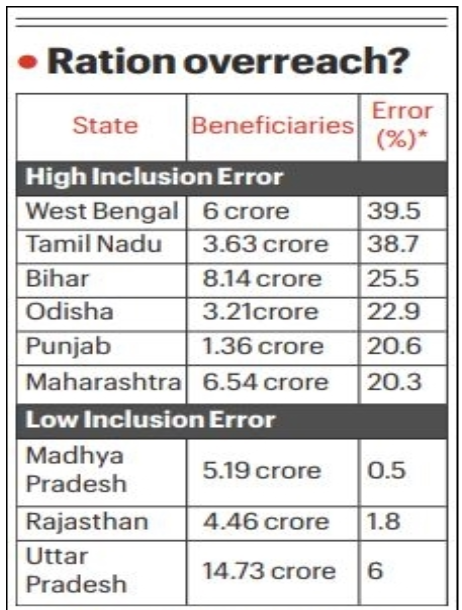
- An evaluation study commissioned by the Union government has found a 13.2% inclusion error among beneficiaries of the Pradhan Mantri Garib Kalyan Anna Yojana (PMGKAY), under the National Food Security Act (NFSA) 2013.
About
- Inclusion error occurs when households that do not meet the prescribed eligibility criteria are included in the beneficiary list and continue to receive subsidised food grains.
- It reflects deficiencies in the identification and verification of eligible beneficiaries.
- Exclusion error occurs when eligible and deserving households are left out of the beneficiary list and consequently denied their entitled food security benefits.
National Food Security Act (NFSA), 2013
- NFSA aims to supplement the food requirements of up to 75% of the rural and up to 50% of the urban population, which, at Census 2011, comes to 81.35 crore persons.
- It aims to ensure food and nutritional security by providing affordable foodgrains through the Targeted Public Distribution System (TPDS).
- Eligible households receive subsidized foodgrains based on;
- Antyodaya Anna Yojana (AAY) households: These households constitute the poorest of the poor. AAY households are entitled to 35 kg of food grains per household per month.
- Priority Households (PHH): These households are entitled to 5 kg of food grains per person per month.
Who are the Beneficiaries?
- Antyodaya Anna Yojana (AAY) Households: Chosen by States/UTs based on Central Government criteria, covering the poorest of the poor. The Eligible Categories are;
- Households headed by widows, terminally ill persons, disabled persons, or elderly persons (60+) with no assured means of subsistence or societal support.
- Widows or terminally ill persons or disabled persons or persons aged 60 years or more or single women or single men with no family or societal support or assured means of subsistence.
- All primitive tribal households.
- Landless agricultural labourers, marginal farmers, rural artisans/craftsmen, slum dwellers, and people earning a daily livelihood in the informal sector and other similar categories in both rural and urban areas.
- All eligible Below Poverty Line (BPL) families of HIV-positive persons.
- Priority Households: Selected by State Governments/Union Territory Administrations as per their own criteria.
Merger With PMGKAY
- During the COVID-19 pandemic in 2020, the government launched the Pradhan Mantri Garib Kalyan Anna Yojana (PMGKAY), under which additional foodgrains were provided free of cost.
- From January 2023, the government merged PMGKAY with NFSA and made the regular NFSA entitlement itself free of cost.
- In November 2023, this free foodgrain scheme was extended for five years (January 2024 to December 2028).
Challenges in Beneficiary Identification
- Outdated beneficiary databases: Changes in household income, employment and socio-economic conditions may not be reflected in ration card records.
- Divergent eligibility criteria: Different exclusion and inclusion criteria across States make uniform assessment difficult.
- Identification gaps: Weak verification mechanisms may allow relatively well-off households to continue receiving benefits.
- Digital exclusion: Excessive dependence on Aadhaar authentication and biometric verification may deny entitlements to genuine beneficiaries due to authentication failures, connectivity issues or inaccurate records.
- Dynamic poverty: Temporary improvements in household income do not necessarily indicate sustained economic security, making rigid exclusion criteria problematic.
Way Ahead
- An effective food security system must balance the prevention of inclusion errors with the protection of eligible beneficiaries against exclusion.
- States should regularly update beneficiary databases using verified socio-economic information, income and asset records.
- Gram Sabhas, local bodies and community institutions should participate in identifying ineligible beneficiaries and ensuring that deserving households are not excluded.
- Also, accessible mechanisms should enable households to challenge wrongful deletion or denial of ration entitlements.
Source: IE
Previous article
Skill Development and the Role of ITIs in Nation-Building
Next article
Bridging the Gaps in Universal Health Coverage
