


Syllabus: GS2/ Governance
Context
- The Municipal Corporation of Delhi (MCD) Standing Committee has approved the revised Solid Waste Management Bye-Laws, 2026.
Key Provisions of the Revised Bye-Laws
- Higher and Graded Penalties: Penalties have increased by approximately 50% to 150% for several existing violations.
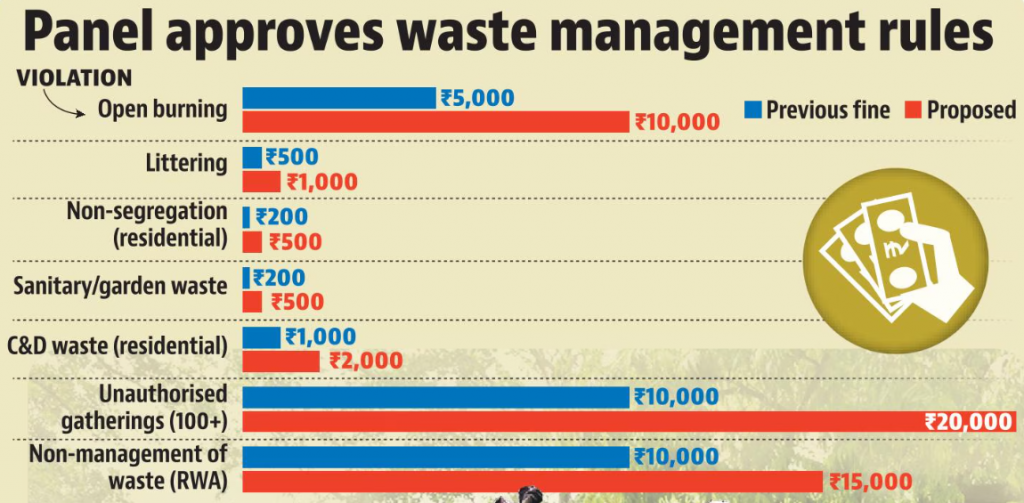
- Regulation of Large Gatherings: Organisers of gatherings involving more than 100 people at unlicensed venues are required to inform the MCD and obtain the prescribed permissions. Organisers must ensure;
- Segregation of waste generated during the event.
- Provision of colour-coded waste bins.
- Arrangements for collection and proper disposal of waste.
- Monthly Garbage User Charges: The revised bye-laws provide for monthly user charges to recover the costs associated with garbage collection, transportation, processing and disposal.
- Charges will vary according to property size, category and type of establishment.
- Annual Escalation and Repeat Violation Penalties: Both penalties and garbage user charges will increase automatically by 5% from January 1 of every succeeding year.
- Late payment surcharge: A 10% surcharge will apply if dues are not paid within 30 days of the demand being raised.
Solid Waste Generation in India
- In FY 2021–22, India generated 170,000 tonnes of municipal solid waste per day, about 156,000 tonnes were collected, of which nearly 54% was treated, and 24% was deposited in landfills.
- The remaining 22% was unaccounted for due to leakages in the waste supply chain.
- Indian cities will generate approximately 435 million tonnes of solid waste by 2050 (MoHUA 2021).
- There are only 645 landfills in operation and the total number of existing dumpsites in the country is 2,452.
What are the difficulties in managing waste?
- Changing patterns of consumption: The rising penetration of packaged food, beverages, personal-care products and multi-layered plastics has increased non-biodegradable waste in villages.
- High collection costs: Collection and transportation are costly because of dispersed settlements, difficult terrain, poor roads and long distances to recyclers.
- Open dumping: In the absence of formal systems, waste is dumped in fields, water bodies or openly burnt, leading to soil, water and air pollution.
- Poor segregation at source: Wet, dry, sanitary and hazardous wastes are often mixed at the household level, making recycling, composting and scientific treatment difficult.
Regulatory Framework for Solid Waste Management in India
- Solid Waste Management Rules, 2016: Notified under the Environment (Protection) Act, 1986, these rules provide the national framework for segregation, collection, transportation, processing and scientific disposal of solid waste.
- The Polluter Pays Principle requires waste generators and polluters to bear the costs associated with preventing and managing environmental damage.
- Extended Producer Responsibility (EPR) places responsibility on producers, importers and brand owners for managing the waste generated by their products and packaging.
- Swachh Bharat Mission (SBM):SBM-Urban focuses on 100% door-to-door waste collection and encourages source segregation.
- SBM-Rural promotes biodegradable waste composting and bio-gas plants in villages.
Way Ahead
- Source segregation: Ensure segregation of wet, dry, sanitary and domestic hazardous waste at the household level, supported by separate collection and transportation systems.
- Conduct public awareness campaigns on waste segregation, responsible consumption and the 3Rs — Reduce, Reuse and Recycle.
- Use GPS-enabled collection vehicles, digital tracking and regular audits to prevent waste mixing, illegal dumping and open burning.
Source: IE
Previous article
Beyond Farm Fire Counts in Measuring Stubble Burning
Next article
News In Brief 21-11-2026
